
Sir Philip Gibbs
Introduction. In his 1940 essay ‘Inside the Whale‘ George Orwell wrote:
Even more than at most times the big shots of literary journalism were busy pretending that the age-before-last had not come to an end. Squire ruled the ‘London Mercury’, Gibbs and Walpole were the gods of the lending libraries, there was a cult of cheeriness and manliness, beer and cricket, briar pipes and monogamy, and it was at all times possible to earn a few guineas by writing an article denouncing ‘high-brows’. But all the same it was the despised high brows who had captured the young. The wind was blowing from Europe and long before 1930 it had blown the beer-and-cricket school naked, except for their knighthoods.
Orwell took it for granted that his readers knew who Squire, Gibbs and Walpole were as Sir John Collings Squire, Sir Philip Armand Hamilton Gibbs, and Sir Hugh Seymour Walpole, were alive and active in 1940. For modern readers it is different.
I looked at Sir John Collings Squire in a previous article. Here I look at Sir Philip Gibbs. In another I will look at Sir Hugh Seymour Walpole.
George Orwell only directly mentions Gibbs once apart from in the above article. In his March 1949 reading list Orwell includes lists Gibbs’s novel Both Your Houses (Hutchinson 1949). This was a novel about the post Second World War European political scene written from the view point of an old fashioned British Liberal.
Apart from the explicit naming of Gibbs, Orwell possibly refers to him in The Road to Wigan Pier. There he writes that: the machine civilization is here and it can only be criticised from the inside, because all of us are inside it. It is only romantic fools who flatter themselves that they have escaped it, like the literary gent in his Tudor cottage with bathroom h and c (hot and cold running water). This may have referred to Sir Philip and Lady Agnes Gibbs’s cottage Dibdene at Shamley Green in Surrey.
Philip Armand Hamilton Gibbs – Early Life and Family. He was born in London on 1 May 1877 the fifth of nine children (one died in infancy) of a Catholic Henry James Gibbs, a Board of Education official, journalist and novelist; and Helen Gibbs née Hamilton. Five of their children became writers – Philip; Charles Joseph Hamilton Cosmo Gibbs; Francis William Hamilton Gibbs; Arthur Hamilton Gibbs; and Helen Katherine Hamilton Ibbetson nee Gibbs who wrote novels as Helen Hamilton Gibbs.
The best known of these five literary siblings, apart from Philip, was Charles Joseph Hamilton Cosmo Gibbs who wrote more than seventy novels and plays. Twenty six of his often salacious stories were made into films. He was married twice; was a Lieutenant (the naval equivalent of a Captain) in the Royal Naval Air Service in the First World War; worked for the Ministry of Information in the Second World War; and died in 1942 aged seventy two.
Arthur Hamilton Gibbs studied at Oxford, went to the USA in 1912 to act in a play written by his brother Cosmo, joined the British Army in 1914, rose to be a Major, served in France, Egypt and Serbia, and won the Military Cross. In 1919 he returned to the USA and married a lawyer Jeannette Philips. He had two volumes of poetry and sixteen novels published. Two of his novels were made into films. He became a US citizen in 1931, lived in an eighteenth century New England farmhouse, and died in Boston in 1964 aged seventy six.
Philip Gibbs was educated at home. His first job was publishing school textbooks at Cassell’s. In 1898 aged twenty one he married Agnes Mary Rowland aged twenty four the daughter of the Reverend William John Rowland an Anglican clergyman. She became a Catholic. Philip and Agnes Gibbs’s only child the novelist Anthony Thomas Francis Xavier Gibbs was born in 1902.
Cassell published Philip Gibbs’s first book The Founders of Empire in 1899. That year he joined Tillotsons a literary agency where he bought books for serialization. Those he spotted included Arnold Bennett’s The Grand Babylon Hotel that had been published as a serial in 1901 in The Golden Penny, a London journal. Chatto & Windus published it as a book in 1902.
Alfred Harmsworth who owned the Daily Mail appointed Philip Gibbs its literary editor in 1902. Philip Gibbs did not last long there and joined the Daily Express as a reporter. He refused to compromise his liberal convictions and resigned.
Philip Gibbs needed to make a living. His book Men and Women of the French Revolution was published in 1906; and his book George Villiers, Duke of Buckingham, about James I’s favourite, was published by Methuen in 1908. However he could not make a living this way. He joined the Daily Chronicle a Liberal paper as its magazine page editor; and was literary editor of the short-lived Liberal daily the Tribune.
In 1909 Gibbs’s first novel The Street of Adventure was published. Much of it was autobiographical based on his experiences at the short lived Tribune. It sold well but his royalties were swallowed up because of a libel suit by his former colleague and friend Randal Ernest Charlton. The novel portrayed under a thin pseudonym Charlton as a good hearted rogue. The case never reached court but Gibbs’s costs were high. His solicitor Sir George Henry Lewis was a very formidable and expensive lawyer.
Philip Gibbs’s career with the Daily Chronicle flourished. In 1909 he exposed the claim of Dr Frederick Albert Cook an American explorer to have been the first man to have reached the North Pole. Chapman & Hall published Gibbs’s next novel Intellectual Mansions SW in 1910. It did badly. In 1912 he reported the Balkan Wars. His book Adventures of War with Cross and Crescent (Methuen, 1912) sold well.
Philip Gibbs’s wife Agnes Mary Gibbs had converted to Catholicism. Between 1910 and 1913 she had several pamphlets and articles published by the Catholic Truth Society and other Catholic publishers about social work and other matters.
The First World War. Philip Gibbs was a British Army War Correspondent on the Western Front in the First World War. He went there in 1914; was arrested and sent home after refusing to leave the front; but in 1915 was allowed to return as one of the five official Western Front British War Correspondents.
Gibbs’s First World War dispatches were published in three volumes during the war – The Soul of the War (1915); The Battle of the Somme (1917); and From Bapaume to Passchendaele (1918). After the war his book Realities of War (Heinemann, 1920) exposed the true horrors of the war which official censorship had concealed from the public. In 1920 he was knighted.
Between the Wars. Sir Philip Gibbs, who was a Roman Catholic, was in 1920 the first journalist to interview for publication the Pope Benedict XV in Vatican City. The pope kindly explained that papal infallibility only applied to ex cathedra announcements on doctrine not to everyday life. In other words anyone who wanted papal advice on stock market prices or sporting results would be disappointed.
Gibbs left the Daily Chronicle in 1920 because it supported British repression in Ireland. He briefly edited the Review of Reviews before becoming a freelance journalist and novelist. His more than fifty fiction books included The Middle of the Road (Hutchinson, 1922), inspired by a trip to Russia he made in 1921 on behalf of the Imperial Famine Relief Fund. Though his books addressed controversial issues such as adultery and divorce they were middle brow and very readable. He also wrote short stories.
Nine of Gibbs’s novels were made into films. The first such film was the 1921 Street of Adventure a British silent film based on his 1909 novel of that title. The final one was the 1933 Captured! an American talking but pre-code film. It portrayed First World War allied prisoners in a German POW Camp, and starred Leslie Howard and Douglas Fairbanks junior. It was based on a 1930 Gibbs short story Fellow Prisoners and had a very implausible plot.
Gibbs also wrote non-fiction based on his travels in Britain and abroad. He strongly supported the League of Nations. He sat on the 1935-1936 Royal Commission on the Private Manufacture of and Trade in Arms which he found interesting but time consuming. The commission found that some of the worst international arms sale scandals were caused by state owned armament companies. Private arms firms, at least usually, only sell arms to people who can afford to pay for them.

Meanwhile, Gibbs turned his travels and dinner guests into books. In 1936 he published England Speaks: A Panorama of the English Scene in this Year of Grace 1935. Actually, that is an abbreviation of the title, which requires twelve lines to print in full. Only a year later, in June 1937 the same publisher, Heinemann, issued a sequel with the shorter title Ordeal in England: England Speaks Again. Juliet Gardiner in her book, The Thirties: An Intimate History, calls it the riposte to Orwell and J.B. Priestley’s journeys into social conditions. It went into a second printing in September, but those thirty thousand copies cannot have been felt to be an adequate response, for in September 1938 the Right Book Club issued a “Special Edition” Ordeal in England. Gibbs had reordered the early chapters on the abdication crisis, and added a seventy-page chapter, ‘The Jeopardy of War’. Oddly, while Gibbs emphasised the costs and risks of rearmament, Heinemann’s John Heartfield-style photo-collage cover illustration was dropped in favour of a stylised lion passant on the cover of the Right Book Club edition.
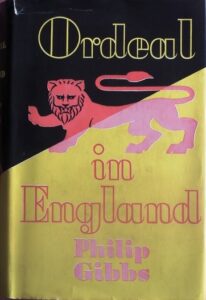
The names of George Orwell and J B Priestley did not appear in the book, but other names of the Marxist left did, including J B S Haldane, Harold Laski and Cecil Day-Lewis. It was his discussion of Laski that allowed Gibbs to write of the Left Book Club (which had published The Road to Wigan Pier three months before Ordeal in England appeared):
If it isn’t one of the most subversive influences in this country I am much mistaken. It challenges our social system, and the whole structure of Capitalism, not easy to defend with all these profiteers about, and so much callous wealth – from every side. It is distinctly Red in its hue of thought and I dislike that colour which reminds me of blood. (Original edition: p311, RBC edition pp272-273).
Sir Philip Gibbs’s wife Lady Agnes Mary Gibbs studied at King’s College of the University of London and obtained a B SC. geology degree in 1932 aged fifty eight. She did research work chemically analysing the age of rocks; and had research papers published. She died of natural causes in 1939 aged sixty five.
The Second World War. During the Second World War Gibbs was briefly a war correspondent in France again. He visited an Arras cellar bar which he had used in the First World War. He wondered if everything that had happened since his previous visits had just been his imagination. After Dunkirk he returned to writing but in 1941 visited America to lecture on behalf of the Ministry of Information.
Final Years. Sir Philip Gibbs eventually went blind. He had three volumes of memoirs published – The Pageant of the Years (Heinemann, 1946), Crowded Company (Allan Wingate 1949), and Life’s Adventure (Angus & Robertson, 1957). He died in hospital in Surrey on 10 March 1962 aged eighty four leaving £14, 544 and sixpence. He got a Dictionary of National Biography entry and Times, Guardian and Telegraph obituaries. His son Anthony died in 1974 aged seventy two.
*
Leave a Reply