
The Joys of St Cyprian’s: I
*
Introduction. George Orwell, (Eric Arthur Blair), attended St Cyprian’s an Eastbourne Preparatory School, from September 1911 aged eight, to December 1916 when he was thirteen. He then went to first Wellington, then Eton on a scholarship for which St Cyprian’s staff had prepared (I.e. crammed) him. He had few happy memories of it.
Orwell’s essay “Such, Such Were the Joys” bitterly criticised the married couple who ran St Cyprian’s i.e. the headmaster Lewis Chitty Vaughan Wilkes and Cicely Ellen Philadelphia Wilkes née Comyn who ran the domestic side and taught there. The school meals were allegedly bad and the building squalid. It was submitted to the publisher Warburg in 1947 who as Orwell expected rejected it as libellous.
In 1952 the American Partisan Review published “Such, Such Were the Joys”, calling St Cyprian’s “Crossgates” and Mr and Mrs Wilkes the Simpsons. After Mrs Wilkes died in 1967 it was published in Britain with St Cyprian’s and Mr and Mrs Wilkes named. Other names remained changed in this and later editions. Only in Volume XIX of the Orwell Collected Works were all the known names given correctly.
St Cyprian’s School was founded in Eastbourne in 1899 by (Alpheus) Lewis Vaughan Chitty Wilkes. It was initially housed in a large Carlisle Road house. In 1906 it moved into purpose built buildings with a playing field behind them in Summerdown Road, Eastbourne. He aimed to get as many pupils Eton and Harrow scholarships as possible and so attract wealthy parents. To this end the school took some bright boys such as Orwell on reduced fee scholarships.
St Cyprian’s was named after St Cyprian a Christian Bishop of Carthage in North Africa, and theologian, martyred in AD 258 under the Roman Emperor Valerian. This emphasised its Anglican and allegedly muscular Christian ethos which as Orwell pointed out contradicted its real get on in life ethos.
Lewis Chitty Vaughan Wilkes was born on 15 September 1869 in Stowmarket in Suffolk the oldest of four children of the Reverend Alpheus Wilkes who was born in 1838 at Leeds the son of William Wilkes a stone mason; studied at the University of London; married Mary Davies at Cheltenham in 1866; was curate of Stowmarket 1868-1870; held other posts including Headmaster of Walsingham Grammar, and Chaplain of Walsingham Workhouse; and died in 1914 aged seventy six leaving £2,435 12s 2d.
Wilkes studied at Persse School, a Cambridge public school, and at Hertford College, Oxford, graduating in 1892 with a second class Classics Degree. On Saturday 16 September 1899 he married Cicely Ellen Philadelphia Comyn, twenty three, the daughter of Charles James Bourchier Comyn, a civil servant, at St Mary Abbot’s Church in Kensington.
The 23 September 1899 edition of Queen – The Lady’s Magazine, a journal that operated from 1861 to 1969, gushingly reported this marriage. The couple honeymooned at Marlow before going to Eastbourne.
Wilkes, whom pupils nicknamed Sambo, produced five children. John Comyn Vaughan Wilkes was born in 1902; studied at Fonthill in East Grinstead, St Cyprian’s, Eton, and Trinity College Oxford; became the Warden i.e. headmaster of Radley College an Oxfordshire public school; was ordained in 1946; and held various parishes. In 1940 he married Joan Argentine Allington. They were to have six sons and a daughter. He died in 1986 aged eighty four.
Richard Leslie Vaughan Wilkes was born in 1904, became a colonial civil servant in Nigeria and then a Devon farmer and died in 1970 aged sixty six. He had married Hilary Joan Summerhayes.
Rosemary Vaughan Wilkes was born in 1909 and in 1933 married William James Vincent Tomlinson, a St Cyprian’s schoolmaster and cricketer, who replaced his father in law Lewis Wilkes as St Cyprian’s headmaster in 1936 when Lewis Wilkes became Warden of St Cyprian’s. William and Rosemary Tomlinson were to have three children. She died in 1963 aged fifty four. He died in 1984 aged eighty two.
Marigold Vaughan Wilkes was born in 1910; in 1943 married David Fitzroy Ashmore a schoolmaster who had once taught at St Cyprian’s; and died in 1964 aged fifty four. He died at Malvern in 1974 aged seventy one.
Deryn Mary Vaughan Wilkes was born in 1915. In 1947 she married Alexander Anthony Hurst a Merchant Navy officer who had survived a Japanese POW Camp. He became a nautical writer and died in 1999 aged eighty one. She died a few months later in 1999 aged eighty four.
Apart from her five children Cicely Wilkes probably had miscarriages. She was moody and St Cyprian’s pupils nicknamed her Flip although officially they called her Mum. Even old boys who liked and/or respected her and regarded Orwell’s criticism of her as grossly unfair (see below) agreed about this. Morning Sickness, labour pains, and post natal depression, would explain it. If she and Lewis temporarily abstained from sex so she could rest after her childbirths PMT would cut in.
George Orwell accused Lewis and Cicely Wilkes of snobbery. They allegedly gave preferential treatment to very rich children, then to ordinary rich children, and then to impoverished scholarship boys such as himself. This applied in matters ranging from discipline to pocket money. The very rich children were never caned, ordinary rich children rarely and scholarship boys including himself routinely.
Schools of all descriptions often behave like this. The difference between a prep school and a comprehensive is that children who would be at the bottom of a prep school pecking order would probably be favoured in a comprehensive.
Mr and Mrs Wilkes may have been moved by monetary considerations. Driving out children whose parents paid full fees would be costlier than alienating scholarship boys. Also very rich children who got poor results would still inherit great wealth. Most ordinary rich children would fall on their feet. Boys from poorer backgrounds needed to study hard if they were to get anywhere in life.
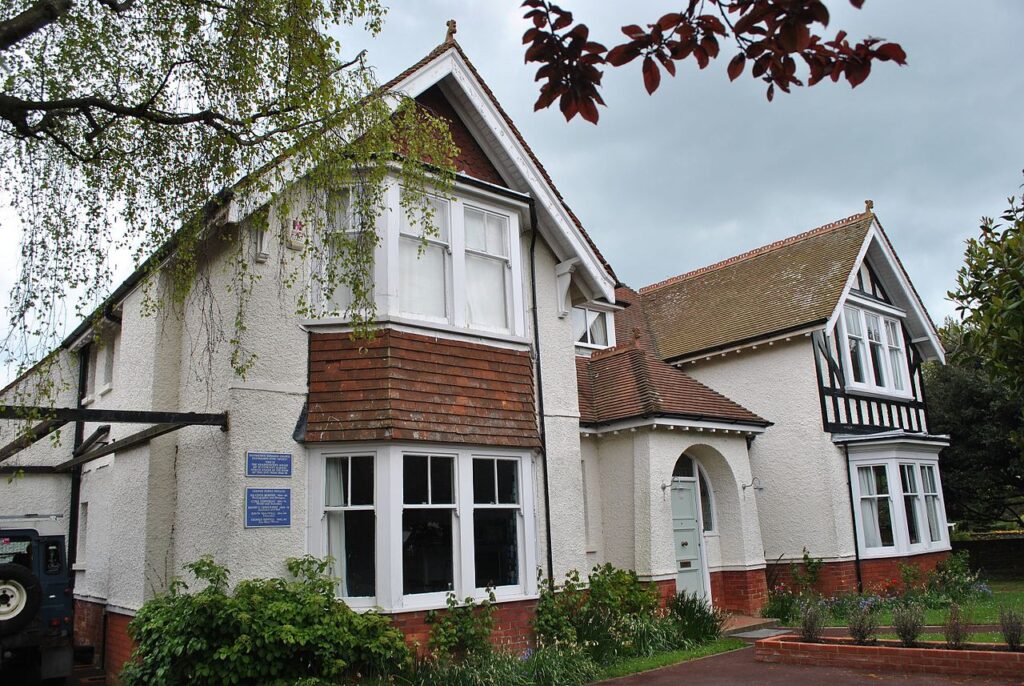 Blue plaques on building which survived the burning of St Cyprian’s in 1939
Other Masters mentioned by Orwell included the Second Master Robert Lawrence Sillar who was born in Surrey in 1863 one of the ten children of Thomas Frederick Sillar an East Indies Merchant; studied at Worcester College, Oxford, graduating in 1885; by 1911 was a resident St Cyprian’s teacher; and died in Scotland in 1943 aged seventy nine. George Orwell spoke highly of him but Sillar was called Mr Brown in earlier versions of Such, Such Were the Joys.
The other St Cyprian’s teacher who Orwell respected Mr Foster Knowles was non- resident and Orwell called him Mr Batchelor. I intend to produce a separate article about this Mr Knowles.
A teacher who Orwell disliked and whom he did not name Charles Edgar Loseby, was born in 1881; taught at St Cyprian’s; and was called to the bar in 1914. Before he could practise the First World War broke out and he joined the Royal Lancashire Fusiliers. He rose to be a Captain, was gassed at Ypres in May 1915, briefly returned as a St Cyprian’s teacher, recovered his health and was wounded and won the Military Cross at Cambrai in 1917.
Captain Loseby was elected Coalition National Democratic Labour MP for Bradford East at the 1918 Coupon Election but was out of place in that parliament of hard faced men who looked as if they had done well out of the war. He lost his seat at the 1922 General Election and returned to legal work practising at Leicester. After the Second World War he moved to Hong Kong and practised there becoming a QC. He died in 1970 eighty eight on Guernsey and was survived by his widow and their daughter.
George Orwell’s disliked Loseby because after an internal scandal at St Cyprian’s regarding homosexuality this solemn, black haired, imbecile of an Assistant Master, who was later to be a Member of Parliament, took the older boys to a secluded room and delivered a talk on the Temple of the Body.
In this period anal sex carried a maximum sentence of life imprisonment with hard labour and gross indecency a maximum sentence of two years hard labour. Such a scandal if it leaked out could ruin a school’s reputation especially a new school such as St Cyprian’s.
The 1911 census for St Cyprian’s lists Mr and Mrs Wilkes and their then four children; their governess Evelyn Mary Zenner twenty; Susannah Young, forty nine, the Matron; five resident Masters including Sillar; sixty two pupils; and nine women servants including Margaret Bond, thirty two, the second oldest of the nine women who may be the Margaret Orwell remembered as Matron. Eric Arthur Blair was not listed. He had not started there when the census was taken.
Census enumerators sometimes make spelling mistakes. For instance the Wilkes family were called the Withers and Robert Lawrence Sillar Robert Lawrence Sileer.
Curriculum. Lewis and Cicely Wilkes, their five resident masters, and the visiting masters, taught a curriculum that obsessively crammed boys for the Eton and Harrow entrance exams. It was dominated by the Latin and Greek Classics, Scripture, History, French, English Literature and drawing. Mathematics and Geography were downplayed and science despised. Robert Lawrence Sillar took boys out on natural history excursions but Mrs Wilkes openly sneered at them.
The Case for the Defence. George Orwell’s friend and St Cyprian’s and Eton contemporary, Cyril Vernon Connolly, had described St Cyprian’s in his book Enemies of Promise (Routledge, 1938) which called it St Wulfric’s and Mr and Mrs Wilkes Sambo and Flip.
Cyril Connolly criticised the private school system as a whole for separating children from their parents before it was natural; but said that St Wulfric’s was a well-run and vigorous example which did me a world of good. He said that Mrs Wilkes was able, ambitious, temperamental and energetic. After Orwell’s attack was published Connolly defended the school and Mrs Wilkes; and said that his own milder criticisms had been unfair.
Cyril Connolly’s father Major William Kemble Connolly of the King’s Own Yorkshire Light Infantry was born in 1872 his father being a Royal Navy Vice Admiral. Major Connolly retired in 1914 and became a leading expert on molluscs especially snails. He died in 1947 aged seventy five leaving £3,891 4s 10d.
George Orwell’s father Richard Walmesley Blair had been an Indian Opium Service official. He died on 28 June 1939 leaving £505 16s 1d. Thus Connolly’s father was richer than Orwell’s and was in a far more prestigious occupation. Also Cyril Connolly started St Cyprian’s aged eleven while Orwell started aged eight. Separating a boy from his parents to go to a boarding school is less traumatic for an eleven year old than an eight year old. Cyril Connolly probably never wet his bed at St Cyprian’s.
The same may apply to other old boys who defended St Cyprian’s including Sir Cecil Walter Hardy Beaton the society photographer; Douglas Blackwood the Second World War Fighter Pilot who published Walter John Christie a colonial civil servant’s defence of St Cyprian’s in the May 1971 Blackwood’s Magazine; Charles Rivett Carnac a Royal Canadian Mounted Police Commissioner; Major General Henry Bowreman Foote VC; (Harold) Alaric Jacob the writer and journalist; Henry Carpenter Longhurst the golf journalist and TV broadcaster in his 1971 autobiography; and Robert Hepburn Wright who wrote about Nigeria.
Some old boys defended Orwell’s remarks about St Cyprian’s. They included David Mackenzie Ogilvy an advertising executive whose wealthy stockbroker father had been impoverished by the First World War.
The naturalist and writer Gavin Maxwell of Ring of Bright Water fame came from a wealthy landowning family and his mother was the fifth daughter of the 7th Percy Duke of Northumberland. Gavin Maxwell was sent to St Cyprian’s because his parents thought it would be good for him to mix with boys of lower social status! Whatever Mr and Mrs Wilkes thought of him the other boys resented him and he moved elsewhere. Snobs can be envious and favourites have no friends.
The National Board of Education whose officials inspected St Cyprian’s approved of it whatever Orwell thought. A 1931 report on it survives in the National Archives and I will partly base part two of this article on it.
Getting Cross. I have identified the scholarship boy Cross, who according to Orwell was savagely caned and expelled from St Cyprian’s for alleged homosexuality and, who later studied at Eastbourne College. Contrary to what Mr and Wilkes predicted Cross, the son of a Bolton bleach works manager, served as a British Army Officer; married and had a daughter; and died in 1982 aged eighty two a tax exile on the Channel Islands leaving £8,216,127
Conclusion. The main St Cyprian’s building burnt down on Sunday 14 May 1939. A maidservant Winifred Mary Higgs, aged sixteen, misused the safety rope, fell heavily and died in hospital. The inquest returned a verdict of accidental death. The pupils moved elsewhere and the school closed but the Wilkes family still lived at the Headmaster’s Lodge.
The Eastbourne newspapers massively publicised this fire and the inquest. In the Second World War Eastbourne, which housed some war industries, suffered many air raids. Although much of the population was evacuated a hundred and eighty people died in them.
Wilkes died on 14 February 1947 at the Holloway Sanatorium at Virginia Water in Surrey aged seventy seven. He left £71,420, probate going to his wife Cicely and their oldest son the Reverend John Comyn Vaughan Wilkes. Cicely Ellen Philadelphia Wilkes died on 11 August 1967 at Eastbourne aged ninety one leaving £2,695. Probate went to her two sons.
Lewis Wilkes had come up from the working class over two generations. His father had been a workhouse chaplain and knew how the society of his day treated the poor. His rationale for his harsh discipline may have been a desire to help other boys rise above their background and not just money. As for his and his wife’s hostility to bed wetting washing and replacing sheets costs money. St Cyprian’s had to cover its costs and support the Wilkes family.
*
Part II will follow
“The Case for the Defence”?
I do not believe there is any defence for the poor treatment of vulnerable, defenceless children left alone to institutions. The Wilkes were Victorians, with all the beastly trappings that came from that ever so long, starched century.
“It’s wrong now; it was wrong then! Damn them!” Is a quote from a curious story about Disappointment Rooms that actually existed as an extreme example of the opprobrium, oppression and ostracising that turned the wheels of Victorian society.
The society of the 19th century is a warning from the past. Not a training manual for the present, nor the future.