
Walpoling Activities
*
Introduction. In his 1940 essay “Inside the Whale” George Orwell wrote:
Even more than at most times the big shots of literary journalism were busy pretending that the age-before-last had not come to an end. Squire ruled the ‘London Mercury’, Gibbs and Walpole were the gods of the lending libraries, there was a cult of cheeriness and manliness, beer and cricket, briar pipes and monogamy , and it was at all times possible to earn a few guineas by writing an article denouncing ‘high-brows’. But all the same it was the despised high brows who had captured the young. The wind was blowing from Europe and long before 1930 it had blown the beer-and-cricket school naked, except for their knighthoods.
George Orwell assumed that his well-educated readers knew who Squire, Gibbs and Walpole were. Sir John Collings Squire, Sir Philip Armand Hamilton Gibbs, and Sir Hugh Seymour Walpole, were alive and active in 1940. For modern readers it is different: some have now even forgotten his reference in the Monty Python cheese shop skit..
Apart from the reference above, Orwell mentioned Hugh Walpole on multiple occasions throughout his career. In a letter to Brenda Salkeld written on a Sunday in September 1932 Orwell wrote: By the way if you are by any chance wanting to impose a penance upon yourself, I should think you might try Hugh Walpole’s recent 800 page novel. This novel The Fortress was published in 1932 as part of the Rogue Herries saga (see below). To quote an online description.
It had been the wish of her whole life to flee from all the Herries, but Walter Herries had challenged her and she had taken up the challenge. Judith Paris, now middle aged, returns to the Lakes to deal with the bitter feud between the two branches of the family. A feud culminating in the construction by one branch of a huge house known as the Fortress which will dominate the land of the others. But within this conflict the children of the two families have an important part to play.
Orwell next mentioned Walpole in a review of Amy Cruse’s book The Victorians and their Books in the August 1933 issue of The Adelphi. In this review Orwell wrote that: It may be hard to believe after a course of Walpole and Gould but the Victorians took their novels quite as seriously as we do. “Gould“ meant Gerald Gould who has an important role in Orwell’s early literary career and is worthy of an article in his own right. I intend to produce one.
George Orwell’s next mentioned Walpole in an article “Bookshop Memories” published in November 1936 in the journal, Fortnightly. George Orwell wrote that: It is therefore worth noting that of all the authors in our library the one who “went out” the best was – Priestley? Hemingway? Walpole? Wodehouse? No, Ethel M. Dell, with Warwick Deeping a good second and Jeffrey Farnol, I should say, third.
And finally Orwell in 1945 came to review London Belongs To Me by Norman Collins, in which he gave a literary genealogy: There are some writers whose line of literary descent is so clear as to remind one of those chapters of the Old Testament which consist entirely of “and so-and-so.” Thus, Cervantes begat Smollett, and Smollett begat Dickens, and Dickens begat Walpole (also several other novelists, of course), and Walpole begat Priestley, and Priestley begat Mr. Norman Collins,1 whose “London Belongs to Me” must be one of the bulkiest novels published in this country in recent years.(Orwell and Collins had had an uncomfortable relationship since Collins had been the publishing editor at Gollancz for Orwell’s Keep The Aspidistra Flying in 1936, forcing him to make difficult re-writes for fear of libel suits).
When I heard the name Walpole I thought of Britain’s first Prime Minister Robert Walpole the 1st Earl of Orford who died in 1745; and his fourth son the writer Horace Walpole of Strawberry Hill the 4th Earl of Orford who died in 1797. After all, Orwell did mention Horace Walpole describing the beheading of two Scottish noblemen after the 1745 rebellion. I was surprised to discover that Hugh Seymour Walpole was a twentieth century writer.
Hugh Seymour Walpole was born on 13 March 1884 at Auckland, New Zealand, the oldest of three children. His father George Henry Somerset Walpole was born in 1854 and studied at King’s Lynn Grammar School and Trinity College Cambridge where he took a first class degree in theology. By 1884 he was Warden of St John’s Protestant Episcopalian Theological College in Auckland.
George Walpole was Professor of Dogmatic Theology at the Protestant Episcopalian Theological Seminary in New York from 1889 to 1896. From 1910 to his death in 1929 he was Protestant Episcopalian Bishop of Edinburgh. In Scotland the Presbyterian Church of Scotland was the established church, the Catholics were the second largest group and the Protestant Episcopalians the third. Episcopalian meant that they had bishops. He was Horace Walpole’s great grandson and Robert Walpole’s a great-great grandson.
The baby’s mother was Mildred Helen Walpole née Barham. Her father was Charles Foster Barham, a Cornish doctor, scientist and medical writer, whose father Thomas Foster Barham was a theologian, playwright, composer and lyricist. The Barham family money came from slave worked Jamaican sugar plantations.
Early Life. Hugh Walpole was educated at a Girls’ School in Truro, Cornwall; then by an American governess; then at Newham House a Truro Boarding School; at Marlow, a Buckinghamshire boarding school; at King’s School at Canterbury; and at Emanuel College, Cambridge. He graduated with a BA in history in 1906.
Walpole was briefly a lay minister at the Mersey Mission to Seamen in Liverpool, but was not cut out to be a clergyman. He then worked in Germany as a tutor to the children of the British novelist Mary Annette Von Arnim née Beauchamp. Under her pen name Elizabeth Von Arnim her best known work was Elizabeth and her German Garden, a satiric and pastoral work, published anonymously in 1898 which became a best seller.
By 1909 Hugh Walpole lived in London and reviewed books for the London Standard. He had become a practising gay at a time when this was illegal: buggery carried a maximum penalty of life imprisonment with hard labour and gross indecency a maximum of two years hard labour.
In 1909 Smith Elder in Britain and George Doran in the USA published Walpole’s first novel The Wooden Horse. By 1914 he had had five more novels published. His literary friends included Henry James, Arnold Bennett and Joseph Conrad. Walpole was noted for skilful scene setting and vivid plots.
The First World War. Walpole was rejected for service in the British Army in that war due to poor eyesight. He worked as a journalist and for the Russian Red Cross. In June 1915 he won the Russian Cross of St George for a single handed rescue of a wounded soldier. He later headed the Anglo-Russian Propaganda Bureau in Petrograd. He left Russia before the October 1917 Bolshevik revolution. Back in England he was awarded the CBE in 1918 and worked with the novelist John Buchan at the Ministry of Information.
Between the Wars. Walpole wrote thirty six novels, five volumes of short stories, three plays and three biographies. His literary novels included The Dark Forest (1916) and The Secret City (1919), which won the first James Tait Black Memorial Prize for fiction that year. They were based on his Russian experiences. This prize was endowed in 1919 from the estate of the late Janet Black née Coats, in memory of her late husband, the publisher James Tait Black.
Macmillan in Britain and Doran in the USA published Walpole’s The Cathedral in 1922. It was an expose of religious life based on personal knowledge. In 1925 they published Portrait of a Man with Red Hair a horror story depicting the malign influence of a manipulative, insane, father on his family and others.
Walpole began a trilogy about a boy growing up with Jeremy (1919); Jeremy and Hamlet (1923) and Jeremy at Crale (1927) which was set in a boarding school. They were based on personal experiences. Cassell in Britain and Doran in the USA published them. They helped popularise the name Jeremy, and were later published as an omnibus volume. Readers might like to compare them with P. G. Wodehouse’s Mike novels – as Orwell discussed those, but not the Jeremy books.
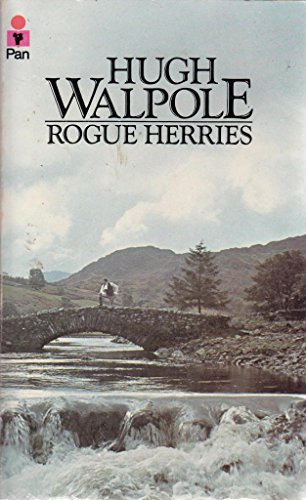
Pan Books acquired the paperback rights to Walpole’s works and kept them in print long after the Second World War.
The most famous Walpole novels were the six Rogue Herries novels set in the Lake District; and spanning from Tudor times to the 1930’s i.e. what was then the present day. They were Rogue Herries (1930), Judith Paris (1931), The Fortress (1932: the one mentioned by Orwell), Vanessa (1933), The Bright Pavilions (1940) and Katherine Christian (1943). They were published by Macmillan in Great Britain and Doubleday in the USA. They were raunchy in the picaresque bodice ripper tradition but much better written than most such works. They inspired many readers to visit the Lake District.
Hugh Walpole’s other novel series included the eight London novels published in Britain and the USA between 1913 and 1928; and the four Scenes from Provincial Life novels published between 1922 and 1935 by Macmillan in Britain and Doran and later Doubleday in the USA. The Windsor Magazine published ten of his short stories between October 1923 and November 1934.
Apart from fiction Walpole wrote a biography of Joseph Conrad published in 1916 by Nisbet in Britain and Henry Holt in the USA; The Art of James Branch Cabell published in 1920 by R. M. McBride in the USA; and a biography of Anthony Trollope published in 1928 by Macmillan in both countries.
He travelled widely, made five well-paid lecture tours of the USA, wrote film scripts for Hollywood, and played a bit part in the 1935 MGM film David Copperfield. He bought a country house at Brackenburn near Keswick in the Lake District.
Walpole had a long standing partner, Harold Cheevers, who was born in Cornwall in 1893; joined the Metropolitan Police; married and had a son; and met Walpole in the Lake District in 1924. Cheevers left the police and became Walpole’s chauffeur travelling with him around Britain and abroad. In London Walpole lived in a flat and Cheevers in a Hampstead house where his wife and family stayed with him. The couple were discreet.
In 1925 Hugh Walpole gave the annual Sir Robert Rede lecture at Cambridge speaking about, the evolution of the English novel. This annual series started in 1858. It replaced lectureships in logic, philosophy and rhetoric endowed in Tudor times from the estate of Sir Robert Rede a Chief Justice of the Court of Common Pleas who died in 1519.
The writer William Somerset Maugham (who had attended the King’s School Canterbury some years before him) lampooned Walpole as the literary opportunist Alroy Kear in Cakes and Ale (1930) a novel satirising the literary world. Hugh Walpole and Somerset Maugham were gay and this may have been due to a homosexual quarrel. It upset Walpole but he carried on writing. In 1937 Walpole was knighted.
Later Years. Walpole in his later years divided his time between London and the Lake District. He was generous to young writers as veteran writers had been kind to him. He collected paintings, sculptures and manuscripts and in 1938 donated many old books and manuscripts including a fourth folio Shakespeare to the new library at his old school at Canterbury. In May 1941 he over exerted himself at a Keswick War Weapons Week taking part in a lengthy march and making a long speech. Hugh Walpole died of diabetes and congestive heart disease at his Brackenburn home in the Lake District on 1 June 1941 aged fifty four. He left £43,116 12s and 8d. Some of his paintings were left to the Tate Gallery and others to the Fitzwilliam Museum in Cambridge including works by Cezanne, Manet, Augustus John and Renoir.
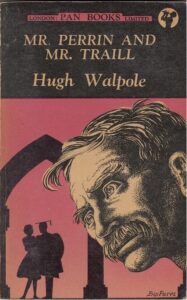
Three Walpole novels appeared posthumously. In 1942 Macmillan in Britain and Doubleday in the USA published The Killer and the Slain, about a murderer who gradually turns mentally and physically into the man he killed. Katherine Christian the last of the Rogue Herries series was published in 1943 by Doubleday in the USA and in 1944 by Macmillan in Britain. Macmillan published Mr Huffam and Other Stories a collection of twelve short stories in Britain in 1948. His 1911 novel about schoolmasters falling out, probably inspired by his own problems,, Mr. Perrin and Mr. Traill, was filmed to popular success in that same year.
Harold Cheevers died in Hastings in 1971 aged seventy seven. His wife died in 1973 aged seventy eight and their son in 1989 aged sixty nine. By then gay sex was legal in private in England and Wales.
*
Leave a Reply