
Orwell and the Detectives: II
Having looked at R. Austin Freeman’s Dr Thorndyke stories in Part One, we now move on to Max Carrados.
*
Ernest Brammah Smith, who wrote as Ernest Bramah, was born on 20 March 1868 at Hulme near Manchester, the son of Charles Clement Smith, a factory hand who had risen to be a warehouseman, and Susanna Smith née Brammah. He attended the prestigious Manchester Grammar School but did badly.
In 1887 Ernest left Manchester and moved to Erith in Kent. He spent six years farming and wrote for newspapers. In 1893 he gave up and in 1894 Leadenhall Press published his book English Farming and why I turned it up. It sold badly and most copies were pulped.
After a brief spell as a journalist in 1894 Smith was taken on by the humourist and playwright Jerome K(lapka) Jerome as a secretary. Smith then worked for Jerome’s two-penny paper, Today. It was founded in 1893 and folded in 1897. On 31 December 1897 he married Lucy Maisie Barker in London.
In 1900 Grant Richards published Ernest Bramah’s first novel The Wallet of Kai Lung. It contained nine stories allegedly told by Kai Lung, a decent and worldly wise itinerant Chinese story teller. Eight other publishers had rejected it, possibly because this was the time of the Boxer Uprising in China when many Europeans, especially missionaries, and their families were murdered. Three more collections of Kai Lung stories were published – Kai Lung’s Golden Hours (1922), Kai Lung unrolls his mat (1928), and Kai Lung beneath the Mulberry Tree (1940).
The Kai Lung stories contained much alleged homespun Chinese philosophy such as:
It has been said there are few situations in life, that cannot be honourably settled, and without loss of time, either by suicide, a bag of gold, or by thrusting a despised antagonist over the edge of a precipice on a dark night.
Others were the alleged Chinese curses May you live in interesting times, and May you come to the attention of those in authority.
In 1907 Ernest Bramah’s novel; What Might have been: the Story of a Social War was published. It described a civil war between an elected British socialist government and a Conservative resistance which with foreign help establishes a fascist regime. It was toned down and republished as The Secret of the League in 1909 (see below).
Max Carrados. In 1913 the News of the World published the first Max Carrados story The Coin of Dionysus. Max Carrados had been accidentally blinded but developed his other senses to compensate. He is wealthy through inheritance from a cousin, cultured and urbane. He has a sighted man servant, Mr Parkinson, and a secretary, Mr Greatorex. The threesome assist Mr Carlyle a solicitor who was falsely accused of forgery, cleared his name, and became a private detective with a retired policeman as an assistant.
Over the next fourteen years Ernest Bramah produced twenty six more Max Carrados short stories. They appeared in the News of the World, Strand Magazine, The New Magazine, Pearson’s Magazine, The Story Teller; and as stories written for two Max Carrados collections i.e. Max Carrados (1914); and the Max Carrados Mysteries (1927). A Max Carrados novel The Bravo of London was published in 1934.
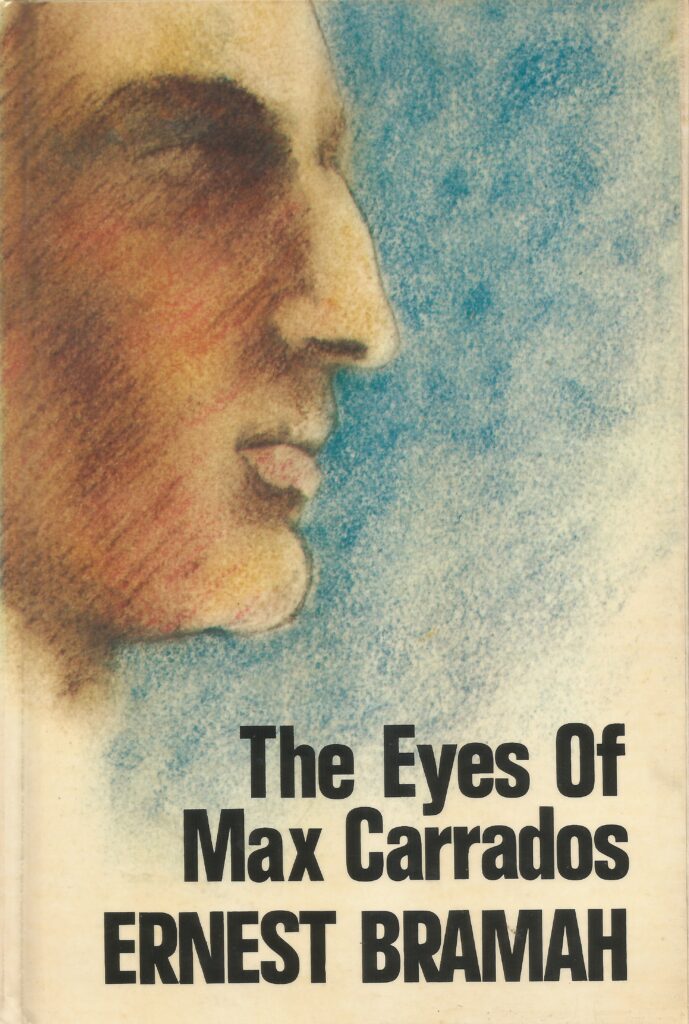
There were suggestions that Ernest Bramah was a pen name covering two writers. In 1924 to refute this Ernest Bramah had published an anthology The Specimen Case containing both Kai Lung and Max Carradox stories. He also wrote a play Blind Man’s Buff performed in 1918 and four of his stories were adapted into plays by other writers.
Ernest Bramah also wrote A Guide to the Varieties and Rarity of English Copper Coins, Charles II – Victoria, 1671-1860 (Methuen, 1929). Pure copper coinage stopped being minted in 1860. His hobby was collecting coins and auction houses still use the book.
Smith and his wife lived privately. He died on 23 June 1942 at Weston Super Mare aged seventy four. He left £15,172 3s 9d. His usual address at this time was in London. His wife Lucy Maisie Smith died on 23 July 1957 aged eighty three at Bath. She left £25,620 18s. Probate went to the Public Trustee.
Some Max Carrados stories have been reprinted, televised or adapted for radio in Britain and the USA. The Kai Lung stories have apparently disappeared from view. Modern racial attitudes are very different to those of the twentieth century.
George Orwell reviewed The Wallet of Kai Lung in the 23 July 1936 New English Review. He called in tedious, and as owing its reputation to having been praised by Hilaire Belloc, who disliked most modern books but exempted a few including this one. George Orwell writes that it would have been better to reprint the Max Carrados stories, which along with the Sherlock Holmes and Dr Thorndyke stories were the only detective stories since Edgar Allan Poe worth reading.
George Orwell wrote that Ernest Bramah…
is an example of a rarer bird than the Phoenix, the modest literary man. He hated publicity and though he made a great popular success with his books, he managed to live so obscurely that no one except a few close friends ever discovered what name his pseudonym covered.
On 4 August 1936 Smith wrote to Orwell thanking him for praising the Max Carrados stories. He forgave Orwell for finding the Kai Lung stories tedious because Orwell had good grounds for his lack of interest. Perhaps he had read Burmese Days or at least knew that Orwell had lived in Burma
George Orwell reviewed Bramah’s 1909 book The Secret of the League in the 12 July 1940 Tribune. In the novel a Labour government wins a big parliamentary majority and by its policies wrecks the economy. A Conservative upper class conspiracy with foreign help deliberately aggravates the economic crisis, overthrows the Labour government, bans Trade Unions and ends parliamentary rule. Orwell wondered how a decent man such as Bramah should take such an attitude and blamed it partly on the reaction of a struggling class to challenges from below; and partly to the stupidity of much socialist propaganda which insults the middle classes.
On 17 December 1943 Orwell completed an article in French ‘Grandeur et Decadence du roman policier Anglais’ (Greatness and Decadence in the English Detective Novel). It was published in France in late 1944 after the liberation; and in translation in the Orwell Collected Works as ‘The Detective Story’.
George Orwell admired Edgar Allan Poe, Conan Doyle, Richard Austin Freeman and Ernest Bramah; but admitted that the Dr Thorndyke and Max Carrados stories are not in the same class as Sherlock Holmes. However Dr Thorndyke and Max Carrados were memorable heroes, Orwell especially admired the long and sometimes apparently irrelevant, but atmospheric, digressions. He disliked most of his contemporary detective novelists naming Dorothy L. Sayers, Agatha Christie, and Freeman Wills Croft.
The 2 November 1945 Tribune included Orwell’s article ‘Good Bad Books’ a phrase coined by G. K. Chesterton to describe readable and well written books with no literary pretensions. Orwell includes Sherlock Holmes, Richard Austin Freeman and Ernest Bramah in this category.
Conclusion. Some modern stories of the type Orwell admired are the late Isaac Asimov’s five volumes of Black Widower dining club mysteries. Most of are not about murders and some are not about indictable offences. Their detectives are mostly based on Asimov’s fellow members of a real dining club. Isaac Asimov a scientist was best known as a science fiction writer but these stories are well worth reading.
You seem to suggest that Orwell wrote the article Grandeur et Decadence du roman policier Anglais’ (Greatness and Decadence in the English Detective Novel), that is the French version of the article. From what I have seen on the internet it was translated by one Fernand Auberjonois. (“Traduit par Fernand AUBERJONOIS”.)
Is this right after all, or have I misread the info? I believe Orwell would have been capable of writing passable French, at least a couple of decades earlier, but maybe not still so at this later point.
As you say, in the Complete Works Professor Peter Davison says that the version published in Fontaine was translated by Fernand Auberjonois from the English.
Is there then an English version of this essay “Greatness and Decadence in the English Detective Novel” in print or online?
It can be found in the 1943 volume of the Complete Works.