
Hopkinson, Hulton and the Herald
Introduction. The first serious Orwell biography was a pamphlet issued in 1953: George Orwell, by Henry Thomas Tom Hopkinson, was published by Longmans, Green & Co., for the British Council and the National Book League. John Masefield, the writer and poet laureate founded The National Book League (NBL) in 1945, as an offshoot of the National Book Council founded in 1925. The successor organisation to the NBL is the Book Trust, a charity dedicated to getting children reading.
Longmans, Green & Co. published for the NBL a series Writers and their Work. On the back cover of my copy of Hopkinson’s pamphlet George Orwell are listed studies of forty one other writers who feature in it, including one about the three Bronte sisters. The only writer listed of whom I had not heard was the Welsh-Irish Elizabeth Dorothea Cole Cameron née Bowen i.e. Elizabeth Bowen. Within George Orwell included drawings of pigs and other animals from Halas and Batchelor’s film of Animal Farm. Halas and Batchelor were the Hungarian John Halas (Janos Halasz) and his English wife Joy Ethel Halas née Batchelor.
Tom Hopkinson’s study was a sympathetic but sometimes critical look at Orwell and his writings. He took an anti-Stalinist line, writing of, for instance,
the ruthlessness and treachery of the communists which ended by destroying the government’s side’s resistance and paving the way to a Franco victory.

Hugh Thomas, on whom later Sonia Orwell and Ian Angus relied for their comments on Orwell’s Spanish writings in the first volume of the Collected Essays Journalism and Letters, in his 1961 book The Spanish Civil War took a different position: the Russian contribution to the Republican cause was mixed. Russian military experts saved Madrid in 1936. Russian arms bought by the Spanish government with hard cash prolonged its resistance, as did the forty thousand strong communist organised International Brigades. This does not excuse the OGPU agents who destroyed the allegedly Trotskyite POUM leadership on false treason charges. However without Russian help the Spanish republican government would have fallen in 1937.
Family Background. Henry Thomas Tom Hopkinson was born in Manchester on 19 April 1905. His father John Henry Hopkinson was born in 1877 one of seven children of the lawyer Sir Alfred Hopkinson KC; studied at Dulwich College, and University College, Oxford; taught Greek at Birmingham University 1901-1904; in 1902 married Evelyn Mary Fountaine a Lincolnshire vicar’s daughter; had six children by her; and taught Classical Archaeology at Manchester University, 1904- 1914.
In 1914 John Henry Hopkinson was ordained and joined the Royal Army Medical Corps as a private. He was appointed Vicar of Colne in 1915; held other livings; was Archdeacon of Westmorland 1931-1944; and died on 22 October 1957 aged eighty two. The Hopkinson family tree includes many high achievers.
Early Life. Hopkinson studied at St Edward’s College, Oxford, a public school, helped by money from a wealthy uncle, Alfred Austin Augustine Hopkinson, an industrialist who was an independent MP for Mossley 1918-1929 and 1931-1945. Tom won a scholarship to Pembroke College, Oxford, getting a second in classics in 1925 and a third in humane literature in 1927. His philosophy tutor was Robin George Collingwood, the philosopher and historian. For seven years after graduating Hopkinson lived by freelance journalism and work at Crawford’s a leading London Advertising Agency. In 1930 his novel A Wise Man Foolish was published by Chapman and Hall. On 28 November 1930 he married at Carlisle Anglican Cathedral a Crawford’s colleague and lapsed Catholic Eirine Adeline Botting aged thirty one., who wrote under the pseudonym Antonia White.
Antonia White had been married to Reginald Henry Green Wilkinson and Eric Earnshaw Smith, but both marriages were annulled. She had had several lovers; and had spent nine months in a mental hospital. She already had a child, the writer Susan Chitty née Earnshaw-Smith of Puffin Book of Horses fame, born in 1929, whose actual father was the mining engineer Rudolph Glossop. Hopkinson and White produced one child, a daughter born in 1931.
Hopkinson’s book A Strong Hand at the Helm, published in 1933,. attacked the Prime Minister Ramsay Macdonald. That same year Antonia White’s first novel Frost in May, about her Catholic education, was published. Hopkinson was a womaniser and in 1935 he and his wife separated. They divorced in 1938. She died of cancer in 1980 aged eighty.
The Picture Post Years. In 1934 Hopkinson moved to Odham’s, who published the Labour-supporting Daily Herald. He became Assistant Editor of Clarion, founded by Robert Blatchford but much reduced to a cycling and Labour Youth weekly. Later that year it was incorporated into the Weekly Illustrated, a new Odham’s journal edited by Stefan Lorant a Hungarian photo-journalist and film maker, who had spent six months in a Nazi prison in 1933 before coming to England as a Jewish refugee.
In July 1937 Lorant founded Lilliput, a monthly humour, short story, photograph and arts magazine. Later that year the publisher Edward George Warris Hulton bought it. It was in 1938, though, that Hutlon founded Picture Post with Stefan Lorant as editor and Tom Hopkinson assistant editor, which was to make their names.
On 7 October 1938 Tom Hopkinson married Gertrude Helene Gerti Deutsch aged thirty at Chelsea Registry Office. She was an Austrian professional photographer and Jewish refugee. Her father Victor Deutsch was a rope manufacturer. Tom and Gerti Hopkinson were to have two daughters. Tom and Gerti Hopkins divorced in 1953. She died in Leamington Spa in 1979 aged seventy one.
When Stefan Lorant could not get British citizenship and moved to the USA in 1940, Tom Hopkinson became editor of Picture Post, its readership rising to 1,500,000. He had learnt photo-journalism from Lorant, and added a social awareness contrasting the lives of the rich and poor. He was a good caption writer, had cool professional judgement, was a good administrator and dressed impeccably. He and his hand-picked team contributed to Labour’s 1945 electoral landslide.
Although Hopkinson was a socialist he attacked the 1945-1951 Labour government when it made mistakes. For instance, he strongly criticised the well-intentioned but misguided and costly Groundnuts Scheme. He also wrote short stories and novels in this period. The novels included A Man Below published in 1939, Mist in the Tagus (1946), and Down the Long Slide (1949).
In 1950 Albert Bert William Thomas Hardy a photographer and (Mark) James (Walter) Cameron discovered how the western-backed South Korean government maltreated political prisoners including children. Edward Hulton dismissed Hopkinson for publishing this story. Picture Post lost its way and closed in 1957.
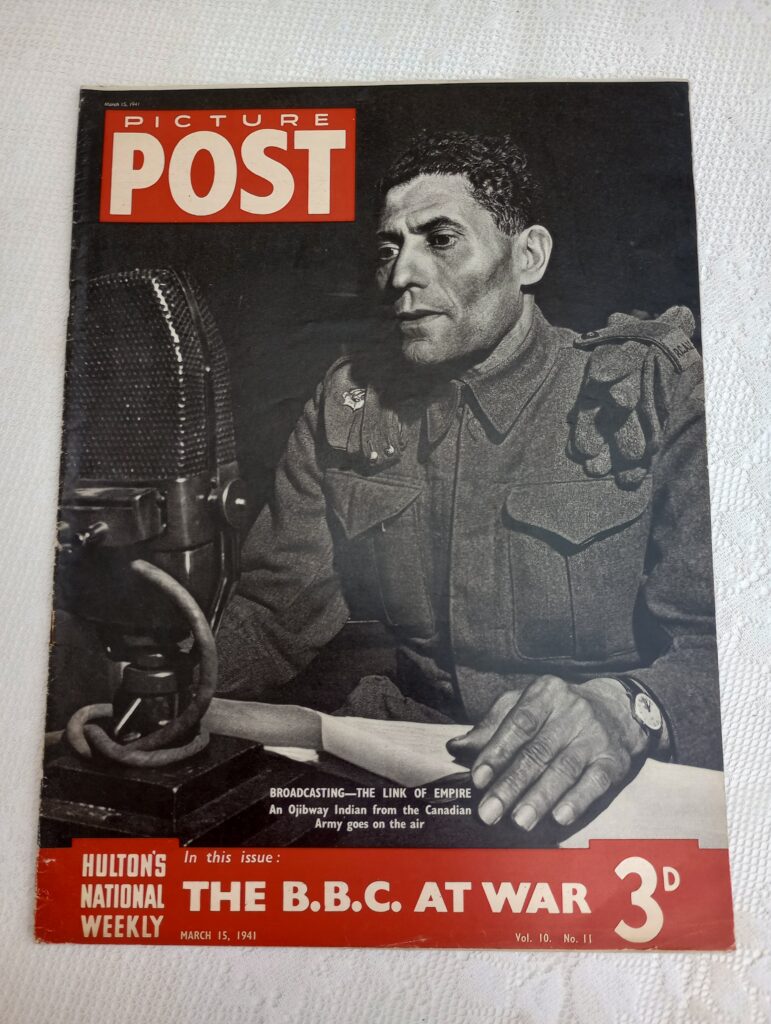
Orwell, Picture Post and Hopkinson. George Orwell gave Picture Post a favourable reference in an 8 March 1940 letter to David Houstin Thomson, a Deputy Regional Officer for the National Council for Social Service. On 15 March 1941 Picture Post published Orwell’s article A Roadman’s Day about the hard lives of road maintenance men. In a 15 April 1941 London Letter in the American Journal Partisan Review he favourably mentions Picture Post’s attempts to democratise the Home Guard.
On 11 July 1942 Picture Post published an Orwell letter commenting on J. B. Priestley’s article Britain’s Silent Revolution. On 27 February 1943 it printed an Orwell letter which criticised an article that had called for a return to individualism and opposed a welfare state.
On 15 August 1943 The Observer printed Orwell’s review of Edward Hulton’s book The New Age. George Orwell thought that Hulton had his heart in the right place but was somewhat naïve despite being an astute businessman.The 7 January 1944 Tribune carried Orwell’s As I Please column which mentioned how ugly the actual and would be dictators pictured in Picture Post were. In his essay the English People completed by 22 May 1944 Orwell commented how Picture Post and other publications appealed to all classes.
On 2 February 1945 the Manchester Evening News published Orwell’s review of the Australian Francis Rhodes Farmer’s book Shanghai Harvest about the Chinese-Japanese war. George Orwell mentioned how Picture Post in late 1941 after Pearl Harbour printed pictures of Japanese soldiers bayoneting manacled Chinese prisoners. Many people thought they were faked but they were genuine; and had been publicly available since 1938 when American magazines had published them.
In a 2 January 1946 letter to Arthur Koestler Orwell wrote that he was going to lunch with Hopkinson and Barbara Ward. On 10 January 1946 Orwell wrote back to Koestler that Hopkinson and Ward were sceptical about Orwell and Koestler’s plans for a League for the Rights of Man, as it would be bound to be anti-Russian; and Hopkinson and Ward were going through an acute phase of anti-Americanism.
Tom Hopkinson’s novel Down the Long Slide was on Orwell’s 1949 reading list. In 1949 Orwell wrote a list of alleged crypto communists or fellow travellers. It included Hopkinson as Appeaser only. Subjectively hostile to USSR? Anti-American.
Later Years. After leaving Picture Post Hopkinson freelanced for four years. On 20 March 1953, forty seven and twice divorced, he married Dorothy Kingsmill née Vernon, forty nine, the widow of the writer Hugh Kingsmill, at Paddington Registry Office. She had an adult daughter by Kingsmill. That year Hopkinson’s life of Orwell, and Hopkinson’s book Love’s Apprentice: How to succeed in the War of the Sexes were published.
From 1954 to 1956 Hopkinson was News Chronicle Features Editor but he left it because he thought that its policy was suicidal. In 1958 his short story collection The Lady and the Cut Throat was published; and he was appointed editor of the South African journal The Drum. It was owned by James Richard Abe Bailey DSO, a Second World War fighter pilot, whose parents were the gold mining millionaire Sir Abraham Bailey and the pioneer aviator Lady Mary Bailey née Westenra.
The Drum was aimed at an urban black readership; reported crime, sport and jazz; exposed the maltreatment of black workers and prisoners; and carried short stories. In 1961 it exposed the truth about Sharpeville. The apartheid government claimed that the police fired in self-defence, but most of the victims were shot in the back while running away. Abe Bailey then dismissed Hopkinson. The Drum toned down its reporting. It is now an online journal.
In 1962 Hopkinson’s book In the Fiery Continent was published and his Orwell Biography was re-issued. Eliot Joseph Benn Jim Rose the director of the International Press Institute asked Hopkinson to set up an African journalism training centre. Tom Hopkinson ran this Nairobi, Kenya, centre from 1963 to 1967.
Tom Hopkinson was Senior Fellow in Press Studies at the University of Sussex 1967-1969; and in 1968-1969 was Visiting Professor of Journalism at the University of Minnesota. In 1970 he was appointed Director of the Cardiff University Centre for Journalism Studies, and set up its first journalism course. That year he edited and wrote the introduction to Penguin’s book Picture Post 1938-1950.
Tom and Dorothy Hopkinson admired the Indian guru Meher Baba. Their biography of him Meher Baba: His Life And Work was published in 1974. In 1975 Tom Hopkinson retired aged seventy. He was knighted in 1978 and was awarded many other honours.
Sir Henry Thomas Hopkinson died on 29 June 1990 at the John Radcliffe Hospital in Oxford aged eighty five of ampullary (sic) cancer a rare condition. He left nearly £115,000. His widow Lady Dorothy Hopkinson died on 4 August 1993 at Oxford aged ninety. She left £86,299.
Leave a Reply