
On ‘A Bright Cold Day’
We are grateful to receive a copy of Douglas Kerr’s speech given at the launch of Nathan Waddell’s A Bright Cold Day,
at Bookmarks Bookshop, London, on 2nd June 2025
*
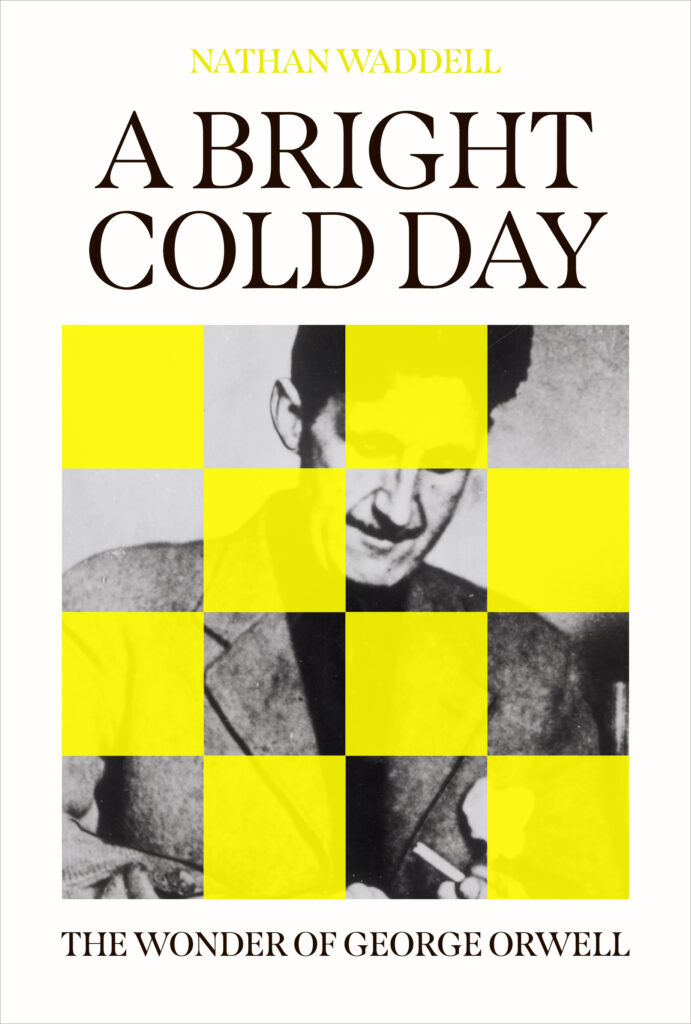
Welcome everybody to this book launch for Nathan Waddell’s excellent new book about George Orwell, called A Bright Cold Day.
Some people might find this title a bit mystifying, though I’m sure everyone in this room recognised it as a phrase from the first sentence of Orwell’s last and most famous novel, Nineteen Eighty-Four: ‘It was a bright cold day in April, and the clocks were striking thirteen.’ Opening sentences are important. We can all probably remember and quote some famous beginnings: Call me Ishmael. It is a truth universally acknowledged .… Stately, plump Buck Mulligan came from the stairhead. In the beginning God created the heavens and the earth. I haven’t asked Nathan why he chose this title for his book, but I think I know.
Orwell’s first sentence in Nineteen Eighty-Four puts together two ideas, in the form of images. The idea of a bright cold day in April couldn’t be more prosaic, familiar, and ordinary. Any novel could start in this way. But the idea of the clocks striking thirteen ends the sentence with a jolt. There’s something unusual, anomalous, even a bit scary, about a clock striking that number. There must be something wrong with a clock that strikes thirteen. It’s this meeting of the ordinary with the extraordinary, and the embedding of the extraordinary in the commonplace, that sets the tone for Nineteen Eighty-Four. It also sets the tone for Nathan’s book.
We all know Orwell is extraordinary—the famous author, inventor of amazing, memorable, sometimes horrifying stories, the writer who could express big ideas in sharp and plain language (‘All animals are equal, but some animals are more equal than others’), the citizen who stood and stands as an example of courage and integrity in bad times, shining out, as Shakespeare puts it, like a good deed in a naughty world. But these stories and sentences and ideas grow out of—that is, are rooted in—the most ordinary, prosaic, common texture of everyday experience. This book is about an important insight, that the original begins in the habitual. You can’t have the ideas without the everyday sights and sounds and smells that always surround them. You can’t have the clocks striking thirteen without the bright cold day.
We are lucky that Orwell recorded, and in his novels invented, such a wealth of daily experience, micro-behaviours. These treasures, disregarded by other readers as unconsidered trifles, have been lying around in all Orwell’s writing and waiting for Nathan to come along with his scholarly spade to dig them up.
So here is a literary study of the author that is about ‘the daily Orwell’, from the perspective of the domestic and everyday. Nathan writes: ‘His attention to the ordinary is his literary signature.’ Orwell didn’t allow the important things in life to obscure the seemingly unimportant ones. Here’s one example. In April 1946, the British Government announced that Britain was going to grant independence to India. This was a momentous event, arguably the most important event of Orwell’s lifetime: the beginning of the end of the British Empire, which he had argued for over many years. What was Orwell doing in April 1946? In his writing he doesn’t comment on this moment in world history. That month, he was writing an article for Tribune called ‘Some Thoughts on the Common Toad’. But he explains in that essay why paying attention to nature, including toads in your garden, is important too. ‘I think that by retaining one’s childhood love for such things as trees, fishes, butterflies and—to return to my first instance—toads, one makes a peaceful and decent future a little more probable….’ Surely there’s something humane, and something democratic, about Orwell’s respect for the domestic and everyday, and his enjoyment of these things.
What fascinates Nathan about Orwell, a fascination he passes on in this book, is that he paid so much attention to ‘the small nuggets and grains of everyday life’. This book is a sort of inventory, a catalogue of the granular contents of the great writer’s mind and memories. I should add, by the way, that books about Orwell are not always a bundle of laughs, but this is the certainly funniest of them yet.
The architecture of the book is that of a day. Its chapters follow Orwell’s work across the daily landmarks of getting up, washing, breakfast, and so on, through his daytime activities, to dinner, sleep, and dreams. As a kind of anatomy of a-day-in-the-life, it’s a modernist project like James Joyce’s Ulysses and Virginia Woolf’s Mrs Dalloway, both novels that take place on a single day. It takes its time to meander through all sorts of themes and reflections: the revelations of waking up; the morning rituals of cleansing; the politics of breakfast, especially marmalade; the question whether you’d rather have Rat Soup or Mock Rat Soup (perhaps a topic for The Moral Maze); the difference between work and labour; and why Orwell was willing to risk his health to have a good lunch.
It’s both a social history and a kind of biography. From this book you can piece together the events of Orwell’s life —the illnesses, the travels, the work, the friendships—so that a person who has never read any of the Orwell biographies could glean a good account of the story of his life from this unorthodox piece of life-writing. But instead of asking the question: What happened?, this book asks: What was it like? The style invites us into the process. In the chapter on Walking comes my favourite sentence: ‘After all, anyone who has a favourite brand of walking boot, as he did, probably knows a thing or two about putting one foot in front of another.’
What was Orwell like? We are familiar with the outward Orwell, a man with a moustache who wrote about politics. But we get an insight into him when we read his words: ‘Outside my work, the thing I care most about is gardening, especially vegetable gardening’. There’s another truth about him in the fact that he was obsessed with cataloguing things. Here’s what Nathan says about this. ‘Orwell wrote lists for many different reasons: to describe national character, to announce the threats of the machine age, to catalogue rules for writing, to tell his readers key details about a given character’s habits and dispositions. But he also wrote lists because at some level he appears to have found it difficult not to write lists.’ A profound insight, very deftly put. There are several good biographies of George Orwell, but I think this book will help you better than any of them to answer the question: What was Orwell like?
Finally, the subtitle—The Wonder of George Orwell. This is a challenge and a provocation. Surely the prosaic Orwell is the least wonderful of English authors? Didn’t the man who wanted his prose to be transparent as a window-pane try to exclude from it anything romantic or high-flown, anything that might be wondered at or about? There is nothing wonderful, surely, about A Clergyman’s Daughter, or about Homage to Catalonia. What was the Wonder of George Orwell? Well, you won’t know the answer until you’ve bought a copy of the book and read it.
Congratulations to Nathan on his wonderful book. To everyone else, enjoy the book. Happy reading!
*
A Bright Cold Day: The Wonder of George Orwell
by Nathan Waddell
*
Douglas Kerr is the author of Orwell and Empire (Oxford University Press)
Just read Nathan Waddell’s joyous foreword to a Bright Cold Day (the humour in the title on a cold bright day with no apostrophes) and know straight away that this is the Orwell book I want and need to read. I hope upon hope that it explains his moustache, his haircut and, by some miracle, the old importance of playing cards in the kitchen or front room (whist or crib?), putting the kettle on for strong tea not coffee and chatting away between hands and the shuffling!