
Reviews Spain 1938
George Orwell’s review of Searchlight on Spain by the Duchess of Atholl; The Civil War in Spain by Frank Jellinek; Spain’s Ordeal by Robert Sencourt
Time and Tide, 16 July 1938
Although no one who publishes books at seven and sixpence a time (with a profit of ninepence to the author) can regard such a venture without alarm, the Penguin Library have shown admirable judgment in their choice of “specials.” The Duchess of Atholl’s Searchlight on Spain probably contains less original matter than Germany Puts the Clock Back or Mussolini’s Roman Empire, but it is a worthy successor. As a short popular history of the Spanish war, simply written and well documented, it is not likely to be bettered until the war is over. Its chief virtue is that it is well-balanced and keeps the main facts in the right perspective.
Its chief fault is the fault of virtually all books on the Spanish war—political partisanship. As I have pointed out elsewhere, there is not even among Government supporters one simple and generally-accepted “version” of the Spanish war. The Loyalists include Socialists, Communists, Anarchists and “Trotskyists”—one might add Basques and Catalans—who have never been in quite perfect agreement as to what the war is about. Every English writer on the Government side adopts more or less unreservedly the “line” of one or other political party, and unfortunately he usually does so while claiming to be strictly impartial. The Duchess of Atholl follows the Communist “line” throughout, and this fact should be borne in mind in reading her book. So long as she is dealing with the origins of the rebellion, with the military side of the war and the scandal of non-intervention, all is well; but I would be a little cautious about accepting her account of the internal political situation, which is one-sided and very much oversimplified.
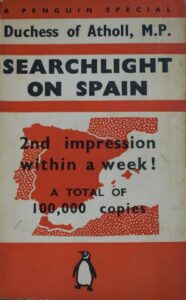
In her final chapter, “What it means to us,” she points out the probable consequence of a Fascist victory in Spain—that England may lose the command of the Mediterranean and France may be faced with another hostile frontier. This raises what is perhaps the most mysterious question of the whole Spanish war. Why has our Government behaved as it has done? Without any doubt the British Cabinet has behaved as though it wished Franco to win; and yet if Franco wins it may—to put it as its worst—mean the loss of India. The Duchess of Atholl states the facts but does not offer any explanation of Mr. Chamberlain’s attitude. Other writers have been less cautious. The real meaning of British foreign policy in the last two years will not become clear until the war in Spain is over; but in trying to divine it I believe it is much safer to assume that the British Cabinet are not fools and that they have no intention of giving anything away.
Mr. Jellinek’s book has approximately the same angle of approach as Searchlight on Spain, but it is much longer, weightier and less “popular.” It is at its best in describing the causes that led up to the war, and it is distinguished by some brilliant chapters on the Church, the land-system and the growth of the Spanish labour movement. It has the same qualities and defects as Mr. Jellinek’s earlier book on the Paris Commune—a wonderful grasp both of the interplay of political movements and of the motives of individuals, marred by clumsy writing. Mr. Jellinek is qualified to write a really authoritative book on the Spanish war; perhaps some day he will do so; but it will have to be a long time hence, when the guns are silent and several kinds of hatred are less bitter.
Mr. Sencourt is pro-Franco, but—as the advertisements in the Matrimonial Times say—not bigoted. Unlike some others who have thundered against the “Reds,” he has a deep affection for Spain and does not feel obliged to believe that every Spaniard east of no man’s land is a demon. He does, however, completely completely misunderstand the aims of most of the left-wing parties. He is much too ready to assume that a Communist is necessarily a revolutionary extremist and that Anarchism is the same thing as “anarchy”—which is simply a misuse of words. And once again those phantoms, the Russian volunteers, are produced as realities. Mr. Sencourt appears to accept M. de Kerillis’s estimate of “10,000 to 15,000 Russians, mostly regulars.” Now, it has never been denied that there were Russian airmen, technical experts and political agents in Spain; on the other hand, literally everyone who has set foot in Loyalist Spain would testify that there were no Russian infantry. Hundreds have already done so. Is it necessary to go on assuming that all these people are liars?

Leave a Reply