
2051, Aaronson’s Disquisition: II
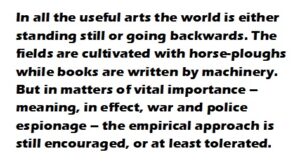
Partial Text
The Fall of Territoria
*
XXI. The Collapse
Little history has been salvaged to confirm the moment when the Western corporate oligarchs collapsed. It turned out that the greatest lessons the world had ever learned were not from the empires of the ancient world and the dynasties of previous centuries, or the totalitarian dictatorships, or the religious caliphates, but from the democracies and republics that utilized the excesses of all three of these monoliths to calibrate specific ways to marginalize their citizens in the name of freedom. High privilege, semi-divine authority, and the promise of supernatural deliverance all rallied around fortune as a means to an end, the end justifying the means, no matter how intolerably the subjects of each staggered through the various exercises of power.
The dreamt-of promise for democracy to deliver its subjects from empire began in earnest, proclaimed in civil eloquence but quickly silenced by the imperishable natures of lies, greed, and desire. Of the three, greed emerged as the ageless scion of human nature’s terrible triumvirate. And this king of human nature was relentless in crushing the conceit that the pure virtues but fragile natures of love, charity, forgiveness, and humility could prevail to put community before commerce.
By the end of the century, two Western democracies revealed themselves as the emerging and dominant oligarchies empowered by triumphalism. England and the United States (as well as other forgotten nations) manipulated commerce to increasingly impoverish the very citizens who had authorized the politically elected emissaries to enable the captains of industries to create various slave labor populations. These populations benefited economically only insofar as they could participate in a consumer loop to enrich the producers of material goods that really had very little to do with achieving an authentic quality of life. After its former empire collapsed, the United Kingdom shrank, but its subjects arguably fared better with its postmodern kings and queens and lords and ladies. However by the time they had joined the United States in destabilizing third-world and oil-producing countries, leading to mass refugee migrations, a desperate dreamed-for nationalism had poked its head above the ideological fray and punched its way into fascism. Titles and their hollow sympathies, and constitutions and gestures to goodwill became boardroom fables, easily dismissed by men who had ceased believing in fairy tales.
The hard capitalism of these oligarchs gave birth to political strategies that decimated economic norms and brought about crushing global austerity, exposing and laying waste to the profound myth and lure of opportunity. Information for its own sake triumphed over material production and perpetuated an emotional construct for the future at the expense of the past, hollowing out progress, disappearing hope for any other than the wealthy and powerful, who would soon prey on each other.
In a vindictive march to self-consumption, accelerated greed became the ultimate goal of capital—power its guarantor. War, deregulation, and resource exploitation were the permanent paths in accruing the financial means of power; peace, ecology, wage growth, and civil rights were obstacles to that path; and TV, mass social media, aggressive disinformation, and the myths of immigration and fear of the Other reinforced the emotional tenets needed to sustain a belief in the implied security of power.
The fall was precipitous. The United States was all but finished. Exhausted by wars; divided by endless civil strife; shaken by daily gun massacres in schools, malls, and sports gatherings; its dependence on martial law to keep order often invoked on the flimsiest authoritarian whim; its cities broken and in ruin through decades of infrastructure neglect; its labor and farm policies abandoned in favor of one-sided trade agreements; its stock market permanently unstable for all except billionaires and the two trillionaires who manipulated it for their own ends; its courts backlogged by corporate claims against the public good and burdened by international lawsuits challenging its climate behavior and human rights abuses abroad and in its own prisons—populations that equaled all of the world’s incarcerated; its debt so substantial that the dollar had become worthless to the first-world economic marketplace in which the United States was eventually prohibited from participating—these were among the causes that led to its ruination.

XXIII. The Public Good
The great experiments in service to the community, as mentioned, were suspended in litigation. Public education, public health, public media—all were abandoned and absorbed by the private sector or given over to foreign control. America’s energy policies were reversed, and its energy needs now tied into its own shrinking energy supplies—these supplies manipulated within the market, which was totally deregulated and became ripe for renegade corporate energy embezzlers. And the country’s Constitution was corrupted by congressmen and presidents who merely acted as subsidiaries of the corporate oligarchies that had them do their bidding in exchange for gaming the process by which they were elected in perpetuity—despite meaningless and endless cycles of campaigning, investigations, executive impeachments, and legislative censures, almost entirely to enrich media moguls banking on the entertainment and commercial value of sensationalizing the republic’s certain collapse. The public simply didn’t matter.
XXIV. Homeland
No progress had been made in medical research; permanent highway gridlock and an all but abandoned rail system made interstate commerce nearly impossible. Environmental safeguards against global climate change staggered through Congress and were irrelevant by world ecological standards. At one time the crucible of technological advance retreated into technological arrogance and technical debt, conspiring to devour its creators within a cyber basilisk of Cloud Wars.
Perhaps the breaking point was the environmental crisis of global warming, which caused a permanent refugee crises throughout the world. In the Concentration of Arid States (CAS), severe water crises in sub-Saharan Africa, the Middle East, and parts of South America culminated in civil and state Water Wars. The impact of climate and these constant wars within the CAS was devastating, with hundreds of millions of migrant refugees permanently seeking new settlements.
The sheer numbers obligated the rest of the world to act on their behalf, but the failure to do so was catastrophic. Those countries that for more than a century had exploited the world’s arid and undeveloped regions for cheap labor and resources destabilized third-world economies, preventing them from developing national agricultural and technological bulwarks against feared climate calamities and the subsequent Water Wars. Consequently, approaching the new century, the CAS grew in membership, estimating a mass migration of nearly a half billion people to cooler climes. National strikes forced first-world reparations in the form of residentialism—a demand by these permanent refugee hordes of immigrants for their right to have a home. Europe and the United States never recovered from the political fallout from this crisis, leading to competing policies of mass incarceration and malignant neglect of migrant innocents. A state of martial law became permanent and grew in proportion to a larger military response that led to the first of the Last Wars.
XXX. War
The long wars in the Middle East and in Northern and sub-Saharan Africa bankrupted America’s national treasure and exhausted the industrial, technological, and inventive substance of future generations for many decades to come. National defense now consisted of 73 percent of the aggregate budget—most of it hidden from the public in black operations—this tax burden placed squarely on the shoulders of the working class. While the Pentagon was beating its chest for being able to simultaneously fight four wars on two continents, inspiring the flag wavers and enriching the coffers of arms merchants worldwide, the idea of perpetual war had emerged to a general indifference for much of the public. The military was now the chief employer of the United States, both for the public and private sectors. The idea of a college education with any focus outside of the pan-national and corporate requirements of a war economy fostered an educational malignancy that America’s children could not avoid without considering a future of financial destitution. Consequently, war as a career was now in the DNA of youth, and the political polarities that once defined youthful protest largely disappeared under several decades of the kinds of nationalistic propaganda that emphasized heroic contemplations rather than individual ambitions.
Except for the rare small businesses that struggled to focus on traditional commerce, corporations owned the economy and the impetus for production. Almost every corporation was somehow tied into the arms industry and the war efforts, so thoroughly indoctrinated were the corporate strata of people to the economic principles of war. The more wars, the better for war profiteers. In the distant past, wars had been economic drivers, providing jobs and advancing science and research, which often led to peacetime utility and higher GDP growth. However, now that corporations were nearly tax exempt under several permanent martial provisions, there was no palpable financial return on the investment of most of the American people, not even for dead or wounded family members who had protected and sacrificed for the benefit of the industrialized military. Dead soldiers were private concerns for grieving families, as the war count of the dead was kept from the public by law. The wounded were largely ignored and given minimum medical attention, as the VA was privatized, and only the wounded of the most privileged families—those who had more children to sacrifice—received marginally better treatment. As there was no draft, volunteers were necessary for the whole industrial war complex to function. As there were few jobs, war was a permanent job fair.
The war corporations were multinationals, so their allegiances were not to borders, but to profit only. As the American manufacturing and industrial base ceased to exist because of the poor education and work ethic of Americans, and as better educated and more ambitious immigrants stopped even trying to get into a country that was as poor as most third-world countries, war munitions were manufactured all over the world by countries who were not at war, but could benefit by America’s obsession with war.
In closed policy meetings, some diplomats expressed dismay over how their nations contributed to America’s war obsessions, while many others took the existential view of America as a country on its last legs whose demise should be hastened for the good of the world. With America out of the picture, these diplomats believed it would be easier to negotiate peace agreements with smaller warring nations in exchange for a pan-global economic and technological outreach to help nations heal and rebuild. Some accused the United States of prolonging the war on terror long after most terrorists groups had exhausted their resources and fallen out of favor with all but the most renegade tribes. These tribes were concentrated in very small areas and were closed off to the kinds of resources that could keep them functioning for much longer.
The global effort to rebuild the war-torn Middle East, using Nationals as architects, engineers, and labor, demonstrated a new ethic of cooperation that had been modeled, ironically, on America’s Berlin Airlift during the Cold War, the Marshall Plan after the Second World War, and US efforts to create a future policy of normalizing the country’s relations with Cuba in the new century. American multinationals were now shut out from rebuilding the Middle East by a triad of nations—China, South Korea, and Germany—who engineered administrative contracts to former and fellow NATO countries, strengthening the economies of several European nations that suffered under now-illegal austerity programs. For example, public revolt and the assassinations of its authoritarian leaders led to the Syrian-Yemen-Libyan experiment, which encouraged self-determination, inspiring other tribal nations, who had once pursued terrorism, to reform themselves by allowing the free practice of any religion and the cultivation of education and self-determined economies. Israel’s future and fortune, once tethered to America’s global paranoia, tempered its myopic sovereignty, as more pragmatic leaders sought accords with its eternal enemies and cooperated as a matter of survival. With the prospect of the collapse of the entire Middle East, even Israel could not afford any form of hostile isolation from its neighbors.
With the United States no longer a worldwide military and economic threat, there was no fear of its imperial interference. Equal in corruption and economic exhaustion, even Russia capitulated to a new world order. With the assassination of its long-time president and the punishing decades-long sanctions for its regional wars and predatory military behavior that threatened the Scandinavian countries, the New Soviet Union (NSU) sought new alliances with the new first world to reform its historical belligerence, mostly in reaction to Western political and military obstinacy. Soviet citizens longed for the kind of stability dreamed about for centuries, partially realized for a brief time under post–Cold War decentralization many decades prior, before the rise of the hard capitalist oligarch class that swiftly poisoned all efforts toward democracy by seeking territory instead of peace.
An alliance of Scandinavian and Asian cyber hackers all but made the NSU and United Nations of China (UNC) militarily impotent—a situation that had first devastated the United States and issued in a new world digital order. Cyber storms reseeded digital clouds and neutralized information and currency to devastating effects.
Like most first-world countries, the sabotage of its energy and informational grids through mercenary and counter-mercenary efforts left America defenseless and helpless. And by the time of the Last Wars, it was easily defeated and occupied; its subjects enslaved, imprisoned, reeducated; and its malcontents, teachers, and scientists systematically executed. Subsequently, America and the entirety of Territoria (CNAS) was absorbed into one of the three superstates Oceania—to join the war-exhausted nations of Old Europe.
Eventually, NATO was dissolved because of massive corruption and intra-national economic and trade divisions, which led to pressuring the United Nations to scale back its mission in favor of the new Eurasian Nation League (ENL) that shaped policy around accelerated public education, health, the demand for residentialism, fair and equitable economic policies, shared solutions to climate change, and world peace efforts.
Thank you. Once again, Iliana.
Iliana: Thank you, Albert. No one vexed the Party like my mother, Julia. The Party had lost Julia. The botched leukotomy had made her docile but not obedient enough. Her pregnancy was difficult and Room 101 was no place to administer punishment for her thought crimes. Forced to hand me over to a miniluv orphanage where kennelsitter surrogates would care for me until I could be sent to Territoria for settlement, something in my mother snapped.
IngSoc’s Anti-Family policy never sat well with Julia, but she had become indifferent to the concept of family until my birth. Consequently, her attendance at minitru waned and eventually stopped. Her previous devotion to the novel writing machines was noted by Threepes, a minitru supervisor who fancied Julia and her capacity for assembling fictional plots and employing more realistic perversions that titillated Prole readers. Prolit was not the same without her. Reluctantly, Threepes had to report her missing to O’Brien, who calmly fumed at her disappearance.
Julia never returned to her flat, but fell in with a group of subterranean thought criminals, called Remnants. As autarks, Remnants assembled surreptitiously at abandoned trams where they planned acts of Party sabotage and collected artifacts to give some presence to the past. Names were never exchanged, but Julia did find out where I was going to be sent.
When Julia gained their trust, the Remnant elders shared portions of Aaronson’s Disquisition with her and some new recruits. An historical correlative to Goldstein’s The Theory and Practice of Oligarchical Collectivism, Aaronson’s writings were considered authentic and not written to trap and expose thought criminals.
In the dusty ruins of the abandoned Swindon tram, Julia read the disjointed parts of Aaronson’s Disquisition to those less able, written on soiled parchment and unused spools of newsprint. If I may, I’d like to read this final portion. Pilar insisted that caution cannot be given enough; therefore, Aaronson thought some points previously stated needed to be repeated to emphasize how people give in to power:
*
_______________________________
These excerpts are from Edward Morneau’s forthcoming novel, A Conspiracy of Ravens. The annotations serve to give a basic context to these excerpts. This experimental work explores four intersecting stories: “Honeyboy,” a Holocaust parable; “Remnants,” an extension of George Orwell’s Nineteen Eighty-Four; “The Holes,” the strange effects of a cosmic singularity; and “Territoria,” the collision and culmination of the these stories through the establishment of a new world and the discovery of an impactful cultural relic.
Leave a Reply