
Maurice Baring
*
Introduction. George Orwell casually mentions many people who in his day were well known at least to the educated; but who are today totally forgotten except by a few specialist literary historians. One such man was Maurice Baring. In his As I Please column in the 1st December 1945 Tribune Orwell writes that:
Maurice Baring, in his book on Russian literature, which was published in 1907, and must have been the means of introducing many people in this country to the great Russian novelists, remarks that English books are always popular in Russia. Among other things he mentions “The Diary of a Nobody” (which, by the way is reprinted by the Everyman Library, if you can run across a copy).
The Diary of a Nobody is George Grossmith’s 1892 classic novel about the adventures of the well-meaning but hapless Englishman Charles Pooter. It is still in print and Grossmith is worth an article in himself, which hopefully I may eventually write.
As will become clear, Baring had more connections with Russia than just literature, writing books on Russia, revolution and the Far East.
Family Background. Maurice Baring was born on 27 April 1874 at 37 Charles Street off Berkeley Square in Mayfair in Middlesex. He was the eighth child and fifth son of Edward Charles Baring; and Louisa Emily Charlotte Baring née Bulteel a granddaughter of the 5th Earl Grey. The birth was registered on 28 May 1874 when the baby was a month old.
Edward Charles Baring was called a merchant on his son’s birth certificate but was an international high financier. In 1885 he was created the 1st Baron Revelstoke. This honoured his financing of the Canadian Pacific Railroad completed that year. Revelstoke, a railway town in British Colombia in Canada is named after him. In 1890 his bank was temporarily insolvent and was bailed out by the Bank of England of which he was a director.
The Baring banking dynasty was founded by John Baring, a German who had moved to Exeter in 1717 to learn the trade of serge-making; and his English wife Elizabeth Baring née Vowler an Exeter wholesale grocer’s daughter. For many years the Rothschilds and the Barings dominated international high finance and were regarded as great powers in their own right. A full history of the Barings is beyond the scope of this article. Their notable members included a Sir Thomas Baring who helped brutally suppress the Hampshire Swing Riots (protests against the introduction of threshing machines) in 1830. One of Maurice Baring’s uncles, Evelyn Baring, the 1st Earl of Cromer, as British Consul General in Egypt 1883-1907 turned it into a British colony with a native puppet government. One of Lord Cromer’s sons Charles Evelyn Baring the 1st Baron Howick of Glendale suppressed the Mau Mau uprising in Kenya in the 1950’s.
The Baring dynasty included some strong minded women. One was Lady Louisa Caroline Baring née Stewart-Mackenzie the second wife of William Bingham Baring the 2nd Lord Ashburton. She was an art collector, literary hostess, philanthropist and temperance advocate. Her guests included Thomas and Jane Carlyle; John Ruskin; Edward Lear; Robert Browning; Charles Kingsley; and many other famous or once famous names.
Early Life. Maurice Baring studied at Eton, where he won the Prince Consort’s prize for French. After leaving Eton he visited Germany and learnt German. In 1893 he entered Trinity College, Cambridge, but left without taking a degree. His gift for languages led Baring to apply to join the British Diplomatic Service in 1894. He was repeatedly rejected because he was poor at maths but in 1899 he was admitted.
After briefly working at the Foreign Office in London Baring became an attaché at the British Embassy in Paris. In 1900 he was appointed Third Secretary at the British Embassy in Copenhagen. He learnt Danish, and befriended the Russian Minister in Copenhagen Count Alexander Phillipp Konstantin Ludwig Von Benckendorff, who described Baring’s gift for learning languages as comparable to that of a small child. In 1904 Baring was transferred to the British Embassy in Rome but that year he abandoned diplomacy for a literary life. He had already had published two plays The Black Prince (1902) and Gaston de Foix (1903); and a volume of poems The Black Prince and other poems (1903).
Baring visited St Petersburg and learnt Russian. Count Benckendorff was Russian ambassador to Britain from 1903 to his death in 1917, and Baring spent many happy summers at Beckendorff’s Russian family home. Baring reported for the Morning Post and the Times on events including the 1904-1905 Russian-Japanese War; the 1905-1906 First Russian Revolution; the 1910 Constantinople (Istanbul) cholera epidemic; and the 1912-1913 Balkan Wars. These experiences inspired his With the Russians in Manchuria (1905); Letters from the Near East (1913); and his autobiographical The Puppet Show of Memory (1922).
In 1909 Baring was received into the Roman Catholic Church. He became a close friend of G. K. (Gilbert Keith) Chesterton, and may have inspired the character Horne Fisher in Chesterton’s 1922 detective short story collection The Man Who Knew Too Much. Another of Baring’s Catholic friends was Hilaire Belloc who Baring warned not to discuss theology or the Catholic Church with outsiders.
Apart from Catholic writers Baring was friendly with groups such as the Cambridge Apostles a twelve member Cambridge University Discussion Group which had a reputation for homosexuality; and the Corrupt Coterie, a fashionable set of aristocratic and intellectual men and women known for high living and wild parties.
By 1914 Baring had published satiric poetry, translations from other languages including Thoughts on Art and Life by Leonardo da Vinci (1906), short story collections such as Orpheus in Mayfair (Mills and Boon 1909), and other literary work. Methuen published Baring’s Landmarks in Russian Literature, a short account of Russian literature in 1910, not 1907 as Orwell wrote.
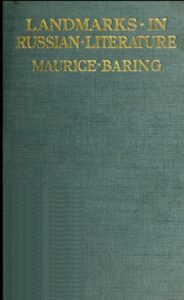
Landmarks in Russian Literature looked at Russian characteristics; the Realism of Russian Literature; Nikolai Vasilyevich Gogol and the Cheerfulness of Russian Literature; Count Leo Nikolaievich Tolstoy and Ivan Sergeievich Turgenev; the place of Turgenev; Fyodor Mikhailovich Dostoyevsky; and the plays of Anton Pavlovich Chekhov.
Methuen published Baring’s book The Russian People in 1911 while Thomas Nelson and Sons published Baring’s The Mainsprings of Russia in 1914.
The First World War. During the First World War Baring joined the Intelligence Corps and was attached to the Royal Flying Corps (the RFC) on the Western Front. He became a Staff Captain in 1916, a Major in 1917 and a wing commander in the newly created RAF in 1918. From January to April 1918 he was personal secretary to Hugh Montague Trenchard the head of the RAF on the Western Front. Maurice Baring was mentioned in dispatches and was awarded the OBE in 1918.
According to the by-then Lord Trenchard writing in The Times in 1945 after Baring’s death Baring was with Trenchard, and his predecessor as head of the RFC David Henderson, from the early days of the war to 1918. Lord Trenchard wrote that Baring:
Was a genius at knowing the young pilots and airmen. He knew more about what mattered in war and how to deal with human nature, how to stir up those who wanted stirring up, how to damp down those who were too excitable, how to encourage those who were new to it, and in telling me when I was unfair more than any other man I knew. He was a man I could always trust. He was my mentor and guide, and if I may say so almost my second sight in all the difficult tasks that came in future years.
During the war Williams and Norgate published Baring’s An Outline of Russian Literature in 1915. In 1919 Chatto and Windus published his travelogue Round the World in any Number of Days. In 1920 George Bell and Sons published Baring’s war memoir Royal Flying Corps Headquarters 1914-1918.
He lost many close friends during the war including Raymond Asquith the Prime Minister’s oldest son and a prominent figure in the coterie, who was killed on the Somme in 1916 aged thirty seven leaving a widow and three children; Patrick Houston Shaw Stewart; Auberon Herbert the 8th Baron Lucas a Liberal peer who had lost half a leg in the Boer War but joined the RFC in the First World War and was killed in action in 1916 aged forty; and the brothers Julian Henry Francis and Gerald William Grenfell. Count Benckendorff’s youngest son Peter Alexandrovich fought in the Russian Army in the First World War and died of wounds on 27 May 1915 aged thirty three. Count Beckendorff died of influenza on 11 January 1917 and was buried in the Catholic Westminster Cathedral. He had converted to Catholicism from Protestantism. His wife died in Ipswich in 1928 aged seventy. One of their grandchildren Jasper Maurice Alexander Ridley was killed in action in the British Army in the Italian campaign in 1943 aged thirty.
Later Years. In his later years Baring was mainly a novelist. His first novel was Passing By (Martin Secker, 1921). Others followed including C (Heinemann, 1924); Cat’s Cradle (Heinemann, 1925, illustrated by Baring’s niece Daphne Pollen née Baring). Daphne Adeane (Bernhard Tauchnitz, 1926), Tinker’s Leave (Heinemann, 1927); Comfortless Memory (Bernhard Tauchnitz, 1928), the Coat Without Seam (Bernhard Tauchnitz, 1929), Robert Peckham (Heinemann, 1930), Friday’s Business (Bernhard Tauchnitz, 1933), and Darby and Joan (Heineman, 1935).
In My End is my Beginning (Bernhard Tauchnitz, 1931) Baring told the story of Mary Queen of Scots from the point of view of her four aristocratic ladies in waiting; the Four Mary’s i.e. Mary Beaton, Mary Seton, Mary Fleming and Mary Livingston.
Baring’s life experiences inspired his novels. They excellently portray character and the milieu of late Victorian and early twentieth century high society. They were written in a pure and simple style yet display sensitivity and learning. He never married but his women friends included Dame Ethel Mary Smyth, the composer, suffragette and writer. Heinemann published her biography of Baring in 1938. Another was the novelist and playwright Lady Enid Algerine Jones née Bagnold. She lived in the village of Rottingdean near Brighton where Baring and many other prominent people also lived.
Final Years. Baring developed Parkinson’s disease which was then called Paralysis Agitans. A lot can now be done to manage though not cure it but in the 1930’s the only treatment, belladonna, helped a little in the early stages but had severe side effects. His last book Have You Anything to Declare (Heinemann, 1936) was an anthology of his favourite quotations in several languages with translations and comments.
The 1939 National Register lists Baring as living at Halfway House Rottingdean with Jean Rayner, a nurse. She was thirty five and divorced. She maintained his house and beautiful garden.
In August 1940 Baring left Rottingdean and moved to Beaufort Castle in Inverness-shire in Scotland where his relative Lady Laura Lovatt cared for him. His Rottingdean house was destroyed in a Nazi air raid. He died on 14 December 1945 aged seventy one of Parkinson’s disease, pneumonia and a heart attack.
Leave a Reply