
Seven Commandments and Seven Genres

*
Many years ago, at the special collections reading room at University College London, I held in my hands the manuscript of George Orwell’s Animal Farm. The pages were typed so much neater than anything I has seen of Orwell’s that I assumed they could only have been typed by his wife Eileen, who regrettably, would not live to see the book published. Not only could I feel the weight of tens of millions of copies sold around the world, I could also hear the long-dead voices of disapproval towards the damning lesson screaming out from Orwell’s pages. Above all, one felt the millions of school-hours spent (and continue to be spent) re-reading and deconstructing the thirty-thousand-word text, as I slowly leafed through the precious typescript sheet-by-sheet.
The story of the publication of Animal Farm reveals how close Orwell came to such an error of misjudgement that. according to its eventual publisher Fred Warburg, it could have changed the face of English literature in the second quarter of the twentieth-century. The book had been rejected by his publisher Victor Gollancz due to it being an attack on ‘many aspects of internal and external Soviet policy.’ Jonathan Cape was dissuaded from publishing it by the Ministry of Information, while T.S. Elliot at Faber and Faber rejected it, mainly because he misunderstood it. Eventually Orwell approached David Astor for a loan of £200 to enable him to publish it himself as a political pamphlet. Had Warburg not stepped in at that vital moment, he believed that Orwell ‘would not have had the morale or strength to have written Nineteen Eighty-Four.’
Publication of Animal Farm was thereafter delayed owing to a shortage of paper. Peter Davison revealed that the initial print-run in Britain for the rescheduled August release was 4,500 copies, followed by 10,000 copies in October and 6,000 in November. It was not published in America until August 26, 1946, by Harcourt and Brace – the first print run being 50,000 copies, followed by a ‘Book of the Month Club’ edition that had print runs of 430,000 and 110,000 copies. Davison states that Orwell received an advance of $37,500 for these ‘Book of the Month’ editions, and then proceeds to explain how little of that advance he was allowed to keep. Firstly, there was just over four dollars to the pound in 1946 and he had to pay US taxes of thirty percent, so could expect to receive around £6,500. Thereafter he would have had to pay UK tax at forty-five percent, plus supertax on top of that. Nevertheless, this was only the beginning, for the book has never been out of print since, and it made Orwell financially secure.
The Book’s title, and genre (or genres) throw up many interesting questions. On the surface, Animal Farm may seem very simple, in that it has a third person narrator who is detached and omniscient. Everything that happens is clearly described, including the characters’ thoughts. As readers we are provided with enough information to reach our own conclusions about events on the farm.
The information we are not given is how these events correspond with what we know or don’t know of events inside the Soviet Union during a critical period in its history.
Because of this, and various other elements to the book, there is a problem of classification with Animal Farm, in that its physical and literary elements allow it to fit into so many different genres of literature. These include fairy story, novella, fable, dystopian fiction, allegory and satire – political or otherwise. Some critics have cited the work as belonging to a genre popularised in the 17th century called ‘roman á clef’ – a French term typically ascribed to novels in which real-life events are overlaid with fiction. Additionally, it could also be read as a narrative with a lesson that is suitable for children. It is well-known that Orwell visited bookshops to surreptitiously move his book out of the children’s section, but where did he move it too? Knowing Orwell as we do, our best guess would indicate somewhere between Swift’s Gulliver Travels and Wells’ Island of Dr Moreau. Of course, as with anything involving Orwell, it is seldom that simple.
When Orwell first submitted the manuscript of Animal Farm to Warburg, he added the subtitle A Fairy Story, which was dropped in just about every other country in which it was published, including America. It is an interesting question why Orwell did this, as we know he held a certain fascination for fairy stories, and the idea of talking animals and the simple written style are elements that fit this genre. However, on another level this classification does not, strictly speaking, add up. Typically, in fairy stories the hero or heroine triumphs over extreme adversity, and yet the violence and tyranny that followed the rebellion in Animal Farm does not end peacefully as one might expect of this genre.
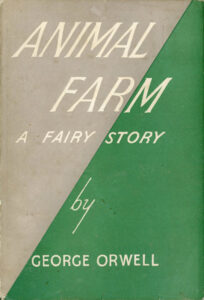
The first edition of Animal Farm
Animal Farm is often regarded as conforming to another literary genre referred to as a fable, which is a story that uses animals, objects or mythical creatures to communicate a moral lesson – much like a parable, but without any religious content. Orwell uses the behaviour of the animals to teach the reader lessons about equality, power, corruption and freedom. Put simply, the animals act as if they were humans. Fables are typically short stories, which places the book into another genre called a novella, a classification that sits somewhere between a short story and a novel – between 17,000 and 40,000 words to be more precise.
The fable/novella is also unquestionably an allegory. It is allegorical in the sense that the farm and the animals are an extended metaphorical representation of actual historical events. The physical act of revolution is represented by the cow, followed by the other animals breaking into the food store, and ends with Jones and his men being chased from the farmyard. Thereafter, through the dialogue and actions of the animals in the farmyard setting, Orwell provides an accurate critique of political activity inside the Soviet Union during the post-revolutionary era. Orwell’s allegorical representations of the pigs and dogs in relation to the other animals, illuminates the methods by which Stalin reinforced his absolute rule. His detachment from the original premises of Lenin is illustrated by the manner in which both Old Major and Napoleon address the other animals. The pronouncements of Old Major (Lenin or Marx) form the basis for discussion, whereas those of Napoleon (Stalin) are the basis for obedience.
Orwell’s allegory goes much further to illustrate through his animals how Stalin was able to evoke feelings of love among the population, regardless of the enormity of his crimes. He was admired for his peasant wisdom, even though they were on the receiving end of his brutal decrees. Orwell uses his pigs to great effect to illustrate many other aspects of the deception and terror inside Stalinist Russia, from the scapegoating of Snowball to Squealer’s deceptive propaganda. He somehow makes space for even the lesser-known details, such as the mass-arrests of agricultural wreckers sowing weeds into the collectivised farms!
Animal Farm also very clearly conforms to what we consider to be satire – or more accurately, political satire. Orwell satirises the political leaders of post-revolutionary Russia by exposing tyranny and ignorance through exaggerated animal behaviour and through irony and humour. The characters on the farm serve to illustrate the perversions of political power and the corruption that occurs in human societies. It also has a satirical appeal and meaning at various other levels. It can be a humorous tale that could be enjoyed by children, or it could be read as a bitter attack on social and moral abuses of power. Thirdly, it could be read as a demonstration of the inhumane ways in which people treat one-another; essentially an exposure of man’s ingratitude, complacency and stupidity.
Animal farm is clearly humorous, especially as a revelation of the lengths that demagogues will go to in their thirst for power. Of particular amusement is the gradual amendments to the seven commandments of ‘Animalism’, where the addition of a word or two completely negates the original concept. There are additional examples of wry humour right through the book; from the cat voting on both sides on the question of whether rats are friends or enemies (chapter I), to the case of whiskey arriving shorty after Boxer had been taken to the knacker’s yard (chapter IX).
In a roman á clef (which translates to ‘a novel with a key’) the novel’s characters and events are more subtle representations of real people and events. The ‘key’ is the level of understanding required by the reader, the clues of which, are embedded in the text. It is easy to understand why the novel might fit into this genre, as Orwell’s method of disguising his real-life characters as animals, affords him some protection from potential legal action or excessive criticism among certain political or social groups, something Animal Farm certainly had its share of. To my mind, there was nothing subtle about Orwell’s representations, as the rejections clearly show. In his letter to Orwell explaining his reasons for declining the book, T.S. Elliot implied that to criticise the Soviet Union in this way ‘goes against the current of the moment’.
Finally, that leaves us with our seventh genre, that being dystopian fiction. Orwell introduces a power struggle very early on to create an enemy (Snowball), with which, to deceive and manipulate the other animals, leading to the creation of a society run on totalitarian lines. Individual agency and freedom of expression are virtually outlawed, as every aspect of the animal’s lives is dictated by the pigs. Alleged traitors are framed and executed, as fear becomes the critical medium employed to prevent further rebellion. When the pigs walk on two legs and begin fraternising with the humans, is has become clear to every reader that the dream of Utopia has been transformed into a dystopian nightmare.
*
Ron Bateman is a former editor of the Orwell Society Journal.
Ron, thanks for an excellent tour de force.
Cheers
Quentin
Thanks Quentin
It was a bit rushed, hence the typos!
Fascinating essay Ron. Another genre to add to your impressive list is ECLOGUE, a story of agricultural or country life. This goes back to Virgil. We are accustomed (and taught) to read THROUGH the characters and events of Orwell’s story to find the political content beneath them. Quite right too. But ANIMAL FARM is also a story, a fantasy, about a farm, and about farm animals. There is a lot in it about the changes of the agricultural year, the economics and risks of land-owning, cash crops and technology, competition and co-operation between neighbouring farmers, and the habits of particular species in the farmyard. Wherever he lived, if he had the chance, Orwell kept animals and cultivated the earth. He knew about good and bad harvests, on a small scale, and recorded the weather conditions and the yield of his livestock. He observed how animals behave, and in his story he translated that behaviour into what we recognise as “character”. He knew a lot about country life, and for him it was strongly invested with value, including a patriotic love of country, as it was for Virgil. Readers who have known only city life may miss the strong rural texture of ANIMAL FARM; but it one of the poignant enjoyments of the book.
Douglas, I’m amazed that you found a genre to encapsulate that aspect of the book.
I did a quick re-read of AF and the thing that struck me as never before was the realisation that Orwell knew a lot more about farming and the farming Callander than your average man.
Your comment masterfully encompasses of all of those identifiable merits
Thank you