
Orwell and Dorothy L. Sayers: Part One
Orwell and Dorothy L. Sayers
Part One.
Introduction. The Orwell Collected Works contain several references to Dorothy Leigh Sayers. Here I will look at them and her early life in this part. She is still famous among classic crime fiction aficionados, but is less well known to even the well-educated general public. I will look at her later life in part two.
Orwell and Sayers. George Orwell first mentioned Dorothy L. Sayers in a 23 January 1936 New English Weekly review of her novel Gaudy Night, (Gollancz, 1935), the tenth featuring her fictional detective Lord Peter Wimsey; and the third featuring Harriet Vane a fictional detective story writer who in the novel agrees to marry Wimsey.
The dons of the all-women Shrewsbury College, Oxford, modelled on Somerville College, where Sayers studied, have invited Harriet Vane, an alumni, to attend their annual Gaudy Night dinner. The mood sours when poison pen messages, obscene graffiti and vandalism occur.
The Shrewsbury College Dean Letitia Martin asks Vane to investigate for the situation has worsened with an attempt to drive a vulnerable student to suicide. Harriet Vane persuades the reluctant Dean to ask Wimsey to help. He finds that the culprit was Annie Wilson a college servant. Annie Wilson’s husband, a University of York academic, had committed suicide after being exposed as an academic fraud by a Shrewsbury college don.
George Orwell wrote that:
I do not share the opinion expressed in the “Observer” that Gaudy Night puts Miss Sayers “definitely among the great writers” but there is no doubt that as far as literary ability goes she is out of the class of the other writers I am considering here. Yet even she if one looks closely, is not so far removed from “Peg’s Paper” as might appear at a casual glance. It is after all a very ancient trick to write a novel with a lord as a hero. Where Miss Sayers has shown more astuteness than most is that you can carry that kind of thing off a great deal better if you pretend to treat it as a joke. By being on the surface a little ironical about Lord Peter and his noble ancestors, she is enabled to lay on the snobbishness (“his lordship”) etc. much thicker than any overt snob would dare to do. Also her slickness in writing has blinded many readers to the fact that her stories, considered as detective stories, are very bad ones. They lack even the minimum of plausibility that even a detective story ought to have, and the crime is always committed in a way that is incredibly torturous and quite uninteresting. In Gaudy Night Harriet Vane has at last succumbed to Lord Peter’s advances. So it is time that Lord Peter, who is now forty five, settled down and gave up detection. But needless to say he won’t. He and his title are too profitable for that. A little bird in a yellow jacket has just whispered to me that next year there will be another corpse in the library and Lord Peter and Harriet (Viscountess Wimsey?) will be off on a fresh quest.
George Orwell next mentioned Sayers in his essay The Detective Story. It was written in French in 1944, and published in the 500 pages French literary journal Fontaine numbers 37-40 in Algiers in 1945. Its French title was Grandeur et Decadence du Roman Policier Anglais – the greatness and decline of the English detective story. In the Orwell Collected Works Volume XVI the original French and the English translation appear.
In this article Orwell compared the then contemporary crime writers, Sayers, Agatha Christie, and Freeman Wills Croft, unfavourably with the classic English crime writers Conan Doyle, Ernest Brammah (Smith) and R(ichard) Austin Freeman. George Orwell wrote that we can find in each of these works a quality of style, and even better an atmosphere, which we do not usually find in contemporary authors.
George Orwell admitted that mention must be made of Agatha Christie, who handles dialogue elegantly and shows artistry in laying false trails. He then wrote that: The much vaunted short stories of Dorothy Sayers would probably have attracted little attention if the author had not had the bright idea of making her detective the son of a Duke.
In his 28 August 1944 essay Raffles and Miss Blandish Orwell favourably compared Ernest William Hornung’s gentlemanly Edwardian Raffles novels, with James Hadley Chase’s sado-masochistic 1940 novel and play No Orchids for Miss Blandish. This Orwell essay was published in the October 1944 British journal Horizon, and the November 1944 American journal Politics. In it Orwell wrote: Some of the Peter Wimsey stories, for instance seem to point to definite necrophilia. Necrophilia is being sexually attracted to corpses. In a 5 September 1944 letter to Dwight Macdonald who edited Politics, Orwell suggested he alter the word necrophilia to morbid interest in corpses or whatever phrase would fit in.
Dorothy L. Sayers presented Lord Peter Wimsey as a First World War veteran, who has served in the trenches, and in military intelligence; risen to be a Major; but has suffered shell shock or in modern parlance post-traumatic stress disorder. As Orwell suggested elsewhere the First World War and its extreme violence probably explains the greater brutality of the post First World War crime novel.
George Orwell was worried about British libel laws and said he believed that American ones were less strict; and that: Bringing libel actions is quite a lucrative profession over here. Dwight Macdonald ignored this advice but Horizon’s editor followed it as did the publishers who published this essay in an anthology in Britain in 1945 and the USA in 1946. The Orwell Collected Works editor restored Orwell’s cuts in Volume XVI where this episode is discussed.
The last reference to Sayers in the Orwell Collected Works is in his August 1949 reading list. He had read most of her Mystery Omnibus. Evidently his criticisms of her did not stop him reading her works.
Early Life. Dorothy Leigh Sayers was born on 13 June 1893 in the Old Choir House, 1 Brewer Street, St Aldates, Oxford, the only child of the Anglican Reverend Henry Sayers, thirty nine, the Head of Christchurch College, Oxford, (Oxford Cathedral), Choir School; and Helen Mary Sayers née Leigh, thirty seven, a solicitor’s daughter. They had married in 1892. This birth was registered on 26 June 1893. The Leighs were an Isle of Wight landowning family. Dorothy L. Sayers’s Leigh relatives included several scholars and writers, notably her cousin Margaret Mary Leigh a governess, teacher, university lecturer, crofter, poet, novelist, and writer about Scottish crofting communities. She died in 1973 aged seventy eight.
In 1897 the Reverend Sayers, aged forty three, accepted a better paid living the parish of Bluntisham-cum-Earith in the Huntingdonshire fens. In 1917 the family moved to Christchurch in Cambridgeshire even deeper in fenland. Sayers’ 1934 Wimsey novel The Nine Tailors was set in the Fens. Bluntisham Rectory had no running water but the Sayers family dressed for dinner in the evening. Dorothy, a lonely only child, was largely home educated by her parents and governesses. She lived through books and stories, had a gift for languages and story-telling, and wrote sketches and plays which she performed in front of her parents. Her closest friend, her cousin Ivy Amy Shrimpton had been bought up on a Californian farm.
Dorothy L. Sayers was sixteen when her parents sent her to Godolphin School in Salisbury, a private girls’ school opened in 1784. It still exists and recently agreed to admit boys. She was unhappy there. A devout High Church Anglican she regarded many of the teachers as sanctimonious Low Church types. While there she nearly died of measles. These experiences inspired her never completed or published novel Cat O’Mary. In autumn 1912 she went up to the women’s Somerville College, Oxford, on a £50 pa Gilchrist scholarship plus parental support. The Gilchrist Trust an educational charity founded in 1841 still exists. She enjoyed college life, learnt scholarly methods and made lifelong friends. They included Muriel St Clare Byrne, an expert on Elizabethan theatre, who persuaded her to write the 1937 Wimsey play Busman’s Honeymoon, on which Sayers’s 1937 novel of that name was based.
At Oxford Sayers had unrequited crushes on Hugh Percy Allen the New College Organist, an orchestral conductor who was middle aged and married with two children; the Reverend Maurice Roy Ridley, who she saw reading his Newdigate Prize winning poem Oxford at the Encaenia Ceremony in July 1913; and a student, First World War veteran, teacher and travel writer Eric George Whelpton. Ridley and Whelpton were two of the models for Wimsey.
Dorothy L. Sayers obtained a first in Modern (i.e. Medieval) French in 1915. When Oxford University let women graduate in 1920 she was among the first to be awarded her degree that year.
Early Working Life. Sayers got her first job in 1916 teaching Modern Languages at Hull Girls High School, moving in 1917 when she found a job with Basil Blackwell, the Oxford publisher and bookseller. In 1919 she began teaching English at a school near Verneuil sur Avre in Normandy. She was an assistant to Eric Whelpton. In 1921 she returned to London and taught at Acton Girls School.
From 1922 to 1929 Sayers was a copywriter for a leading British advertising agency S. H. (Samuel Herbert) Benson, founded in 1893. Its clients included Guinness, Bovril and Colman’s Mustard. A version of it appeared in her 1933 Wimsey novel Murder Must Advertise. In her translation of Dante’s Inferno she compared advertising and PR to the flatterers in the Eighth Circle of Hell – the circle of Fraud. Here she introduced the Guinness toucan and wrote the verse: If he can say as you can/ Guinness is good for you/ how grand to be a Toucan/ Just think what Toucan do. She helped found the Colman’s Mustard Club and wrote the 1926 Colman issued book Recipes of the Mustard Club.
Early Literary Work. In 1916 Blackwell’s published a seventy one page volume of poetry by Sayers Op I. In 1918 it published her Catholic Tales and Christian Songs. Her first Wimsey novel Whose Body was published by Fisher Unwin in 1923. It got mixed reviews but sold well and her publishers wanted a sequel. Before it was published Wimsey featured in a short story The Fascinating Problem of Uncle Meleager’s Will in the July 1925 Pearson’s Magazine.
Fisher Unwin published Clouds of Witness the second Wimsey novel in 1926, while Ernest Benn published the third Unnatural Death in 1927, and the fourth The Unpleasantness at the Bellona Club in 1928.
In 1928 The Fascinating Problem of Uncle Meleager’s Will and other Wimsey short stories featured in a Gollancz anthology Lord Peter Views the Body; and Sayers edited and introduced a Gollancz crime story anthology by various authors Great Short Stories of Detection, Mystery and Horror. Payson and Clarke published its American edition The Omnibus of Crime in 1929.
In 1929 Ernest Benn published Sayers’s Tristan of Brittany a verse and prose translation of the eight surviving fragments consisting of 3,300 lines of The Romance of Tristan about the legend of Tristan and Iseult. The original author was the twelfth century poet Thomas of Britain but the original was written in medieval French, since in twelfth century England the ruling class spoke French and the peasantry English.
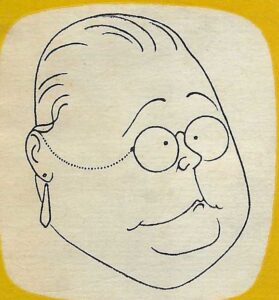
Caricature of Sayers by Nicolas Bentley
Personal Life. In 1921 Sayers began an affair with a writer and translator John Cournos (or Courtney) a Russian Jew, born Ivan Grigorievich Kershun. It went beyond friendship but was never fully consummated. She wanted to marry and have children but for religious reasons would not use contraception. i.e. have sex, with him if he used a condom. He wanted them to live together and see if they were compatible before they considered marriage. John Cournos broke off the affair in October 1922, moved to the USA, and married an American crime writer Helen Kestner Satterthwaite who used the pseudonyms Sybil Norton and John Hawk. This matter helped inspire Sayers’s 1930 Wimsey novel Strong Poison and Cournos’s novel The Devil is an English gentleman.
On 3 January 1924 Dorothy L. Sayers’s son John Anthony was born. His father was not named on the birth certificate. A mother may not know who fathered her child for various reasons, and there are reasons she may not want to name him on a publicly accessible document.
Dorothy L. Sayers had discussed abortion with a doctor friend Alice Bury Chance but in 1923 it was illegal and dangerous. Her employers let her spend the last two months of her pregnancy in seclusion, allegedly on sick leave, so she could keep it secret from her work colleagues and her elderly parents. Her father died in 1928 and her mother in 1929.
According to the Dictionary of National Biography the father of this baby was Bill White, whom she did not want to marry. Another source indicates he was a car salesman and motorbike enthusiast who was already married. Despite help from the Dorothy. L. Sayers Society I could not establish who a definite father of the child. I followed several false or inconclusive leads.
On 13 April 1926 Dorothy L. Sayers, thirty one, married a divorced journalist Major Oswald Arthur Atherton Fleming, a First World War veteran, forty three, at Holborn Registry Office. As he was divorced they could not marry in an Anglican church. He let his wife’s out of wedlock son take his surname but the boy was brought up by Dorothy L. Sayers’s cousin Ivy Shrimpton, who also professionally fostered other children.
Dorothy L. Sayers was at first introduced to John Anthony Fleming as his cousin and then as his adoptive mother. He only found out the truth after she died.
In Part Two I will look at Dorothy L. Sayers’s later life. Having made her fortune she turned to religious writing.
Leave a Reply