
Orwell and Dorothy L. Sayers: Part Two
*
Part Two
Introduction. Part one of this article was about George Orwell’s references to Dorothy L. Sayers; and her early life. I left her in 1929 an advertising copywriter; a detective novelist and creator of Lord Peter Wimsey; married to Captain Oswald Arthur Atherton Fleming, a journalist; and with a son John Anthony Fleming born out of wedlock, the product of a fling with a married man. This boy was cared for by Sayers’s cousin Ivy Shrimpton but Captain Fleming had let the boy take his surname.
The Detection Club. In 1930 Dorothy L. Sayers was one of the twenty nine detective novelist founding Detection Club members. It was set up as a dining club and to give members technical advice and assistance. She wrote its oath which members swear to follow. It is:
Do you promise that your detectives shall well and truly detect the crimes presented to them using those wits which it may please you to bestow upon them and not placing reliance on nor making use of Divine Revelation, Feminine Intuition, Mumbo Jumbo, Jiggery-Pokery, Coincidence or Act of God?…..and to observe a seemly moderation in the use of Gangs, Conspiracies, Death Rays, Ghosts, Hypnotism, Trap-Doors, Chinamen, Super-Criminals, and Lunatics, and utterly and forever to forswear Mysterious, Poisons unknown to Science.
This club’s first President Gilbert Keith (G. K.) Chesterton of Father Brown fame held that office from it being set up in 1930 to his death in 1936. Dorothy L. Sayers held it from 1950 to 1957. (Kenneth) Martin Edwards its current President was elected in 2015.
Dorothy L. Sayers’s next novel The Documents in the Case (Benn, 1930) was written with help from a fellow Detection Club member Dr Eustace Robert Barton a physician whose pen name was Robert Eustace. He provided the main plot device and scientific details, while she wrote the story mainly in the form of fictional letters between the main characters. Lord Peter Wimsey does not appear in it
Enter Harriet Vane. Later in 1930 Gollancz published Sayers’s fifth Wimsey novel Strong Poison. In it Harriet Deborah Vane, a detective novelist, modelled on Sayers, is accused of using arsenic to poison her former lover Philip Boyes. a more literary but less successful novelist modelled on Sayers’s former lover Philip Cournos. Harriet Vane has researched arsenic poisoning for her next novel.
Lord Peter Wimsey investigates, the real culprit is caught, Harriet Vane is saved from the gallows and sales of her books soar. After her release Vane finds a body on a beach and is suspected again but she and Wimsey find the real killer. Wimsey asks Vane to marry him but she refuses.
In 1931 Sayers left her advertising agency job. She and her husband were making enough money from their writing to live comfortably. That year Gollancz published Sayers’s sixth Wimsey novel Five Red Herrings, published in the USA as Suspicious Characters by Brewer, Warren and Putnam of New York. In it an artist is murdered in a Scottish artist colony. Six other artists are suspected but only one is guilty. During the early 1930’s Sayers reviewed most of her contemporary crime writers for the Sunday Times, including Agatha Christie and Margery Allingham.
In 1931 Sayers contributed a chapter to a novel The Floating Admiral (Hodder and Stoughton 1931) about the fictional murder of an Admiral. Its authors were her and thirteen other Detection Club members. In order of its chapters they were Canon Victor Whitechurch; George Douglas Howard Cole and his wife Margaret Isabel Cole nee Postgate who were prominent socialists; Henry Wade; Agatha Christie; John Rhode; Milward Kennedy; Sayers; Father Ronald Knox; Freeman Wills Croft; Edgar Jepson; Clemence Dane; and Anthony Berkeley. G. K. Chesterton wrote the prologue after the others completed their chapters and Sayers wrote an introduction.
By 1931 BBC Radio was a national institution. That year Sayers and some of her Detection Club colleagues co-operated on a BBC radio script The Scoop; and she edited a second collection of Great Short Stories of Detection, Mystery and Horror (see part one of this article.
More Wimsey. Harriet Vane featured in Sayers’s seventh Wimsey novel Have His Carcase (Gollancz, 1932). They solve the murder and he again asks her to marry him but she again refuses.
Montague Egg. Dorothy L. Sayers’s Hangman’s Holiday (Gollancz, 1933) was a collection of short stories. Two featured Wimsey. Five featured Montague Egg a young sales rep for an importer and distributor of fine wines and spirits. Through contact with other sales reps he has a smattering of knowledge of other trades which helps him solve murders he comes across. Two more stories in this collection featured neither Wimsey nor Egg.
The next Wimsey novel Murder Must Advertise (Gollancz, 1933) featured a murder in the overlapping worlds of advertising, 1920’s Bright Young Things (yuppies), and cocaine. Cocaine addiction goes in cycles.
In 1933 Barker published Ask a Policeman a collaborative novel by six Detection Club members – Anthony Berkeley, Milward Kennedy, Gladys Mitchell, John Rhode, Sayers and Helen Simpson. It described the murder of a fictional newspaper magnate and the investigation. Each writer brought in their own detectives Sayers bringing in Wimsey.
Wimsey Again. The Wimsey novel The Nine Tailors (Gollancz, 1934) featured a stolen emerald necklace, murder and other crimes. It is set in the Lincolnshire Fens and is centred on an ancient church and campanology (bell ringing). Lord Peter Wimsey solves the various crimes and the emeralds are recovered.
In 1934 Gollancz published the third series of Great Short Stories of Detection, Mystery and Horror. It was again edited by Sayers.
Gaudy Night (Gollancz, 1935) was reviewed by Orwell and other reviewers. His comments were discussed in part one of this article. That year Sayers’s Aristotle on Detective Fiction was published. It was based on a lecture she gave at Oxford alleging that detective fiction was classical in character.
In 1936 Selwyn and Blount published Six Against the Yard a Detection Club anthology. It featured stories by Margery Allingham, Anthony Berkeley, Freeman Wills Croft, Father Ronald Knox, Sayers and Russell Thorndike. Each described a fictional perfect murder which they thought unsolvable; and then Detective Superintendent George Cornish a retired Scotland Yard man described how the police would have solved it.
In 1936 Sayers’s article The Murder of Julia Wallace appeared in The Anatomy of Murder another Detection Club anthology. She and six other writers – Helen Simpson, John Rhode, Margaret Cole, E. R. Punshon, Frances Iles, and Freeman Wills Croft – described seven real murders. That year Sayers edited Tales of Detection part of J. M. Dent’s Everyman’s Library series; and her fictional Papers Relating to the Family of Wimsey was privately printed.
The Comedy Theatre in the West End of London opened in 1884. It is now the Harold Pinter theatre. In December 1936-1937 it staged A Busman’s Honeymoon, a play by Sayers and her university friend Muriel St Clare Byrne who lectured at the Royal Academy of Dramatic Art. In it Wimsey and his wife solve a murder on their honeymoon. It inspired Sayers’s last completed Wimsey novel Busman’s Honeymoon, A Love Story with Detective Interruptions (Harcourt Brace, 1937). In 1937 Sayers’s fictional account of Lord Mortimer Wimsey: The Hermit of the Wash was privately printed.
In 1939 Gollancz published Double Death: a Murder Story another Detection Club novel in which six writers – Sayers, Freeman Wills Croft, Valentine Williams, Fryniwyd (Winifred) Tennyson Jesse, Anthony Armstrong and David Hume – wrote about one fictional murder.
In 1939 Gollancz published Sayers’s short story collection In the Teeth of the Evidence and Other Mysteries. Two stories featured Wimsey, four Montague Egg and ten neither man. That year two of her Wimsey stories Strident Folly and The Haunted Policeman were published in Detection Medley a detective story anthology.
The Annual Canterbury Festival was founded in 1928 by the then Dean of Canterbury Canon George Kennedy Allen Bell. That year it staged John Masefield’s The Coming of Christ, the first play performed in an English cathedral since the Reformation. In 1937 it staged Sayers’s play The Zeal of thy House, about William of Sens, the architect who rebuilt Canterbury Cathedral Choir after it was destroyed by fire in 1174.
In June 1939 the Canterbury Festival staged Sayers’ play The Devil to Pay about the Faustus legend. Harcourt Williams played Dr Faustus, a German who sells his soul to the devil. In July 1939 it was presented at His Majesty’s Theatre in London and ran for four weeks.
The Second World War. From 24 November 1939 to 26 January 1940 the Spectator published Sayers’s The Wimsey Papers, the diaries of a fictional aristocratic family at war.
Love All, a Sayers comedy presented in April 1940 at the Torch Theatre in Knightsbridge in London featured a love triangle between a romance writer, his playwright wife and his mistress. In the end both women break off their relationships with the man. The play flopped. (The Torch Theatre opened as a Theatre Club in 1938 and closed in 1954).
On 27 December 1941 BBC Radio presented Sayers’s adaptation of The Golden Cockerel, a play by the Russian Alexander Pushkin. The Russians were then our allies and the Germans had discovered that Russia has a winter.
The Man Born to be King, a BBC Radio Drama about the life of Jesus, written by Sayers, was broadcast in twelve parts on the BBC Home Service (Radio Four) on Sunday evenings at monthly intervals between 21 December 1941 and 18 October 1942, a terrible time.
After The War. The Just Vengeance, a Sayers play was written for the 1946 Lichfield Cathedral Festival. A shot down airman’s spirit returns to his Lichfield home, he is shown what atonement means, converts to Christianity and enters heaven. Where Do We Go From Here?, a half hour Sayers’s play was broadcast on the BBC Light Programme (Radio Two) on 24 February 1948. It was the closing one in a six part series Mystery Playhouse. It concerns a fictional married couple who it emerges both murdered their previous spouses.
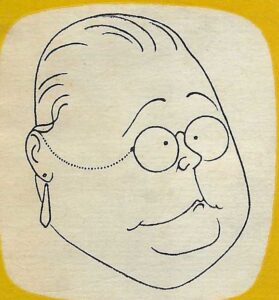
Caricature of Dorothy L Sayers by Nicolas Bentley
Non-Fiction. From 1938 to 1957 Sayers wrote much non-fiction mainly on religious and moral subjects. Various publishers published them mainly in essay collections. The last such collection was The Poetry of Search and the Poetry of Statement and other Posthumous Essays on Literature, Religion and Language (Gollancz, 1963).
Dante. In what she did not know would be her last years Sayers developed a passion for the medieval Florentine Italian poet Dante Alighieri. In 1946 J. H. Clarke of Witham, Essex, published Sayers’s translation of four pietra Canzoni i.e. Stone Songs by Dante. In 1949 Penguin published Sayer’s translation of Dante’s Cantica I, Hell, a journey down through the nine circles of Hell from limbo to treason, and in 1955 Penguin published her translation of Cantica II, Purgatory, a journey up through the seven circles of Purgatory. In 1957 it published her translation of the medieval French poem The Song of Roland.
Dorothy L. Sayers had translated two thirds of Cantica III, Heaven, when she died in 1957. Her god daughter, (Eva Mary) Barbara Reynolds, who died in 2015 aged one hundred, completed this translation, and Penguin published it in 1962. Predictably the translation of Dante’s journey through Hell sold the best. Sayers and Reynolds provided introductions to each of the cantos (chapters) in the three volumes. I and probably many other people read these introductions and then dived into the translations.
The End. Dorothy L Sayers’s husband, the journalist Captain Fleming died after a long illness, on 9 June 1950, aged sixty eight. Dorothy Leigh Fleming née Sayers died on 18 December 1957 of a heart attack, aged sixty four, at their home in Witham, Essex. She left £36,276 13s 7d, probate going to Lloyds Bank and her friend Muriel St Clare Byrne. She left all her money to her out-of-wedlock son John Anthony Fleming who discovered he was her actual son not adopted son. He died on 26 November 1984 aged sixty in the Saint Francis Hospital in Miami in Florida.
After Life. The New English Library published Dorothy L. Sayer’s last Wimsey story Talboys in 1972 in an anthology Striding Folly in which the stories Striding Folly and The Haunted Policeman (see above) also appeared. In Talboys, written in 1942, Lord Peter Wimsey, his wife and their three sons entertain a disagreeable house guest. Six year old Bredon Wimsey the oldest son is accused of theft but his parents clear him.
Sayers’s last Wimsey novel Thrones, Dominations, was unfinished when she died. The manuscript was held by the Wade Centre at Wheaton College, Illinois. Gillian Jill Paton Walsh completed it (Hodder and Stoughton, 1998). In it a husband murders his devoted wife because he wrongly thinks she is unfaithful. He tries to blame the murder on other people but Lord Peter Wimsey and his wife investigate and discover the truth.
Many of Sayers’s works have been televised some while she was still alive. There were BBC televised Wimsey series in 1972-1975 starring Ian Carmichael as Wimsey; and 1987 starring Edward Petherbridge as Wimsey.
Conclusion. Much has been published about Sayers since her death. Leslie Seth Smith, pen name James Brabazon, wrote a biography Dorothy L. Sayers: with a foreword by P. D. James (Charles Scribner’s Sons, New York, 1981). Barbara Reynolds’s edited the five volumes The Letters of Dorothy L. Sayers (Hodder and Stoughton 1995-2002). Much else has appeared including fictional continuations of the life of Lord Peter Wimsey.
I could write a lot more about Dorothy L. Sayers. Space, though, does not permit this.
Leave a Reply