
Coming Up For Ayres
Introduction. In his essay ‘Boys Weeklies’ published in his book Inside the Whale and Other Essays (Gollancz, 11 March 1940) Orwell said that women’s weeklies were superficially more realistic than boys’ weeklies. He wrote that:
These papers are at any rate aiming at credibility and they have a link with real life in their correspondence columns, where genuine problems are being discussed. Ruby M. Ayres’s column of advice in the “Oracle” for instance is extremely sensible and well written.
Ruby Mildred Ayres was as well known in her own day as Barbara Cartland, Catherine Cookson, Daphne du Maurier, and Jean Plaidy were in later years. Ruby Mildred Ayres is now only remembered by specialist literary historians; and by elderly people who read her novels when they were younger. Here I look at her life.
Family Background and Early Life. Ruby M. Ayres was born on 28 January 1881 at Gresham Villa, St John’s Road, Watford, in Hertfordshire. She was one of the six children of Charles Pryor Ayres, an architect, and Alice Whitford Ayres, née Griggs, a surgeon’s daughter. The birth was registered on 17 February 1881. Leaving a gap between a birth, and registering it was common practise because of very high infant mortality.
Charles Ayres had been a pupil of the celebrated architect Edward Welby Pugin, one of the pioneers of Victorian Gothic architecture, and ran a successful Watford architectural practise, designing several Watford public buildings. These included Watford Cottage Hospital, which opened in 1885. The building was later used for other purposes.
Ruby M. Ayres began writing as a schoolgirl and aged fifteen was allegedly expelled from school for writing what the Dictionary of National Biography called an advanced love story. Her class mates appreciated it and she entered a Boys’ Own Paper competition using one of her two brother’s names. She won the first prize of a guinea about £200 in our terms but her brother insisted on keeping the money!
Marriage and Literary Career. On 23 December 1909 aged twenty eight Ruby Mildred Ayres married Reginald William Pocock, an insurance broker, twenty nine, at St John’s Parish Church, a Victorian building in Watford. He was born on 21 August 1880 in Avenue Road in Acton, the son of Arthur Frederick Pocock, an insurance broker and auctioneer, and Fanny Alice Pocock née Wood.
Reginald and Ruby Pocock’s marriage was childless and she continued writing. Her first story The Professor and the Blue Stocking was accepted by a magazine which paid her £16 6s for it (about £3,000 in our terms). She was commissioned to write serial stories for the Daily Chronicle and the Daily Mirror. She also contributed to women’s magazines.
Cassel published her first novel, Castles in Spain, in 1912. It is bitter sweet, being the fictional journal of an elderly bachelor. In it love flowers too late. A British film version of it appeared in 1920.
Ayres began writing for Hodder and Stoughton in 1915, ultimately writing 135 novels for them. She first negotiated fees, then invented titles, and then wrote her novels, writing fifteen to twenty thousand words a day. Her second novel Richard Chatterton VC, published in 1915, a topical title, had an eight thousand first print run. In 1917 twenty five thousand more copies were printed, nineteen thousand in 1918, and thirty thousand in 1932. Her other novels also did well.
Ruby M. Ayres’s fictional world featured white middle class but sometimes impoverished households often with a cook and a maid. Country life is good but town life, especially in London, is often bad. Her plots focus on the misunderstandings that keep lovers apart and the improbable coincidences and crises that bring them together. Forgiveness, truthfulness and kindness to animals are approved of.
The heroes of Ruby M. Ayres’s novels are tough, confident, decisive, moral and well off and older than her heroines. They are sometimes a little rough in manner and occasionally curse and swear. She claimed to admire the ‘he man’ type. Of course, First World War officer veterans were likely to be the type of men she admired.
Ayres’ heroines rarely need to do paid work. They are sweet, meek, and loyal to an exploitative family; or spoilt, wilful self-seekers who need a strong male hand to unlock their better natures, and make them realise that the allegedly glamorous fast set life is not for them. Conversely, convenient deaths feature in her novels often in car or aircraft crashes. In the 1930’s road traffic road accidents killed more than eight thousand people a year. The death rate from such accidents has now fallen by more than two thirds due to improved safety measures, the decline of bicycling and medical advances. In her novels such deaths removed love rivals or others who threatened the hero and heroine’s bliss; or provided helpful legacies. Many novelists used this device including some allegedly serious ones (Charles Dickens, for instance, who must have worried his wife Catherine when he killed off Dora Copperfield, the eponymous David’s first wife, in his autobiographical novel).
While Ayres believed love and loyalty were more important than money, her happy endings leave their central figures comfortably off. She was good with money but did not have an agent except for her overseas interests. She disliked ballet and affected young men; and belonged to several clubs including the Lyceum, the Writers’ Club, and the Junior Carlton.
Ten of Ruby M. Ayres’s novels were turned into films between 1915 and 1930. Her play Silver Wedding was performed in 1932 at the Arts Theatre in the West End of London.
The End. Reginald William Pocock died on 21 September 1948 at 26 Wolverton Avenue in Kingston Hill in Surrey, aged sixty eight, of a heart attack. His widow informed the authorities of his death. He left £8,097 8s 4d, probate going to the General Accident Fire and Life Assurance Corporation Ltd.
Ruby Mildred Pocock née Ayres continued writing. Her last novel The Youngest Aunt appeared in 1954. She died on 14 November 1955, aged seventy four, at Lulworth House, Weybridge, Surrey, of pneumonia and a stroke. She left £29, 326 14s 1d. Probate went to the General Accident Fire and Life Assurance Corporation Ltd. Her body was cremated at Golders Green Crematorium on 18 November 1955.
*
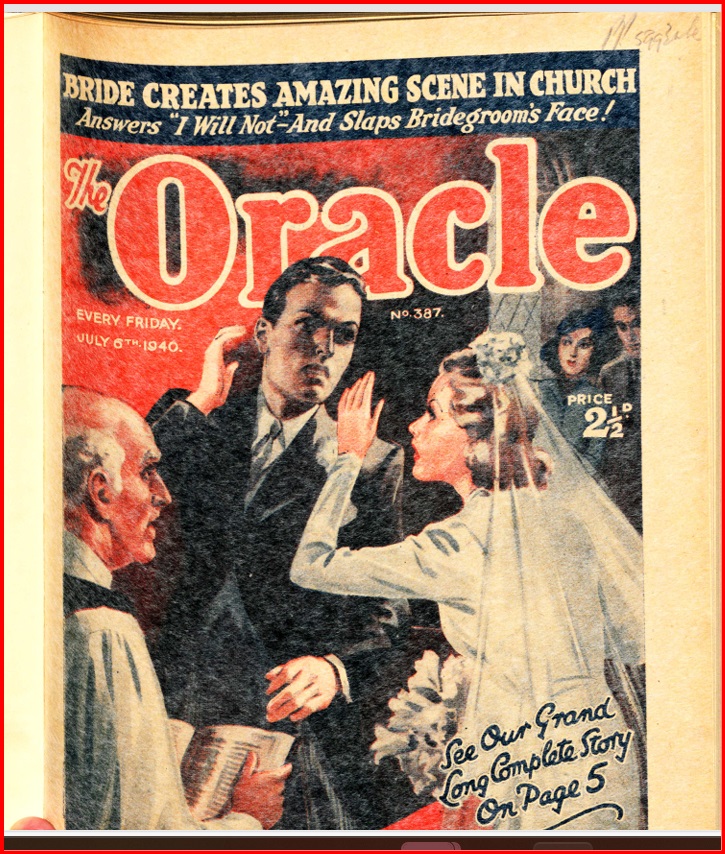
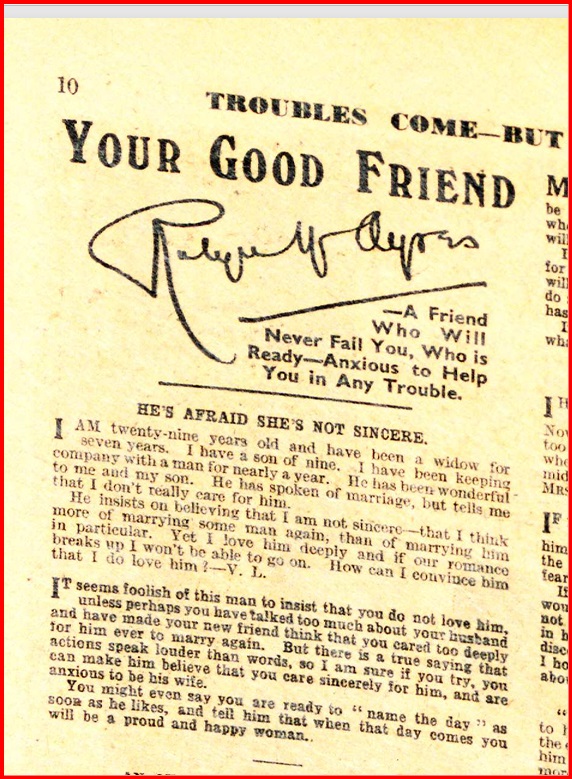
The Oracle was a woman’s weekly journal founded in 1933. To give examples of the problems of its correspondents and Ruby M. Ayres’s reply to them I quote from its 6 July 1940 issue. At this date France had fallen, the British Army had been evacuated from Dunkirk and the Battle of Britain had begun.
HE’S AFRAID SHE’S NOT SINCERE.
I am twenty nine years old and have been a widow for seven years. I have a son of nine. I have been keeping company with a man for nearly a year. He has been wonderful to me and my son. He has spoken of marriage but tells me that I don’t really care for him.
He insists on believing that I am not sincere – that I think more of marrying some man again, than of marrying him in particular. Yet I love him deeply and if our romance breaks up I won’t be able to go on. How can I convince him that I love him? – V. I.
It seems foolish of this man to insist that you do not love him – unless perhaps you have talked too much about your husband and have made your new friend think that you care too deeply for him ever to marry again. But there is a true saying that actions speak louder than words so I am sure if you try you can make him believe that you care sincerely for him, and are anxious to be his wife.
You might even say you are ready to “name the day” as soon as he likes, and tell him that when that day comes you will be a proud and happy woman.
AN ANSWER HER FATHER MAY SEE.
I have been going with a boy for over two years, Miss Ayres (sic). My mother and father object to him, although they have never even exchanged a word with him. They have heard gossip about his family. I have seen him about three evenings a week at his home.
I go to his home because he is not permitted to enter mine, and we do not care to meet at street corners or other public places.
My father hasn’t spoken to me for a long time, because he told me that I could either be on good terms with this boy or with him – and given that choice I chose my boy –VERA.
It seems hard on you that your parents should refuse to meet your friend for the reason, alone, that they have heard gossip about his family. But if you love this boy your best bet will be to endeavour to get your parents on your side.
You might fairly point out that anyone is liable to be gossiped about, but that your parents should not be too ready to condemn.
Your might also show this letter to your father and tell him that I for one fully understand his anxiety that the man of your choice should be one whom those who have your interests closely at heart can approve of.
I think you have made a mistake in concluding that your parents want to part you from this boy. They only want to be convinced that he is good enough for you.
NO INTERFERENCE – NO BLAME.
My sister has been married for five years and has two boys. Ever since her marriage her husband has been lazy and idle, more often out of a job than in one, through his own fault. For years his father has taken care of them, My own father has often helped but now he says he’s fed up with being sponged on and refuses to help any further,
Until now none of our family has interfered in my sister’s affairs, but we feel she has put up with enough, and that she should leave her husband to fend for himself. Her answer is that her in laws have been so good to her that for their sake she can’t do that. What do you think she should do? ANXIOUS SISTER.
My reply to your letter is that I never agree to families interfering in other people’s married lives, and that it will be much better if you leave your sister to decide for herself whether she will stay with her husband or leave him. You will not be thanked whatever you do so why do anything?
If it is anyone’s place to make a move in this matter, it is for her husband’s father and mother, but as they are apparently willing to continue giving help to a lazy man, I should let them do so as no doubt it is their fault, he has turned out as he has – perhaps they spoilt him when he was young.
If you take my advice you will not interfere at all, and then whatever happens you cannot be blamed.
Ruby M. Ayres was also an Agony Aunt for other women’s journals. These included Home Companion. George Orwell wrote in ‘Boy’s Weeklies’ that it was ‘worth comparing the social atmosphere of the boys’ weeklies with that of the women’s weeklies, the Oracle, the Family Star, Peg’s Paper, etc.’ And it is clear from his later war-time journalism that he continued to read them, as references and even social analysis continued to appear in his work.
*
Very interesting John, thanks.