
Making Hay: II
The Ghosts
Ian Hay
Part Two
Introduction. In part one I looked at Orwell’s references to John Hay Beith who used the penname Ian Hay; and at Ian Hay’s early life. I left Ian Hay forty, married but childless, and a junior officer on the Western Front. His book The First Hundred Thousand captured the early trials and tribulations of a New Army battalion. Here I look at his later life.
America. From 1916 to 1918 Ian Hay was in the USA with the British War Mission’s Information Section. He did a lecture tour which was widely reported in the American press. His book, Carrying On – After the First Hundred Thousand (Blackwood and Sons, London, 1917) continued the story of The First Hundred Thousand up to the Somme. Hay was promoted Major and awarded a CBE.
In 1918 Hay spent several months in France with the American Expeditionary Force. His book The Last Million was published that year. It looked at the war from the viewpoint of the American GI’s. Carrying On, and The Last Million did not sell as well as had The First Hundred Thousand.
Between the Wars. After the First World War ended on 11 November 1918 Hay returned to writing light hearted novels. They made a profit but did not sell as well as his pre-war books. He also became a playwright and had exceptionally good theatrical sense.
Hodder and Stoughton published Ian Hay’s novels The Willing Horse in 1921; The Lucky Number in 1924; and The Shallow End in 1924. They were issued at the then common price of seven shillings and sixpence (7s 6d) about £40 in our terms.
Houghton Mifflin published Ian Hay’s novel Paid in Full in Boston, Massachusetts, in 1925. I have found no reference to its publication in Britain. The Springfield Weekly Republican a Massachusetts paper of Thursday 4 June 1925 said that: Major Beith is a deft narrator, and readers will probably find “Paid in Full” a satisfying novel of the light but not frothy sort.
Hay’s next novel was Paid with Thanks (Hodder and Stoughton, 7s 6d, 1925). To quote the Friday 23 July 1925 Western Mail: If the story is not told with Ian Hay’s usual skill it is peopled by characters as delightful as are to be found in any of his previous books.
Hodder and Stoughton published Half a Sovereign in 1926. The reviewer in the Monday 23 August 1926 Western Morning News called it an improbable romance. Hodder and Stoughton published his The Poor Gentleman in 1928. The Saturday 11 February 1928 Hull Daily Mail called it a trifle far-fetched; but also wholly interesting and at times exciting. It is a thriller set against the background of the 1926 General Strike.
The Middle Watch (Hodder and Stoughton 1930,7s 6d) was a farce set in a Royal Navy Cruiser of the China Squadron. The Friday 10 October 1930 Sydney Morning Herald called it: A perfectly glorious story of the British Navy.
Their Name Liveth the Book of the Scottish National War Memorial (Bodley Head, 1931) marked a return to Ian Hay’s serious side. It looked at the Scottish National War Memorial in Edinburgh Castle that was dedicated in 1927, but 1933 saw Ian Hay return to comedy. Hodder and Stoughton published his The Midship-maid for 7s6d. In it an upper class girl wants to escape from her snobbish parents who disapprove of her suitor. She disguises herself as a midshipman on a battle ship. To quote the Friday 27 January 1933 Daily Telegraph it is: a rollicking farce.
The Great Wall of India (Hodder and Stoughton, 7s 6d, 1933) took what the Monday 3 April 1933 Guardian called: a light, pleasant and interesting sketch of what he saw when he briefly visited a soldier friend on what was then the Northwest Frontier of India. This is now the Pakistani-Afghanistan frontier. It supplemented Kipling’s earlier writings about this area.
David and Destiny (Hodder and Stoughton, 1934) is a novel of how a juvenile delinquent reforms and becomes a musician. Lucky Dog (Hodder and Stoughton, 1934) is a dog story told from the canine viewpoint. It sold for half a crown (2s 6). The Housemaster (Hodder and Stoughton, 1936) looked at how some public school boys are affected when some of their housemaster’s young female relatives visit him.
The Playwright. Ian Hay supplemented his income between the wars by play-writing. In 1919 his Tilly of Bloomsbury was performed at the Apollo Theatre in London. His The Safety Match (see part one of this article) opened in 1921. The Happy Ending was performed in 1922 at the St James Theatre in London and starred Robert Bilcliffe Loraine, a Boer War and First World War Royal Flying Corps veteran.
Ian Hay’s play Good Luck which opened in 1923 was produced in co-operation with Edward Seymour George Hicks an actor, theatre manager and author. It was so popular that the Drury Lane Theatre cancelled its 1923 pantomime to continue its run of Good Luck. It featured a swimming pool, a car accident, mutinous prisoners, a prison fire, a yacht wreck, a lifeboat rescue and a horse race.
The Sport of Kings opened at the Savoy in London in 1924. There followed A Damsel in Distress (New Theatre, London, 1928) and Baa Baa Black Sheep (New Theatre, London, 1929) about a raid on a London night club. Ian Hay wrote them in co-operation with P. G. Wodehouse. In this period the police were raiding many night clubs.
The Middle Watch was performed at the Shaftesbury Theatre* in London in 1929-1931. It was written in co-operation with Commander William Stephen Richard King-Hall, a retired naval officer, and was a naval farce linked to Ian Hay’s novel of that name. Film versions of this novel and play were produced in 1930, 1940 and 1958.
A Song of Sixpence opened in 1930 at Daly’s Theatre** near Leicester Square in the West End. In it some women go on strike against their men and demand a living wage. The men make a mess of housework and the women fail in business. Ian Hay wrote it in co-operation with Guy Reginald Bolton an Anglo-American playwright. It was loosely inspired by Aristophanes play Lysistrata, first performed in 411 BC at Athens during the Peloponnesian War. In reality some men are good at housework and many women do well at business.
In September 1930 Ian Hay and P. G. Wodehouse’s play Leave it to Psmith opened at the Golders Green Theatre. Ian Hay’s My Faint Heart starring Marie Lohr and Basil Foster opened at the Shaftesbury in 1931. Ian Hay’s novel version of it was published two years later. He was good at turning plays into novels and vice versa.
Ian Hay and Commander King-Hall’s play The Midship-maid opened at the Shaftesbury in 1931. Having satirised the Royal Navy Ian Hay’s 1932 play Orders are Order, written in co-operation with George Anthony Armstrong Willis, an Anglo-Canadian writer, satirised the British Army. In it a film actress persuades a Colonel to let his barracks be used as a film set. This involves some British soldiers dressing up as Zulu warriors.
A Present from Margate opened at the Shaftesbury in 1933. Ian Hay wrote it in co-operation with A.E.W. (Alfred Edward Woodley) Mason, a novelist and former Liberal MP for Coventry, most famous for his 1902 book The Four Feathers. The Thursday 14 December 1933 Telegraph called A Present from Margate: an amiable collaboration.
Admirals All, another naval farce, opened at the Shaftesbury in 1934. It was again written in co-operation with Commander King-Hall. The Frog opened at the Prince’s Theatre in 1936. It was a legal thriller featuring gangsters and a wrongfully convicted man. It was based on a novel by (Richard Horatio) Edgar Wallace. The 12 April 1936 Sunday Mirror said that it: comes perilously close to trash; and that the audience often laughed in the wrong places.
Hay’s The Housemaster opened at the Apollo in 1936. It was linked to his novel of that name. His The Gusher opened at the Streatham Hill Theatre in 1937. His last pre Second World War play Little Ladyship opened at the Lyric in March 1939.
Public Life. Ian Hay chaired the Society of Authors 1921-1924 and 1935-1939; was a member of the Council of the League of British Dramatists; President of the Dramatists Club from 1937; an officer of the Order of Saint John of Jerusalem; a Governor of Guy’s Hospital; and was involved with St Dunstan’s Hospital. He was charming, personable, even tempered; and a good after- dinner speaker.
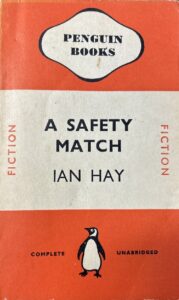
George Orwell was not impressed by a new edition of Ian Hay’s ‘A Safety Match’
The Second World War. Methuen published Ian Hay’s The King’s Service in 1938. It was an informal history of the British soldier and impressed the Secretary of State for War Leslie Hore-Belisha. He appointed Ian Hay Director of Public Relations at the War Office and had him promoted Major General. Hay held this post until 1941 when he retired shortly before his sixty fifth birthday.
Hay’s short story collection Stand at Ease was published in 1940. Hodder and Stoughton published his Little Ladyship, a girls school Story in 1941. His America Comes Across (Hodder and Stoughton, five shillings, 1942) was a collection of articles written during a lecture tour of the USA.
Hodder and Stoughton published The Unconquered Isle – The Story of Malta. G. C. in 1943. The Maltese behaved heroically during their long siege in the Second World War and the country was awarded a collective George Cross. Ian Hay, though, presented his story of How Malta Can Take It rather too cheerfully for a British people who had endured bombing themselves.
After the Second World War. Ian Hay’s The Post Office Went to War (HMSO 1946) was about how the Post Office, which then controlled post and telephones, had coped with massive challenges. Peaceful Invasion (Hodder and Stoughton, 1946) was about the American influx into Britain in the Second World War.
The Central Office of Information published ROF – The Story of the Royal Ordnance Factories 1939-1948 in 1949. It included many human interest stories. HMSO published his Arms and the Men in 1950. It dealt with the role of the army. The War Cabinet had commissioned it in 1945 but it took him two years to write it; and another two years for the War Office to clear it for accuracy and security.
Ian Hay’s last book published in his lifetime was The History of the King’s Bodyguard for Scotland ((Blackwood’s 1951). This was about the Royal Company of Archers, a prestigious Scottish body of which he was a long standing member.
Ian Hay’s Off the Record written in co-operation with Commander King-Hall another naval comedy premiered at the Apollo in 1947. Hattie Stowe was a serious play about the American abolitionist Harriet Beecher Stowe. It was shown at the Embassy Theatre in 1947 but flopped. 1947 was not a good time to look at slavery. Racial tensions in America were acute. The Second World War was over but the Cold War was coming.
The White Sheep of the Family Ian Hay’s last play was written in co-operation Lawrence Du Garde Peach. It was shown at the New Theatre in Oxford in 1951.
The End. John Beith Hay i.e. Ian Hay died on 22 September 1952 aged seventy six of Tuberculosis in, according to his death certificate, Petersfield in Sussex. His probate register entry gives the same date of death but a different address. He left £13,527 4s 2d probate going to his literary agent Alexander Peter Fordham Watt; a chartered accountant William Ernest Gillespie; and Cyril Wentworth Hogg a company director.
Aftermath. Ian Hay’s book A Hundred Years of Army Nursing (Cassell, 1953) was published posthumously. It looked at army nursing from the Crimean War to the Second World War. It showed the heroism nurses have displayed in Britain’s wars; and had a foreword by George V’s widow Queen Mary (Princess Mary of Teck), the Colonel in Chief of Queen Alexandra’s Royal Army Nursing Corps.
Hodder and Stoughton posthumously published Ian Hay’s last novel Cousin Christopher in 1953. In it a deceased man gets his revenge on a dozen or so useless relatives through an eccentric will.
John Hay Beith’s widow Helen died on 20 March 1978, aged ninety, of bronchial pneumonia at St Stephen’s Hospital in Chelsea. She left £11,402.
* The Shaftesbury Theatre opened in 1888. It was destroyed in 1941 in a Nazi air raid. The site was a car park for many years. In 1983 Soho Fire Station opened on the site. This theatre should not be confused with the present day Shaftesbury Theatre which opened in 1911 as the Prince’s Theatre and was renamed the Shaftesbury in 1963.
** Daly’s Theatre (see above) opened in 1893. It was named after the American impresario Augustin Daly; closed in 1937, and was sold to Warner Brothers who built a cinema on the site.
Leave a Reply