
Barnsley, March 2026
Bruce Dear, Orwell Society Education Officer, reports on a visit to Barnsley,
accompanied by OS Chair, Quentin Kopp
*
With apologies to Winston Smith, hope for the future lies not in the proles but in our children and young people. Only they can make a better world from this uncertain and challenging one that we are leaving them.
Orwell’s commitment to his son shows that he also recognised the importance of inspiring the next generation. In a small way, the Orwell Society tries to support that aspiration by sharing Orwell’s noblest ideas with young people as a guide and inspiration for the future.
The Society has been working with Amy Minney, Curriculum Leader for English at Trinity Academy St. Edward’s, Barnsley, to support teaching and research into Orwell, his ideas, and the Barnsley area. The Society granted a School and Teacher Award of £1,750 for this purpose. As part of our continuing work with Trinity, on Wednesday 11 March, Quentin Kopp, the Society’s Chair and I talked about Animal Farm to over 180 twelve-and thirteen-year-old pupils (plus staff).
The timing of our visit was apt because Orwell himself had visited Barnsley almost exactly ninety years before, in March 1936. He was researching The Road to Wigan Pier and stayed in Agnes Terrace, where Quentin recently joined the unveiling of a commemorative plaque on behalf of Barnsley Civic Trust (who shared the cost with The Orwell Society). Orwell much admired the tenacity and work-prowess of the local miners, some of whom saved him from death or serious injury after his mishap with Grimethorpe’s mechanised coal conveyor. Despite the efforts of hostile commentators to characterise Orwell as a snob, if we understand him fairly in the context of his time, he was clearly no such thing.
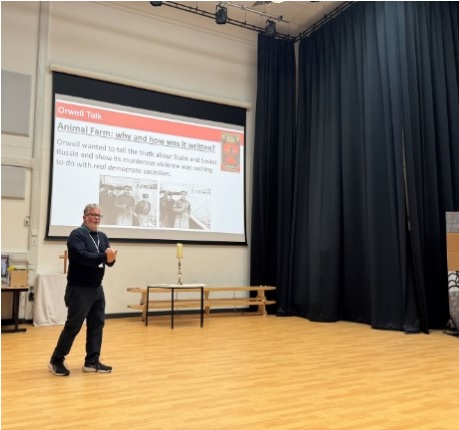
Indeed, his diaries reveal a poignant sympathy with the poverty-stricken victims of eviction in Mapplethorpe’s slum housing and a shared enjoyment with his hosts in the local “smoking concert” scene. Characteristically, Orwell, with his deep love of natural beauty, also took time to listen to the birds singing and to see the buds on the elms and the flowers among the hazels.
On Sunday 15th March 1936, Orwell saw Oswald Mosley speak at Barnsley public hall. He was dismayed to witness Mosley gradually winning the crowd round by speaking from a false “socialist angle”. The ominous echoes of our own day show why teaching Orwell and his gruff ‘social democratic scepticism’ remains such a vital task.
This was a key point that we stressed in our talk. Quentin drove it home with an excellent reading of the moment the pigs declare that they will keep all the milk and apples for themselves. Squealer justifies this act of pure selfishness with a clever pig-mash of plausible lies, fear mongering about Jones’s return and sheer brass snout. For Orwell, revolutions only work if people stand up to their leaders and throw them out at the first sign of them becoming corrupt.
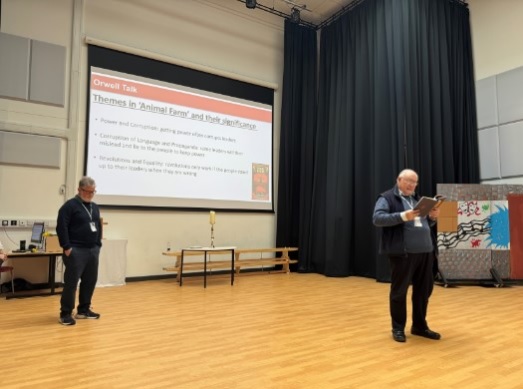
Building on this point, we emphasised the need to be sceptical of politicians without lapsing into lazy cynicism. Power will corrupt politicians if people allow them too much of it and don’t monitor and keep them in check. But democratically controlled politicians are not “all the same” and can be a force for good if kept honest by a watchful people. Animal Farm is a great fable of warning, not an inevitable prophecy.
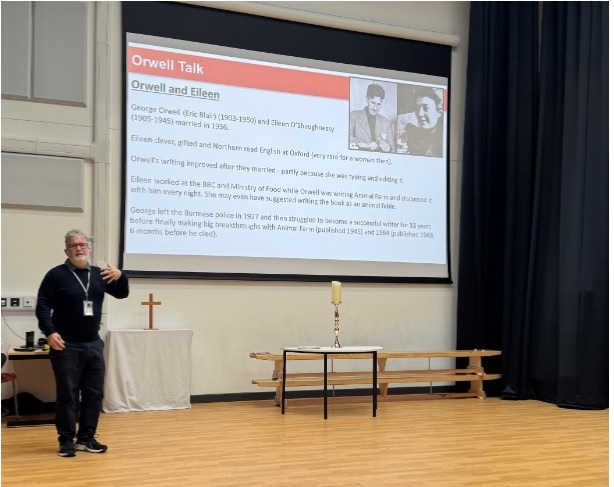
Following Richard Blair’s recent article in The Guardian, we emphasised Eileen’s role in writing Animal Farm. She probably suggested making this anti-Stalinist and anti-totalitarian satire into an animal fable. She also read and discussed the unfolding manuscript with Orwell daily. It is indeed hard not to hear Eileen’s voice in the book’s witty, elegant prose which sounds very similar to that of some of her best letters. Eileen’s influence on Animal Farm had especially deep resonance for everyone because our talk took place during International Women’s Week.
We ended by encouraging the pupils to be inspired by Orwell and always to speak truth to power and to insist that power speaks the truth to them. We left Trinity St. Edwards with the firm impression that these very impressive young pupils will follow Orwell’s example and speak up for a better, more truthful and more beautiful world.
*
Our thanks to Amy Minney for her photographs
*
Leave a Reply