
British Volunteers and the Spanish Civil War
A Review
*
A recent survey of attitudes by Gallup suggested that in western Europe, the willingness to fight for one’s country, should the call come, is fading, with this recent generation the lowest recorded.
This decline may or may not be cynicism with the political process. But in any case, until quite recently, the idea having to even consider the question was ludicrous. Going over the top for the concept of ‘Hard Working Families’, a phrase that modern politicians seem to enjoy, hardly stirs the blood. In an atomised society like ours, there is no common idea of who we are and what we care about. Fight? For what?
To compare the here and now with the nineteen-thirties years wouldn’t be sensible. To quote a British Battalion volunteer from Chris Hall’s book British Volunteers and the Spanish Civil War: ‘It was the last crusade. It could never happen in the world as it is today’. ‘It’ being the fact that ordinary people put themselves in danger, endured miserable conditions, risked injury or death. Not for their own country but for another. As quoted in the book’s introduction, the historian Emily Mason states:
‘The Spanish Civil War captured the public imagination in Britain, arguably more so than any other external conflict before or since. Fighting in Spain lasted three years, during which a popular campaign to aid the Spanish Republic was sustained by British citizens across the country.’
Why? The National Memorial to the International Brigades in London has the wording ‘They went because their open eyes could see no other way’. More prosaically, although ideology was the main drive, and fear of the rise of fascism, not all were Communists. Others had perhaps been escaping issues that they’d rather not confront, or had nothing else to do, bored or unsettled. That they went is no less admirable for that, I will add. Hall’s book looks at motive and the sometimes horrifying experiences of the people who made up the British Battalions.
There were up to forty thousand volunteers from across the world who fought in the International Brigades with two and a half thousand from Britain, Ireland and the Commonwealth. But there were also the ‘Spanish Aid’ activists back in Britain, raising money and awareness. These aren’t ignored. Along with nurses and the child refugees who came and were scattered across the country. We are also told the story of Picasso’s ‘Guernica’ and its fund raising British tour (and some of the odd places it was displayed).
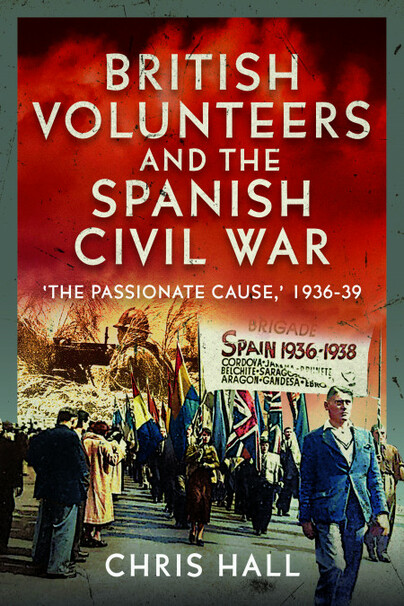
Hall’s approach is one which uses authentic testimony. With extensive quotes, people tell their own story. It is very effective, and the narrative moves along quickly. The voices we hear range from the unemployed to near aristocracy, eccentrics and First World War veterans, I found it a very accessible way of approaching a difficult and complicated subject. As the author says: ‘This account of British participation in the Spanish Civil War is ideal for those readers with little knowledge of the civil war who want an introduction to British involvement in the conflict. Equally, those people well read on the war will find some new material not published before.’
I am not qualified to say what of the material is new but I had never before given thought to the fact that there were British volunteers who fought for the Nationalists. Given the presence of Oswald Mosley and the British Union of Fascists at that time perhaps this is an obvious point. There were also Irish volunteers fighting for Franco for religious reasons (the ‘Blue Brigade‘).
But largely the book follows the timeline of the war, as it affected the British Battalion. Accounts of the journey show getting to Spain for the volunteers was a struggle in itself, crawling over the snow of the Pyrenees, smuggling themselves in to Catalonia from France in perilous conditions. And on through to truly awful battles, all of this pushed home by personal stories. Nurse Molly Murphy says ‘War is indeed hell and many of these and horrible scenes have haunted my nights for years.’ Nurse Penny Phelps, assisting a doctor with front-line surgery, would surely have agreed: ‘We began in the late afternoon, continued throughout the night and all the following day until, in the evening, a lull in the flow of wounded brought us to a temporary halt. Shrapnel and bullets were removed from body or skull, bleeding was staunched, lacerations were sutured, encased in plaster or amputated.’ Anecdotes of amputated limbs piled up in the village square certainly test one’s romantic image of this war.
Ebro, the largest battle ever on Spanish soil was also the last battle in which the Battalion took part. Juan Negrin, the Republican Prime Minister had announced in September 1938 that all foreign volunteers were to be repatriated, This was kept from the volunteers, however, as they were needed for one last action but most were either killed, missing or captured. After which, as Hall writes:
On 24 September, the remnants of the battalion recrossed to the other side of the river Ebro… On 5 October, in an emotional ceremony the British commander Sam Wild gave the battalion banner and Spanish flags to the Spanish part of the battalion who were returning to the front. On 17 October, all foreign International Brigadiers were reviewed by their commander André Marty. Several British volunteers received promotions. They were then driven to Ripoll in northern Catalonia which became their base until they left Spain.
We follow the story beyond this, however, on to the Second World War and how some developed their lives. The trade unionist Jack Jones for instance, and Bob Edwards, who fought with Orwell for the POUM and later became an MP (and Soviet spy, apparently). Hugh Oloff de Wet became an artist, engaged one of Winston Churchill’s daughters and was the subject of an episode of ‘This is Your Life’.
The book reads very well and its focus on individuals helps turn difficult stories and abstract concepts into human stories. The focus is inevitably Republican, but it is to Hall’s credit that he looks at Nationalist volunteers, as small as this numbers appear to have been. History leans generally to the Republic, thankfully, and so the book is uncontroversial. But I hope it adds and sits alongside the growing number of books on the Spanish Civil War and we have to hope that these men and women are never forgotten.
*
British Volunteers and the Spanish Civil War: “The Passionate Cause,” 1936-39 by Chris Hall (Pen and Sword Books, 2026, ISBN13: 9781036102371)
An excellent review of another excellent book by Chris Hall.
Nice work Jason!An interesting review that makes me want to read the book. When Negrin ordered all foreign volunteers were to be repatriated, he was presumably acting on Stalin’s orders (directly or indirectly)? To then allow these same volunteers to be sacrificed at Ebro seems like an appalling betrayal, of the kind Orwell wrote about in Homage and elsewhere.