
Re-examining?
Ann Kronbergs, education lead at the Orwell Society, reviews
Orwell Reconsidered by Stephen Ingle
*
*
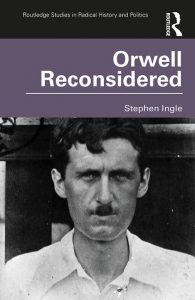
In January 2020, close to the 70th anniversary of Orwell’s death, came the publication of Orwell Reconsidered by Stephen Ingle. It followed swiftly on the heels of the two biographies of Nineteen Eighty-Four (one by Dorian Lynskey, the other by D.J. Taylor) published last year, coinciding with the publication of a new life of the writer by Richard Bradford, Orwell: A Man of Our Time. In this short study (only 121 pages) Ingle provides an overview for new students and general readers of the work of a man who, as he says, may be dead, but who won’t lie down.
Ingle, Emeritus Professor of Politics at the University of Stirling, has a background in the academic study of politics rather than of literature, and a lifelong interest in the work of George Orwell. Chapter by chapter his book offers a clear and uncluttered route through the main events of the writer’s life, both private and public, showing how this changing context was reflected in the writing. With clarity and succinct chronological coverage of each of Orwell’s novels and works of literary reportage, Ingle traces the emergence of the writer’s main concerns and how these eventually became the shaping force behind his two great political novels of the 1940s, Animal Farm and Nineteen Eighty-Four. Intentionally, Ingle avoids quoting authoritative sources by distilling points of critical argument which have shaped his own thinking over the course of his academic career, though key points in each chapter are footnoted throughout. A timeline is included at the back of the edition, and a list of recommended further reading for anyone who wants to deepen his or her interest.
The early chapters of Orwell Reconsidered retrace the well-trodden pathway of Eric Blair’s early life and writing ‘apprenticeship’ which leads to the making of George Orwell, the writer. Ingle tracks how these early years led to Eric Blair’s emergent commitment to a central cause “to make oppression and its consequences the leitmotif for his work”. The later chapters take the reader through the twists and turns of Orwell’s life and work, covering when and how experience helped to define his political perspectives. Ingle argues that Orwell’s eight week period during 1936 studying the lives and working conditions of miners in the North of England prior to writing The Road to Wigan Pier was “nothing short of life-changing: his journey to socialism and to literary prominence was routed through Wigan.” Later Ingle shows how Orwell’s participation in the Spanish Civil War fighting on the side of the POUM militia, “would shape [his] political consciousness for the rest of his life.”
Throughout Orwell Reconsidered Ingle highlights the many ways in which a significant network of literary men supported Orwell in the development of his writing career. Editor Richard Rees at The Adelphi who became a lifelong friend; the literary agent, Leonard Moore, who secured the first book deal with publisher Victor Gollancz; old Etonian Cyril Connolly who favourably reviewed Burmese Days and, as editor of Horizon in the 1940s, made Orwell a regular contributor to the magazine; David Astor at The Observer who became both a professional colleague and personal friend of the writer at the end of his life.
Ingle also gives some acknowledgement to the role of particular women in Orwell’s development as a writer: his Aunt Nellie Limouzin who supported him with food and money whilst he was in Paris, also introducing him to her social circle which included Henri Barbusse, the first editor to publish one of his articles. As more research on the life of Ellen Limouzin comes to light, there is scope for more emphasis on her influence on Eric Blair’s literary and political development from his schoolboy years onwards.
Similarly, with the publication of Eileen O’Shaughnessy Eileen: the Making of Orwell by Sylvia Topp, the significance of Orwell’s first wife will become clearer. Ingle mentions that “Eileen was an able and perceptive critic, one of the most intelligent women Orwell knew and just as widely read as he. We can’t know the extent of Eileen’s influence…” Later he notes that in writing Animal Farm Orwell read pages aloud to her and took her advice in shaping the story. Sylvia Topp’s biography will help to re-define the central importance of Eileen in the development of Orwell’s penultimate political novel and other writings.
In the first part of Chapter Seven, The Heart of the Matter, Ingle pulls together his reconsiderations of Orwell the political thinker, moralist and writer. Whilst admitting this is something of an artificial exercise, Ingle uses many salient examples from Orwell’s writing to interrogate and re-evaluate his position in the context of his time. First, he asks, was Orwell a political theorist or thinker?
Ingle re-evaluates the assertion in ‘Why I Write’ that after 1936 everything Orwell wrote was in defence of democratic Socialism and in opposition to totalitarianism. Ingle shows how little Orwell wrote about programmes for democratic Socialism in Britain, and that he was more critical of Stalin and the USSR than ever he was of Hitler and the Third Reich. He concludes: “…a large hole lies at the heart of Orwell’s thinking and writing: there is no workable definition of democratic Socialism as an ideology.”
In a re-examination of Orwell’s political affiliations, Ingle attempts to answer the question “…with whom might he have felt at home, ideologically speaking?” He revisits a list of potential candidates for this role, reminding us of the ways in which Orwell dismissed the ethical socialists such as William Morris, that ‘empty windbag’ or Edward Carpenter, that ‘pious sodomite’. Nor, it seems, did he find a comfortable place for himself among Labour parliamentarians, despite the fact that his boss at Tribune was Aneurin Bevan, a miner’s son. Ingle sums up the problem: “Parliamentary socialism didn’t cut it for Orwell: the party comprised too many trade union lackeys and ‘backstairs crawlers’.” In Wigan Pier Orwell hardly mentions the Labour Party in his analysis of socialists and socialism. Similarly with scientific socialism. To sum up:
“In short, Orwell was not a regular socialist at all; there was no major branch of organised socialism to which he did not show rancour.”
Rejecting those ‘smelly little orthodoxies’ of the Left, Orwell as a moralist promoted the phrase ‘common decency’ at the heart of his work. Ingle shows the connection between Orwell’s moral position and Christian values, and argues that this offers the key to how we should understand his thought:
“Orwell has far more to say about democratic socialism as a moralist than as a political thinker. Democratic socialism, he concludes, means justice and liberty ‘when the nonsense is stripped off’ (Wigan Pier pp193-4)”.
He concludes that, ultimately, what Orwell meant by ‘democratic socialism’ was in effect just that common decency of which Winston Smith is the last surviving champion in 1984.
Concerning Orwell the writer, Ingle discusses a number of examples which show how “[his] vibrant, robust style offers no guarantee of impartiality, accuracy special knowledge – or “truth”. In fact, he shows time and again the way in which Orwell drives his arguments through, often by using factual inaccuracies and wild assertions. He points out that Homage to Catalonia, a fierce polemic, has shaped the historical narrative about the Spanish Civil War although Orwell himself admitted that he had shown undoubted bias in favour of the POUM side in the conflict.
Ingle dodges the bullet concerning the question of Orwell’s prejudices regarding homosexuality, gender roles and anti-semitism. “I haven’t explored these criticisms in detail because they are not topics he deals with in depth…”, aware though he is of the importance to contemporary Orwell studies of these antipathetic strands in the writings. Nevertheless, he evaluates with great clarity the importance of “Orwell’s prose like a window pane”, arguing that despite his flaws the writer should be seriously considered as ‘the greatest prose writer since Swift’, a claim made originally by the critic George Woodcock.
Finally, Ingle offers a detailed assessment of Orwell’s legacy in terms of the way he has contributed to modern political discourse, how the notion of ‘common decency’ embedded in his writings has relevance in our troubled times. He argues powerfully that ‘common decency’ already exists in the fabric of our nation, in institutions such as the NHS, and encapsulates the values of ‘Britishness’ that politicians have found so hard to define. It could be further brought to bear, he suggests, through ‘institutional capture’ and wider popular involvement, citing Greta Thunberg among others.
Ingle ends with an arresting thought:
“Were he alive today Orwell would stride the blogosphere like Ezekiel, listing the sins of the people and foretelling their doom; no dealer in pomposity, pretention banality or untruth would have been safe. …for all his many faults, how we could do with him now!”
Routledge will shortly be publishing a second revised and updated edition of Orwell Reconsidered under the series Studies in Radical History and Politics edited by Thomas Linehan and John Roberts. We sincerely hope the book will have a long shelf life.
*
(Taylor and Francis CRC Books, 2019, ISBN: 9780367344795)
Uploaded 8 February 2020
Revised 26 April 2020
Leave a Reply