
Food for Thought at Xmas
Today (15 December) is the 75th anniversary of the publication of Orwell’s pleasure-packed Evening Standard column defending English cooking.
It is one of five, wonderfully entertaining – and overly neglected – pieces he contributed to the right-wing Evening Standard on such everyday topics as ‘nice cups of tea’, junk shops and his ideal pub. The clarity of the expression and the attention to detail in all of these features are particularly striking. They are perfect examples of Orwell’s ‘plain’ style of writing, incorporating, as George Woodcock stresses in his celebrated study, The Crystal Spirit, ‘its firmness, its colloquial vigour, its unpretentious vividness and, above all, its limpid clarity’ (1984 [1966]: 229-230). V. S. Pritchett sees Orwell essentially as a pamphleteer in the tradition of Cobbett and Defoe, writing in ‘lucid, conversational’ prose (Bowker 2003: 275). And for Meyers, Orwell’s plain style ‘appeals to readers’ common sense and persuades them of his honesty and good faith. At the same time his arguments are sophisticated, provocative and entertaining’ (2000: 266).
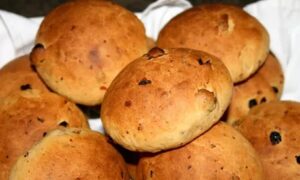 Saffron Buns, made by Sophie Mackenzie of The Guardian, hailed by George Orwell
Orwell begins by saying it is simply not true that English cooking is the worst in the world. Rather, ‘there is a whole host of delicacies which it is quite impossible to obtain outside the English-speaking countries’ (CWGO XVIII: 446). And he proceeds, in impressive detail to list these delicacies, displaying an impressive knowledge of the matters of the cuisine: ‘First of all kippers, Yorkshire pudding, Devonshire cream, muffins and crumpets. Then the list of puddings that would be interminable if I gave it in full: I will pick out for special mention Christmas pudding, treacle tart and apple dumplings. Then an almost equally long list of cakes: for instance, dark plum cake (such as you used to get at Buszard’s before the war), shortbread and saffron buns. Also innumerable kinds of biscuit which exist, of course, elsewhere, but are generally admitted to be better and crisper in England.’
Next mentioned are special ways of cooking potatoes – and the various sauces peculiar to England, English cheeses such as Stilton and Wensleydale and apples such as the Cox’s Orange Pippin. But he admits there is a snag from the foreign visitor’s point of view: good English cooking is to be found in private houses and not in restaurants. Pubs, at the time, sold no food other than crisps and ‘tasteless sandwiches’. So the solution – restaurant meals must improve.
Celebrating the Xmas Pud
Just before Christmas in the following year, Orwell devotes another inventive, witty and joyous ‘As I Please’ column in Tribune to considering the four necessary ingredients for a successful Christmas: a roast turkey, Christmas pudding, a dish of mince pies and finally a tin of –‘s Liver Salt (CWGO XVIII: 517). But in this piece, given the progressive views of his expected readership, he does not ignore the plight of the poor and hungry in Europe, India and China. ‘In India there are, and always have been, about 100 million people who only get one square meal a day. In China, conditions are no doubt much the same. In Germany, Austria, Greece and elsewhere, scores of millions of people are existing on a diet which keeps breath in the body but leaves no strength for work…’ (ibid).
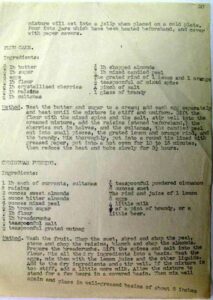
Before this sobering point, Orwell has had a great deal of fun celebrating the joys of the Xmas feast. He writes: ‘The whole point of Christmas is that it is a debauch – as it was probably long before the birth of Christ was arbitrarily fixed at that date. Children know this well. From their point of view Christmas is not a day of temperate enjoyment, but of fierce pleasures which they are quite willing to pay for with a certain amount of pain’ (ibid: 518).
He moves on to consider the literature about eating. And he concludes: ‘In all the writers who have enjoyed describing food, from Rabelais to Dickens and from Petronius to Mrs Beeton, I cannot remember a single passage which puts dietic considerations first. Always food is an end in itself.’
References
Bowker, Gordon (2003) George Orwell, London: Little, Brown
Davison, Peter (1998) CWGO The Collected Works of George Orwell, 20 Vols, London: Secker & Warburg
Meyers, Jeffrey (2000) Orwell: Wintry Conscience of a Generation, New York: W.W. Norton & Company
Woodcock, George (1984 [1966]) The Crystal Spirit: A Study of George Orwell, London: Fourth Estate
- Richard Lance Keeble was chair of The Orwell Society, 2013-2020.
Leave a Reply