
Food For Thought: II
Spain – and the Politics of Food
Part Two Of Four
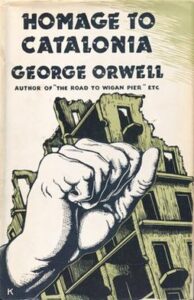
Late in December 1936, Orwell joins a Republican militia fighting Franco’s fascist forces in the Spanish civil war. In his account of the conflict and his time on the frontline, Homage to Catalonia, food features prominently. For instance, he comments: ‘In trench warfare five things are important – firewood, food, tobacco, candles and the enemy. In winter on the Zaragoza front they were important in that order, with the enemy a bad last’ (1980 [1938]: 245). He adds: ‘The food was good enough and there was plenty of wine. Cigarettes were still being issued at the rate of a packet a day, matches were issued every other day, and there was even an issue of candles’ (ibid: 250).
When Orwell arrives in Barcelona he is profoundly inspired by the revolutionary situation he sees all around him – which he considers ‘worth fighting for’. ‘Every shop and café had an inscription saying it had been collectivized … Waiters and shop-walkers looked you in the face and treated you as an equal. … Tipping was forbidden by law’ (ibid: 236). But when he returns to the city after two and a half months at the front, he notices deep changes: ‘… the people – the civil population – had lost much of their interest in the war’ and ‘the normal division of society into rich and poor, upper class and lower class, was reasserting itself’ (ibid: 293). The changes in cafés and restaurants are particularly noticeable. ‘Now things were returning to normal. The smart restaurants and hotels were full of rich people wolfing expensive meals while for the working class population food-prices had jumped enormously without any corresponding rise in wages. … The restaurants and hotels seemed to have little difficulty in getting whatever they wanted but in the working class quarters the queues for bread, olive oil, and other necessities were hundreds of yards long. Previously in Barcelona I had been struck by the absence of beggars; now there were quantities of them. Outside the delicatessen shops at the top of the Ramblas gangs of barefooted children were always waiting to swarm around anyone who came out and clamour for scraps of food’ (ibid: 294).
In a world where affluence exists side-by-side with appalling poverty, Orwell astutely avoids adopting a superior tone. ‘A day or two after the street fighting I remember passing through one of the fashionable streets and coming upon a confectioner’s shop with a window full of pastries and bon-bons of the most elegant kinds, at staggering prices … And I remember feeling a vague horror and amazement that money could still be wasted upon such things in a hungry war-stricken country. But God forbid that I should pretend to any personal superiority. After several months of discomfort I had a ravenous desire for decent food and wine, cocktails, American cigarettes, and so forth and I admit to having wallowed in every luxury that I had money to buy’ (ibid: 295).
Orwell returns to the front line, luckily survives being shot in the neck by a fascist sniper, and with the communists keen to capture them – and maybe even later kill – Orwell and his wife, Eileen, go on the run, frequenting posh restaurants as part of their disguise before they escape into France. ‘It was an extraordinary, insane existence that we were leading. By night we were criminals, but by day we were prosperous English visitors – that was our pose, anyway. Even after a night in the open, a shave, a bath and a shoe-shine do wonders with your appearance. The safest thing at present was to look as bourgeois as possible. We frequented the fashionable residential quarter of the town where our faces were not known, went to expensive restaurants and were very English with the waiters’ (ibid: 355).
The Importance of Tea in Orwell’s Oeuvre
In 1933, Orwell’s sister, Avril, opens a teashop, the Copper Kettle, in Southwold. His Aunt Nellie even suggests he joins her as an assistant, Orwell being at the time out of a job, his post at The Hawthorns, a boys’ private school at Hayes, Middlesex, having just ended. Biographer Gordon Bowker comments: ‘The picture of tall and spindly Eric Blair serving afternoon teas to fat ladies in large hats would have made an excellent Punch cartoon, and one can only imagine his chuckles at the very suggestion’ (2003: 151).
But thereafter Orwell has a lot of fun in his novels using the teashop as a symbol of failure and the commercialism and hypocrisy of modern life in which workers are ruthlessly exploited. For instance, in Keep the Aspidistra Flying, Gordon Comstock, the central character, ponders his relatives. ‘They were all more or less alike – grey, shabby, joyless people, all rather sickly in healthy and all perpetually harassed by money-worries which fizzled along without ever reaching the sensational explosion of bankruptcy’ (1976 [1936]: 600). Significantly, his sister, Julia, takes a cookery course and gets a job in a ‘nasty, ladylike, little teashop near Earl’s Court Underground Station’. A few years later ‘Julia was nearly thirty now, and looked much older. She was thinner than ever, though healthy enough, and there was grey in her hair. She still worked twelve hours a day and in six years her wages had only risen by ten shillings a week. The horribly ladylike lady who kept the teashop was a semi-friend as well as an employer, and thus could sweat and bully Julia to the tune of “dearest” and “darling”’ (ibid: 606).
One of the central scenes later in the novel is to occur in a restaurant. Gordon and Rosemary go for a romantic walk in the countryside around Burnham Beeches and end up – extremely hungry – in Crickham-on-Thames. The only place open appears to be the rather expensive-looking Ravenscroft Hotel. But the meal, perhaps inevitably, is a disaster. ‘The beef and salad were corpse-cold and did not seem like real food at all. They tasted like water. The rolls, also, though stale, were damp. The reedy Thames water seemed to have got into everything. It was no surprise that when the wine was opened it tasted like mud’ (ibid: 663). To cap it all, the meal is expensive. So Gordon, ever obsessive about money, has to fork out just about all the cash he is carrying to pay for it. Crucially, his male pride is hurt.
Indeed, the humiliation Gordon experiences in the restaurant prepares the way for the disastrous love-making that follows: ‘It dismayed him to find how little, at this moment, he really wanted her. The money-business still unnerved him. How can you make love when you have only eightpence in your pocket and are thinking about it all the time?’ (ibid: 665).
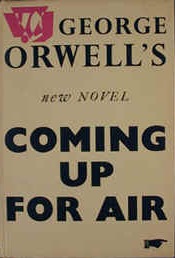
A teashop also appears at a significant moment in Orwell’s 1939 novel Coming up for Air. After service in the war, the parents of the central character, George Bowling, die. One day, walking down Charing Cross, in central London, a poster proclaiming ‘KING ZOG’S WEDDING POSTPONED’ together with the sound of traffic and smell of horse-dung bring back memories of his childhood – and he resolves to lie to his wife, take time off work and spend some time back in Lower Binfield rediscovering the Golden Age of his youth (1976 [1939]: 445). But as Bowker summarises: ‘The journey is doomed – the small town had been engulfed by suburbia and his woodland paradise infested with fruit juice-drinking, sandal-wearing, nudist vegetarians and Garden City cranks. The Golden Age is done for…’ (2003: 250).
Bowling books himself into a hotel and has lunch. But then, symbolising the degeneracy of modern life, he returns to the shop where he grew up and is horrified to find it is now Wendy’s Teashop, serving morning coffee and home-made cakes. He enters and asks for tea. The waitress is ten minutes getting it. ‘You know the kind of tea – China tea, so weak that you could think it’s water till you put the milk in. I was sitting almost exactly where Father’s armchair used to stand…’ He tells her he used to live in the village. But she is not the slightest bit interested – so he leaves (1976 [1939]: 542).
A café is even the site for the crucial final scene in Nineteen Eighty Four. However, the Chestnut Tree does not serve up tea and cakes but Victory Gin – the absence of tea symbolising the death of the pre-revolution, capitalist civilisation. Winston Smith has survived the torture in Room 101 and thinks back on his chance meeting in a park with Julia – with whom he had a passionate secret affair. ‘When he woke, seldom before eleven hundred, with gummed-up eyelids and fiery mouth and a back that seemed to be broken, it would have been impossible even to rise from the horizontal if it had not been for the bottle and teacup placed beside the bed overnight. Through the mid-day hours he sat with glazed face, the bottle handy, listening to the telescreen’ (1976 [1949]: 914).
‘A Nice Cup of Tea’
Tea is also to be the subject of one of Orwell’s light, brilliantly witty, journalistic – and much neglected – features about English life and customs he contributes to the London Evening Standard in 1945-1946. He begins highlighting the fact that, while cook books rarely mention tea, it is actually ‘one of the mainstays of civilization in this country, as well as in Eire, Australia and New Zealand’ while ‘the best manner of making it is the subject of violent disputes’ (CWGO XVIII: 33). Intriguingly, this constitutes Orwell’s rare references to Australia and New Zealand in his writings. The cumulative index for all 20 volumes of the Collected Works, edited by Peter Davison (1998) in Vol. XX makes no mention of these two countries.
The clarity of the expression and the attention to detail are particularly striking in the essay. Read it aloud to any group of people and they will be in stitches throughout – I can guarantee it. It’s a wonderful example of Orwell’s ‘plain’ style of writing, incorporating, as George Woodcock stresses in his celebrated study, The Crystal Spirit, ‘its firmness, its colloquial vigour, its unpretentious vividness and, above all, its limpid clarity’ (1984 [1966]: 229-230). V. S. Pritchett sees Orwell essentially as a pamphleteer in the tradition of Cobbett and Defoe, writing in ‘lucid, conversational’ prose (Bowker 2003: 275). And for Jeffery Meyers, Orwell’s plain style ‘appeals to readers’ common sense and persuades them of his honesty and good faith. At the same time his arguments are sophisticated, provocative and entertaining’ (2000: 266).
According to Alex Woloch (2016), this style can also be deceptively complex. Typically, Orwell begins highlighting what’s missing in cook books. Indeed, Woloch suggests that Orwell’s focus in a range of his writings – such as Wigan Pier, Down and Out, his essay ‘A Hanging’ and in his regular ‘As I Please’ columns for Tribune – on what we are ‘liable to miss’ ‘reveals a strange blankness, or emptiness, at the deliberate heart of Orwell’s work’ (ibid: 23). Later Woloch describes this ‘withholding at the center of his style’ as ‘the poetics of exclusion’ (ibid: 67).
Orwell next lists carefully his 11 rules for making the perfect cup of tea – all of which he regards as ‘golden’. ‘First of all, one should use Indian or Ceylonese tea. China tea has virtues which are not to be despised nowadays – it is economical and one can drink it without milk – but there is not much stimulation in it. Once does not feel wiser, braver or more optimistic after drinking it. Anyone who uses that comforting phrase, “a nice cup of tea” invariably means Indian tea’ (CWGO XVIII: 33). So Orwell proceeds through his points – jokingly listing them as fifthly, sixthly, seventhly and so on.
Each point usually begins with a short and snappy phrase summarising the particular argument and driving the feature forward. For instance, there’s ‘tea should be made in small quantities – that is, in a teapot’, ‘the pot should be warmed beforehand’, ‘the tea should be strong’, ‘the tea should be put straight into the pot’ and so on. Thereafter, Orwell expands on the individual point in a few sentences. He ends with five, mainly humorous paragraphs. For instance: ‘There is also the mysterious social etiquette surrounding the teapot (why is it considered vulgar to drink out of your saucer, for instance?) and much might be written about the subsidiary uses of tea leaves, such as telling fortunes, predicting the arrival of visitors, feeding rabbits, healing burns and sweeping the carpet’ (ibid: 35).
The feature is interesting for a number of other reasons. Most of Orwell’s journalism is directed at the alternative press (see Keeble 2020). Here, he is writing for a right-wing, mass selling evening newspaper. Perhaps this is why he makes no mention, even simply in passing, of the slave conditions tea workers were facing in India and Ceylon (as, indeed, they still do today).i
‘In Defence of English Cooking’
Just a month earlier, on 15 December 1945, Orwell has devoted another pleasure-packed Evening Standard column to defending English cooking. He begins by saying it is simply not true that English cooking is the worst in the world. Rather, ‘there is a whole host of delicacies which it is quite impossible to obtain outside the English-speaking countries’ (CWGO XVIII: 446). And he proceeds, in impressive detail to list these delicacies, displaying an impressive knowledge of the matters of the cuisine: ‘First of all kippers, Yorkshire pudding, Devonshire cream, muffins and crumpets. Then the list of puddings that would be interminable if I gave it in full: I will pick out for special mention Christmas pudding, treacle tart and apple dumplings. Then an almost equally long list of cakes: for instance, dark plum cake (such as you used to get at Buszard’s before the war), shortbread and saffron buns. Also innumerable kinds of biscuit which exist, of course, elsewhere, but are generally admitted to be better and crisper in England.’ Special ways of cooking potatoes are highlighted – and the various sauces peculiar to England, English cheeses such as Stilton and Wensleydale and apples such as the Cox’s Orange Pippin. ‘What else? Outside these islands I have never seen a haggis, except one that came out of a tin, nor Dublin prawns, nor Oxford marmalade, nor several other kinds of jam (marrow jam and bramble jelly, for instance), nor sausages of quite the same kind as ours.’
But he admits there is a snag from the foreign visitor’s point of view: good English cooking is to be found in private houses and not in restaurants. Pubs, at the time, sold no food other than crisps and ‘tasteless sandwiches’. So the solution – restaurant meals must improve.
i See https://www.dw.com/en/sri-lanka-tea-workers-and-a-legacy-of-exploitation/a-55006963
*
References will follow Part Four
Leave a Reply