
Good Book or “Good Bad Book”?
Revisiting Orwell’s Review of Pearl Buck’s The Good Earth
*
Pearl Buck’s classic novel of China, The Good Earth, was published in 1931, around the same time as George Orwell’s four significant published works on Burma.i In 1929, the first of Orwell’s Burma essays, “Comment on Exploite un Peuple: L’Empire Britannique en Birmanie” (“How a Nation Is Exploited: The British Empire in Burma”), appeared in the French publication Le Progrès Civique under the byline E. A. Blair. In 1931, “A Hanging,” a narrative essay set in Burma, was published in The Adelphi under the name Eric Blair. By the time Burmese Days, his first novel, came out in the US in 1934, he had already begun using the pen-name “George Orwell,” and his final Burma-themed text, “Shooting an Elephant,”ii was featured in the literary journal New Writing in 1936, also under his nom de plume. Burmese Days was thus released several years after The Good Earth, although Orwell had conceived of it much earlier. Scholars estimate that he wrote the nineteen extant pages of preliminary sketches for the novel sometime between 1926 and 1930, some of it possibly in Burma (Davison 93-110), so Orwell and Buck may have been working on their novels at almost the same time. Memories and impressions of life “East of Suez,” then, would have been fresh in Orwell’s mind when he reviewed Pearl Buck’s novel in 1931, making his assessment all the more informed and significant. Oddly, The Good Earth, considered by many to be Pearl Buck’s magnum opus, has been panned as often as it has been praised since it was first published 90 years ago. Do the mixed reviews suggest that The Good Earth is an example of what Orwell might later, borrowing the term from G. K. Chesterton, have labeled a “good bad book” (“Good Bad Books” 37)?
Although The Good Earth won the Pulitzer Prize for Fiction in 1932 and Pearl Buck was awarded the Nobel Prize for Literature in 1938 for a body of work that included the novel,iii reviews of the bestseller and its author have not always been favorable. In a 1931 review of the novel, for example, Sophia Chen Zen wrote that despite Buck’s “abundant sympathy, the native reader cannot but feel that [Buck] is, after all, a foreigner, who has never mixed with the Chinese more than what is permitted by the relation between the mistress and the amah, or between a student and a tutor” (915). An even more excoriating review appeared two years later in The New York Times, which published Ms. Buck’s own rebuttal alongside the review. Chinese scholar Kiang Kang-Hu, who admitted at the outset that he “never cared much to read Western writers on Chinese subjects and still less their novels about China,” seems to have relished finding fault with the novel and compiled a lengthy list of points with which he disagreed. Those who first became acquainted with the novel as required reading in middle or high school will likely be amused by some of Mr. Kiang’s objections: “She is especially fond of attacking the sore spot of human nature, namely sex. Some of her skillful suggestions make this commonplace affair extraordinarily thrilling to the reader.” Undismayed, however, Ms. Buck responded: “I will not touch on Professor Kiang’s accusation of obscenity in my books. The narrowest sects of missionaries agree with him, and I suppose this fear of normal sex life is a result of some sort of training. I do not know” (BR2).
While early reviews may have been fettered by priggishness or cultural defensiveness—perhaps exhibiting a reaction to what might today be regarded as cultural appropriation on the part of Ms. Buck—more recent reviews by Western scholars have also been critical of both the author and her novel. Biographer Hilary Spurling, (who, by chance, was also a friend and biographer of Orwell’s second wife, Sonia Brownell),iv lauded The Good Earth, calling it “wonderful—direct, immediate, and so original,” yet her praise was prefaced with a stinging contradictory statement: “The greatest mystery is why [Pearl Buck] didn’t become a great writer” (Ulvang 98). Similarly, in “When the Judges Got It Right,” an article about Rudyard Kipling’s 1907 Nobel Prize for Literature, Allan Massie included Pearl Buck as one of several examples of when the judges didn’t get it right (43), and in 2012, Maura Elizabeth Cunningham opined: “The Good Earth simultaneously manages to be both a classic and not very good” (“Re-Reading Pearl Buck’s ‘The Good Earth’”). In yet another example, educator Charles W. Hayford considered the merits of requiring Western students of Chinese history to read Buck’s novel in an article evocatively called “What’s So Bad about The Good Earth?” though he ultimately concluded that as “a starting point, The Good Earth still works” (7). For the Orwellite, such opinions seem to beg the question: might The Good Earth, then, belong to that betwixt and between category of books that Orwell defined as having “no literary pretensions but which [remain] readable when more serious productions have perished,” namely, those which he labeled “good bad books” (“Good Bad Books” 37)?
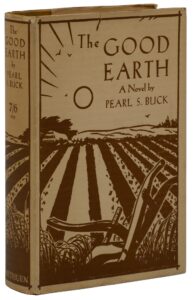 The Good Earth was published in Britain by Methuen at 7/6
Based on the characteristics described in Orwell’s 1945 essay “Good Bad Books,” it is clear that Pearl Buck bore at least some of the hallmarks of the “good bad novelist.” Orwell says that most such authors “have been prolific writers, and their output has naturally varied in quality” (38). With over 70 books to her credit (Conn xii), Buck was certainly prolific, and her works clearly varied in quality. And similar to some of the authors mentioned in Orwell’s essay, Buck had the ability “to identify [with her] imagined characters, to feel with them and invite sympathy on their behalf.” For sure, it is difficult to imagine anyone reading The Good Earth without experiencing sympathy for both Wang Lung and his wife O-lan. But Orwell’s suggestion that the kind of “abandonment” in the creative process that allows authors to create such relatable characters was one “that cleverer people would find . . . difficult to achieve” does not seem to ring true for Pearl Buck (38-39). Besides, nowhere does Orwell suggest that Buck’s novel should be relegated to this category.
Instead, Orwell’s June 1931 review, titled simply “Review of The Good Earth by Pearl S. Buck” and published in The Adelphi with only the initials “E. A. B.” to indicate authorship, begins with a simple six-word sentence packed with praise: “This is a very exceptional book” (205). Having set the tone of the review, Orwell immediately points out what he deems to be the novel’s weaknesses: “It starts uncertainly, and it is handicapped by a bad style, rather like the style of Lang’s crib to the Odyssey.” Having conceded its shortcomings, however, Orwell’s assessment of the novel is overwhelmingly positive: “But one scarcely worries about this,” he asserts, for “the story goes so straight to the very heart of truth. There is no plot,v and yet not a single redundant incident; no words spent in pity, but a fidelity to life which simply withers optimism” (205). And for Orwell, a narrative’s truthfulness, not in terms of a rigid adherence to factual detail, but in the probity with which it presents essential truths—those which get to the heart of human nature and experience, striking a chord that resonates with readers—has always seemed paramount. Indeed, it is this very quality that has blurred the line between fact and fiction in some of Orwell’s own writings, particularly “A Hanging” and “Shooting an Elephant” (the former, coincidentally, was published the same year as The Good Earth). The genre of these texts may be disputed, but the essential truths they convey are not.
Orwell’s sympathies and the impact of his own experiences in the East are evident throughout his brief critique of Buck’s novel. The Good Earth, he writes, “is the story of Wang Lung, a Chinese peasant. Born into crushing poverty, he digs his field with a wooden hoe, drinks hot water, because tea is too expensive, eats meat only on feast days.” In short, Buck’s protagonist is an underdog, the kind of man for whom Orwell always has empathy. And the hardships Wang Lung and his family are forced to endure when their village is ravaged by drought and famine only deepen Orwell’s identification with them. It comes as no surprise, for example, that Orwell says he finds the novel’s “account of the life of rickshaw coolies in an easternvi city . . . particularly moving” (205). Buck describes Wang Lung’s first experience pulling a rickshaw after his family is forced to flee their famine-stricken land thus:
Wang Lung . . . went into the streets and asked hither and thither until he found a place where jinrickshas were for hire and he went in and hired one for the day . . . Pulling this rickety, wooden wagon on its two wheels behind him, it seemed to him that everyone looked at him for a fool. He was as awkward between its shafts as an ox yoked for the first time to the plow, and he could scarcely walk; yet he must run if he were to earn his living, for here and there and everywhere through the streets of this city men ran as they pulled other men in these. (97)
It is, perhaps, this passage to which Orwell refers when he states: “Anyone who has seen that vile sight of men running between shafts like horses, will welcome this description” (205). The dehumanization of laborers always affected Orwell deeply, and his response to images of scuttling rickshaw wallahs calls to mind the quartermaster he encountered aboard the ship to Burma, “scurrying like a rat along the side of the deck-houses,” trying to conceal a “half-eaten baked custard pudding” in his hands (“As I Please” 307). In 1938, the abject poverty Orwell witnessed in Marrakechvii would again arouse his compassion for the peasants and laborers of the world, and the struggles of the poor and downtrodden became a theme that would resurface in many of his writings.
Making an even greater impression on Orwell than the affinity he feels for the story’s characters, however, is the novel’s optimism-withering “fidelity to life.” He accepts the book’s authenticity,viii pointing out that Buck “evidently knows China as her native land, but has been away from it just long enough to notice things which a Chinamanix would miss” (205). And while this “fidelity to life” may express a truth about Chinese peasants of the early twentieth century, it is a harsh truth, a truth that hurts. The concluding paragraph of Orwell’s review so effectively communicates the emotional impact of the novel precisely because, like the novel itself, it contains no “words spent in pity”:
Perhaps the best-done thing in the book is the story of Wang Lung’s relations with his wife, O-lan. O-lan is a slave girl, chosen for her ugliness, because pretty women (women with small feet, that is) are no use on the land. She bears child after child to Wang Lung, works at his side till the very hour of her confinements, obeys him like a dog. Wang Lung’s feeling for her has nothing of love as we know it, only duty. Certain things are due to her, as certain things are due to an ox, and in these he never fails. But she is only a convenience; to love her would be slightly shameful, a kind of infatuation, like loving an ox. How could one love a woman with large feet? Love is for concubines. When O-lan lies dying, worn out with work and childbirths, Wang Lung looks at her and thinks how ugly she is. He knows that she has been a good wife, even dimly feels that he might be sorry for her. But he is not sorry; her big feet repel him too much. Still, he knows his duty. He buys her an expensive coffin. (205-06)
With this optimism-withering synopsis, Orwell’s review abruptly concludes, feeling somehow truncated: Orwell tosses the reader no crumbs, provides no wise takeaway—not even a choice platitude to dispel the gloom. Having conveyed the tenor of Buck’s novel, he leaves his reader—as, perhaps, the novel’s “truth” left him—bereft.
What, then, can be extrapolated by reading between the lines of a review Orwell wrote 90 years ago and an essay he published 14 years after that? If nothing else, The Good Earth was clearly not a title that came to mind when Orwell was crafting the essay “Good Bad Books,” for unlike other well-known titles of the day, including John Habberton’s Helen’s Babies and Harriet Beecher Stowe’s Uncle Tom’s Cabin, Orwell never consigned the novel to that middling category. Admittedly, the review was written by E. A. Blair before his transformation into “George Orwell,” and it is now impossible to definitively determine how Orwell, the writer and critic who came to demand that good prose be “like a windowpane” (“Why I Write” 30), would have judged the book he once said was “handicapped by a bad style” had he revisited it in 1945. Still, despite the unfavorable reviews of some other critics, Orwell’s unequivocal assertion that “The Good Earth can be added at once to the very small list of first-rate books about the East” (205) would seem to forever preclude its inclusion in his “good bad books” category. “First-rate,” after all, is not a term that lends itself to qualifiers.
*
Works Cited
Buck, Pearl S. The Good Earth. 1931. Pocket Books, 1973.
—. “Mrs. Buck Replies to Her Chinese Critic.” New York Times (1923-Current file), Jan 15, 1933, pp. 2. ProQuest, Accessed 18 January 2021.
Conn, Peter. Pearl S. Buck: A Cultural Biography. 1996. Cambridge UP, 1998.
Cunningham, Maura Elizabeth. “Re-Reading Pearl Buck’s ‘The Good Earth.’” asiasociety.org, 18 June 2012, asiasociety.org/blog/asia/re-reading-pearl-bucks-good-earth. Accessed 10 Jan. 2021.
Davison, Peter. “Preliminaries to Burmese Days.” A Kind of Compulsion: The Complete Works of George Orwell—Ten. Edited by Peter Davison. Secker & Warburg,1998, pp. 205-06.
Fowler, H. W. The New Fowler’s Modern English Usage. 3rd ed., edited by R. W. Burchfield, 1926. Clarendon Press, 1996.
Hayford, Charles W. “What’s So Bad about The Good Earth?” Education about Asia, vol. 3, no. 3, Winter 1998, pp. 4-7. Accessed 10 Jan. 2021.
Kiang Kang-Hu. “A Chinese Scholar’s View of Mrs. Buck’s Novels.” New York Times (1923-Current file), Jan 15, 1933, pp. 2. ProQuest, Accessed 18 Jan. 2021.
King, Stephen. On Writing: A Memoir of the Craft. Scribner, 2020.
Massie, Allen. “When the Judges Got It Right.” Spectator, vol. 303, no. 9312, Feb. 2007, p. 43.
“The Nobel Prize in Literature 1938.” NobelPrize.org, www.nobelprize.org/prizes/literature/1938/summary/. Accessed 25 July 2021.
Orwell, George. “As I Please [69].” The Collected Essays, Journalism, and Letters of George Orwell, Volume IV: In Front of Your Nose 1945-1950. 1968. Edited by Sonia Orwell and Ian Angus. Penguin, 1970, pp. 307-10.
—. “Good Bad Books [6].” The Collected Essays, Journalism, and Letters of George Orwell, Volume IV: In Front of Your Nose 1945-1950. 1968. Edited by Sonia Orwell and Ian Angus. Penguin, 1970, pp. 37-41.
—. “Letter to F. Tennyson Jesse [31].” The Collected Essays, Journalism, and Letters of George Orwell, Volume IV: In Front of Your Nose 1945-1950. 1968. Edited by Sonia Orwell and Ian Angus. Penguin, 1970, pp. 141-42.
—. “Review of The Good Earth by Pearl S. Buck.” A Kind of Compulsion: The Complete
Works of George Orwell—Ten. Edited by Peter Davison. Secker & Warburg, 1998, pp. 205-06.
—. “Why I Write.” The Collected Essays, Journalism, and Letters of George Orwell, Volume 1: An Age Like This 1920-1940. 1968. Edited by Sonia Orwell and Ian Angus. Penguin, 1982, pp. 23-30.
Ulvang, Leanne. “Return to The Good Earth.” Publishers Weekly, vol. 257, no. 17, Apr. 2010, p. 98. EBSCOhost, Accessed 30 Dec. 2020.
Zen, Sophia Chen. “The Good Earth.” Pacific Affairs, vol. 4, no. 10, Institute of Pacific Relations, 1 Oct. 1931, pp. 914–15, doi:10.2307/2750496. Accessed 18 Jan. 2021.
*
Notes:
i Orwell also reviewed F. Tennyson Jesse’s book The Story of Burma for The Observer on 24 February 1946. Following his review, Tennyson Jesse and Orwell exchanged several letters, which were published in The Collected Essays, Journalism, and Letters of George Orwell, Volume IV: In Front of Your Nose 1945-1950.
ii For a detailed discussion of possible inspiration for “Shooting an Elephant,” see my 2020 article “Orwellian or Campbellian: ‘Invisible Sources’ in Orwell’s ‘Shooting an Elephant’ and Burmese Days,” published in George Orwell Studies, vol. 4, no. 2.
iii According to the Nobel Prize website, “The Nobel Prize in Literature 1938 was awarded to Pearl Buck ‘for her rich and truly epic descriptions of peasant life in China and for her biographical masterpieces.’”
iv Hilary Spurling’s biography of Sonia Brownell, The Girl from the Fiction Department, was published by Hamish Hamilton in 2002.
v Novelist Stephen King has more recently reflected on the significance (or insignificance) of plot: “I won’t try to convince you that I’ve never plotted any more than I’d try to convince you that I’ve never told a lie, but do both as infrequently as possible. I distrust plot for two reasons: first, because our lives are largely plotless, even when you add in all our reasonable precautions and careful planning; and second, because I believe plotting and the spontaneity of real creation aren’t compatible. It’s best that I be as clear about this as I can—I want you to understand that my basic belief about the making of stories is that they pretty much make themselves. The job of the writer is to give them a place to grow (and to transcribe them, of course)” (163).
vi Although Orwell mentions an “eastern city,” Wang Lung in fact takes his family to a southern city when famine drives them away from their land. It is in this southern city that he works as a rickshaw coolie.
vii Orwell’s essay “Marrakech,” originally published in New Writing in 1939, can be found in The Collected Essays, Journalism, and Letters of George Orwell Volume 1: An Age Like This 1920-1940.
viii Orwell appears to have valued this type of authenticity as he refers to the authenticity of his own novel, Burmese Days, when writing to F. Tennyson Jesse, whose book entitled The Story of Burma he had reviewed for The Observer on 24 February 1946. Having received a letter from Tennyson Jesse, he responds: “You ask me what is my knowledge of Burma. It is out of date, but it is quite good of its kind.” Before signing the letter, he asks: “Did you ever read my novel about Burma (Burmese Days)?” He adds: “I dare say it’s unfair in some ways and inaccurate in some details, but much of it is simply reporting of what I have seen” (The Collected Essays, Journalism, and Letters of George Orwell, Volume IV: In Front of Your Nose 1945-1950 141-42).
ix While the term “Chinaman” is today considered offensive, The New Fowler’s Modern English Usage entry for the word reads: “In 1926 Fowler could say that the normal uses were A Chinaman (rarely Chinese); three Chinamen (sometimes Chinese); 50,000 Chinese (sometimes Chinamen); the Chinese (rarely Chinamen). At some point between then and 1965 (Gowers), Chinaman acquired a derogatory edge, and had virtually dropped out of use in BrE (except as a term in cricket . . .) (174). n
Excellent, Carol
Carol, you did a superb job here. this is a very useful article, and I also think it implicitly challenges any casual assertion that Orwell was anti-woman, even though he was no feminist. Blair’s description of the way in which women with large feet were treated is vivid and unsparing in its condemnation of such misogyny. the fact that he singles out this part of the book, and devotes special attention to it, complicates claims about his allegedly reactionary sexual politics. that’s not the purpose of your essay, but it is an indication of how stimulating I found it
Very useful and informative. Glad to see the reference to my “What’s So Bad About the Good Earth?” Still, as a China historian I did not recommend it as a starting point, only accepted that many teachers do so.