
Beyond the ‘Nancy Poet’ Jibe: Orwell and Auden
George Orwell’s relationship with the poet W. H. Auden is fascinating and constantly evolving. Both begin their U.K. careers as teachers; both have some of their first writings published in the Adelphi, edited in the early 1930s by Richard Rees. And both go to the Spanish Civil War. Orwell damns Auden over a line in his poem ‘Spain’ and mocks his circle of poets in The Road to Wigan Pier and in his essay ‘Inside the Whale’ (the subject of Ian McEwan’s recent Orwell Memorial Lecture in London).i Yet Auden does not take offence, changes the line and then removes the poem altogether from his collected works – and later goes out of his way to praise Orwell.
Into the Spanish Cauldron
Orwell leaves for Spain just before Christmas 1936 with the intention of fighting on the Republican side in the civil war which has erupted on 19 July after a part of the army under General Franco attempts to seize power from the Popular Front Republican government. Impressed with the revolutionary fervour he witnesses in Barcelona, he joins the POUM militia. After a spell on the frontline, Orwell and some of his Independent Labour Party comrades return to Barcelona where, in May 1937, he witnesses the street fighting between the communists (determined to take control of the Republican cause) and the anarchists and Trotskyists. Back on the Huesca front, Orwell is shot in the neck by a sniper on 20 May and narrowly escapes death. After recovering in hospital, he and his newly-wed wife, Eileen, who has joined him in Spain, decide to escape. And with the communists hard on their heels, determined to capture – and maybe even torture and kill them – they escape into France and safety (Bowker 2003: 225).
Auden departs for Spain on 11 January 1937 determined to serve as an ambulance driver for the Republican cause. He is by this time already a media celebrity and his departure is covered in both the communist Daily Worker and Sunday Times. In Barcelona, he meets Cyril Connolly and they go a walk in the gardens at Montjuich. When he disappears behind a bush for a pee, he is immediately arrested by two militia men and is only released after Connolly produces a letter of recommendation from Harry Pollitt, general secretary of the British Communist Party (Lewis 1998: 287). Failing to find work in both Barcelona and Valencia as an ambulance driver, Auden ends up broadcasting propaganda for the Republican government. Biographer Charles Osborne comments: ‘But as his broadcasts were in English and were transmitted over a radius of not much more than fifty miles, they cannot have been of the slightest practical use. … Disillusioned, he remained in Spain for several weeks returning to England early in March’ (1995 [1980]: 135).
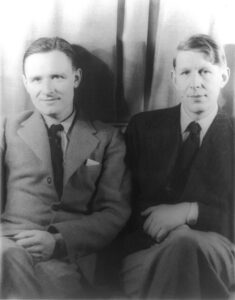 W H Auden (Right) and Christopher Isherwood (see below),
photographed by Carl Van Vechten 1939; from Wikipedia
Writing for the Republic
Soon after arriving in Spain, Auden sends a report which is published in the New Statesman and Nation under the title ‘Impressions of Valencia’ on 30 January 1937 (ibid: 137-138). It begins rather poetically: ‘The pigeons fly about the square in brilliant sunshine, warm as a fine English May.’ Then it suddenly shifts its focus: ‘In the centre of the square, surrounded all day long by crowds and surmounted by a rifle and fixed bayonet, 15ft high is an enormous map of the Civil War, rather prettily illustrated after the manner of railway posters urging one to visit Lovely Lakeland or Sunny Devon. Badajoz is depicted by a firing party; a hanged man represents Huelva …’ Auden comments on the somewhat gruesome posters: one, a photomontage, shows a bombed baby lying on a field of aeroplanes. He continues: ‘Today a paragraph in the daily papers announces that since there have been incidents at the entrances to cabarets, these will in future be closed at nine pm. … Since the Government moved here the hotels are crammed to bursting with officials, soldiers and journalists. There are porters at the station and a few horse-cabs, but no taxis, in order to save petrol. Food is plentiful, indeed an hotel lunch is heavier than one could wish. There is a bullfight in aid of the hospitals; there is a variety show where an emaciated looking tap-dancer does an extremely sinister dance of the machine-guns.’
Finally, celebrating the ways the revolutionary spirit is allowing people to finally taste true freedom, he writes: ‘For a revolution is really taking place, not an odd shuffle or two in cabinet appointments. In the last six months these people have been learning what it is to inherit their own country, and once a man has tasted freedom he will not lightly give it up; freedom of choose for himself and to organize his life. … That is why, only eight hours away at the gates of Madrid where this wish to live has no possible alternative expression than the power to kill, General Franco has already lost two professional armies and is in the process of losing a third’ (ibid).
Back in England, Orwell finds many of the men he had been fighting alongside are being falsely accused of seeking to undermine the revolution. So he composes his first-hand frontline account, Homage to Catalonia, in a state of ‘white hot anger’ during the second half of 1937. And this helps account partly for the extraordinary freedom of his writing, its flair, outspokenness, its creative, imaginative, literary richness – and its use of an eclectic range of fictional techniques. Victor Gollancz, his usual publisher, objects to his links with POUM and the anarchists so it is eventually published by Fredric Warburg on 25 April 1938. While generally well reviewed, it sells only 700 copies during Orwell’s life and there is no US edition until 1952 (Keeble 2015).
Orwell and the Auden Clique
While in Spain, Orwell’s account of his two months in early 1936 investigating the plight of the miners, the poor and the unemployed in the north of England, The Road to Wigan Pier, is published. Early on, after describing in graphic detail his experience going down a coal mine and witnessing the men, nearly naked, toiling underground, he writes: ‘More than anyone else, perhaps, the miner can stand as the type of the manual worker, not only because his work is so exaggerately awful, but also because it is so vitally necessary and yet so remote from our experience. … It raises in you a momentary doubt about your own status as an “intellectual” and a superior person generally. For it is brought home to you, at least while you are watching, that it is only because miners sweat their guts out that superior persons can remain superior. You and I and the editor of the Times Lit Supp and the Nancy poets and the Archbishop of Canterbury and Comrade X, author of Marxism for Infants – all of us really owe the comparative decency of our lives to poor drudges underground, blackened to the eyes, with their throats full of coal dust, driving their shovels forward with arms and belly muscles of steel’ (1980 [1937]: 138-139).
The ‘Nancy poets’ jibe is clearly directed at Auden and his circle many of them known to be homosexuals. According to biographer Jeffrey Meyers, Orwell actually experiences guilty homosexual feelings and uses the ‘Nancy boy’ condemnation as a way ‘to distance himself from these feelings’ (Meyers 2000: 38).
In the second section of the book, Orwell, idiosyncratically and provocatively, explores his own background and the current state of socialism in Britain. In the process, he delights in mocking socialist supporters: ‘As with the Christian religion, the worst advertisement for Socialism is its adherents’ (1980 [1937]: 203). As a result, he argues, artists of any note can never be persuaded to join the Socialist fold. Next follows another jibe at Auden and his circle: ‘A whole generation has grown up more or less in familiarity with the idea of Socialism; and yet the high-water mark, so to speak, of Socialist literature is W. H. Auden, a sort of gutless Kipling, and the even feebler poets who are associated with him. … It is certain that in Western Europe Socialism has produced no literature worth having. … The real Socialist writers, the propagandist writers, have always been dull, empty windbags – Shaw, Barbusse, Upton Sinclair, William Morris, Waldo Frank etc.’ (ibid: 208-209).
Moreover, when approached by Nancy Cunard to contribute to her Authors Take Sides on the Spanish Civil War, Orwell’s response, according to biographer D. J. Taylor, is ‘one of the most intemperate paragraphs he ever committed to paper’:
Will you please stop sending me this bloody rubbish. … I am not one of your fashionable pansies like Auden and Spender, I was six months in Spain, most of the time fighting, I have a bullet-hole in me at present and I am not going to write blah about defending democracy or gallant little anybody (Taylor 2003: 245).
In contrast, Auden wrote for Cunard:
I support the Valencia government in Spain because its defeat by the forces of International Fascism would be a major disaster for Europe. It would make a European war more probable; and the spread of Fascist Ideology and practice to countries as yet comparatively free from them, which would inevitably follow upon a Fascist victory in Spain, would create an atmosphere in which the creative artist and all who care for justice, liberty and culture would find it impossible to work or even exist.ii
Significantly, Orwell is at pains to retract the ‘gutless Kipling’ comment in his essay ‘Inside the Whale’, of 1940. He writes: ‘As a sort of criticism this was quite unworthy, indeed, it was merely a spiteful remark’ (1980 [1940]: 507). But this retraction does not stop him from engaging in a new attack on the Auden Circle (incorporating figures such as Stephen Spender, Cecil Day-Lewis, Louis MacNeice, Christopher Isherwood, Arthur Calder-Marshall, Edward Upward, Alec Brown and Philip Henderson) which Philip Bounds describes as ‘one of the most scathing Orwell ever wrote’ (Bounds 2016 [2009]: 112).iii The leading writers of the Joyce-Eliot 1920s generation were of very varied origins, few of them passed through the ordinary English educational mill (the best of them, bar Lawrence, were not English) and most of them had had at some time to struggle against poverty, neglect and even downright persecution. ‘On the other hand, nearly all the younger writers fit easily into the public school-university-Bloomsbury pattern. The few who are of proletarian origin are of the kind that is declassed early in life, first by means of scholarships and then by the bleaching tub of “London culture”’ (1980 [1940]: 507).
To a certain extent, Orwell spoils his argument against Auden by criticising the poem ‘You’re leaving now, and it’s up to you boys’ for being ‘pure scout-master, the exact note of the ten-minutes’ straight talk on the dangers of self abuse’ (ibid). In fact, it’s from Day-Lewis’s early volume of poetry, The Magnetic Mountain.iv
But Orwell is intent on damning Auden & Co: ‘Marxized’ literature, he suggests, has moved no nearer to the masses. ‘Even allowing for the time-lag, Auden and Spender are somewhat farther from being popular writers than Joyce and Eliot, let alone Lawrence.’ Above all he suggests that Auden’s Circle is using communism to express a range of notions which are largely reactionary. Thus, their support for the USSR is basically a manifestation of displaced patriotism. As Bounds summarises: ‘Raised in their bourgeois homes and their public schools to put love of country before everything else, people like Auden, Spender and C. Day-Lewis longed to be the loyal servants of a nation state. The only problem was that they could no longer give their loyalty to England, since the inglorious history of the post-war period had gone a long way to shattering their illusions about it. Their solution was to transfer their allegiance to Stalin’s Russia’ (Bounds 2016 [2009]: 112).
Orwell is not alone in his criticisms of the Auden Circle. But many communists insist that their essential commitment is to fascism. Edgell Rickword, in the first issue of Left Review, in October 1934, argues that the young writers of the left have, in fact, been gripped by a mood of irrationalism. The fascist regimes in Germany and Italy provide a focus for their patriotism and their adolescent hunger for violence (ibid: 114). While in Partisan Review, the US leftist journal to which Orwell is to contribute during the war years, F. W. Dupee (1938) acknowledges that Auden is the leader of his group but continues: ‘He lacks a critical intelligence; and one cannot be sure whether the hub is turning the spokes or the spokes the hub. At present we may guess that Auden is captive of his friends’ reformist gentility; their politically fostered blindness, the rationalized prudence of their democratic front against fascism – as though fascism were a respecter of prudence, of democracy.’
‘War of Words’ over ‘Spain’
Orwell follows up his own comments in ‘Inside the Whale’ with a blistering attack on Auden’s poem ‘Spain’, published in May 1937, by Nancy Cunard, in her series of poems in English, French and Spanish – with the royalties donated to Medical Aid for Spain.v A longish poem of almost 100 lines, it was acclaimed by critics of the day as one of the best to have come out of the conflict. As Osborne comments: ‘It is a mature, complex and moving poem not so much about Spain as about political struggle and moral choice. To some extent it is an abstract and rather cold examination of its subject’ (Osborne 1995 [1980]: 139). The poem contrasts the hoped-for glories of the socialist future with the hum-drum tasks needed to bring about that future. A line to which Orwell takes particular exception goes: ‘The conscious acceptance of guilt in the necessary murder’ which seems to imply that one of the ‘necessary’ tasks is that of committing political assassinations.
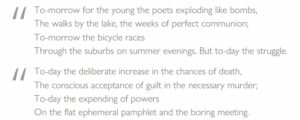 From ‘Inside The Whale’, available on the Orwell Prize website.
Orwell typically balances his critique, beginning by acknowledging that the poem ‘is one of the few decent things to have been written about the Spanish war’ (Orwell 1980 [1940]: 510). He continues:
… notice the phrase ‘necessary murder’. It could only be written by a person to whom murder is at most a word. Personally I would not speak so lightly of murder. It so happens that I have seen the bodies of numbers of murdered men – I don’t mean killed in battle, I mean murdered. Therefore I have some conception of what murder means – the terror, the hatred, the howling relatives, the post-mortems, the blood, the smells. The Hitlers and Stalins find murder necessary, but they don’t advertise their callousness, and they don’t speak of it as murder; it is ‘liquidation’, ‘elimination’ or some other soothing phrase. Mr Auden’s amoralism is only possible if you are the kind of person who is always somewhere else when the trigger is pulled. So much of left-wing thought is a kind of playing with fire by people who don’t even know that the fire is hot (ibid) (italics in the original).
Orwell concludes: ‘On the whole, the literary history of the thirties seems to justify the opinion that a writer does well to keep out of politics’ (ibid: 512). Samuel Hynes comments (1976: 387): ‘This is an odd conclusion to get from the author of The Road to Wigan Pier and Homage to Catalonia, but it became a commonplace of the Thirties Myth: for a decade, so the Myth goes, young writers were seduced into political actions that they didn’t understand, and both politics and literature suffered.’
Initially, Auden responds defensively to Orwell’s critique of the ‘necessary murder’ phrase, saying: ‘I was not excusing totalitarian crimes but only trying to say what, surely, every decent person thinks if he finds himself unable to adopt the absolute pacifist solution. (1) To kill another human being is always murder and should never be called anything else.vi (2) In a war, the members of two rival groups try to murder the opponents. (3) If there is such a thing as a just war, then murder can be necessary for the sake of justice.’vii
Having left – very controversially – with his friend Christopher Isherwood for America in January 1939, Auden converts to Christianity in the following year. Significantly, he changes the controversial line in ‘Spain’ (now renamed ‘Spain 1937’) in his collection Another Time, to read: ‘To-day the inevitable increase in the chances of death;/The conscious acceptance of guilt in the fact of murder.’ But Edward Mendelson argues that Auden’s revision is published a month before ‘Inside the Whale’ so he could not have been reacting to Orwell’s criticisms (Mendelson 1977: 424-425; Crick 1980: 615 n.1).
During the 1950s, Auden comes to believe that writers hold no responsibility to promote political causes. He crosses out the two lines of Cyril Connolly’s copy of ‘Spain’ and scribbles in the margin: ‘This is a lie’ while copies of other friends are treated in a similar way (Osborne 1995 [1980]: 140). In 1967, when Auden’s Collected Shorter Poems are published, the entire poem is excluded.
The historian E.P. Thompson, author of The Making of the English Working Class (1963), takes issue with both Orwell and Auden. The phrase ‘necessary murder’, he suggests, has nothing to do with ‘political murders’: ‘The volunteers who joined the Spanish Republican cause (of whom Orwell himself was one) were committed, as soldiers, to the activity of “murder”; Auden no doubt chose the word with care to emphasise, exactly, that soldiering, in whatever cause, is not “all very edifying” and that killing entails an “acceptance of guilt”; but this “murder” Auden then believed was “necessary” because – as the entire structure of the poem in its first version worked to establish – he believed that the Spanish War was a confrontation of critical historical importance’ (Thompson 1978). Thompson continues: ‘Orwell, by indicting the cause as a swindle and by ridiculing the motives of those who supported it, unbent the very “springs of action”. He sowed within the disenchanted generation the seeds of a profound self-distrust. Socialist idealism was not only discounted, it was also explained away, as the function of middle-class guilt, frustration or ennui’ (ibid, italics in the original).
Auden’s Praise for Orwell
Soon after the controversy over the ‘Spain’ poem, Auden and Isherwood contribute an article to Vogue magazine (of all outlets) on ‘Young British Writers on the Way Up’ (Auden and Isherwood 1939). Before moving on to (the now sadly forgotten) Ralph Batesviii and Arthur Calder-Marshall, the focus falls on Orwell. Auden and Isherwood write:
Orwell’s career has been extraordinary. Educated at Eton he has become a voluntary exile from his own class, preferring to inhabit the bitter and sordid world of the unemployed. A period of service with the Burmese police produced Burmese Days, a brilliant attack on British imperialism in the East. Burmese Days is the only novel that can bear comparison with Forster’s Passage to India. Orwell lacks Forster’s humanity. His irony is coarser, his satire less delicate. But Burmese Days is, nevertheless, a thrilling and moving story of one man’s failure in his struggle with the official machine. Returning to Europe, Orwell wandered about, acquiring the terrible experiences which are recorded in The Road to Wigan Pier, The Clergyman’s Daughter and Down and Out in London and Paris. Not since Jack London’s People of the Abyss has anyone written so frankly about the Lower Depths of English life and its inhabitants, the miserable, huddled figures in their bundles of rags whom you can see any evening trying to snatch a few moments of police-disturbed sleep on the benches of the Embankment and Trafalgar Square. When the Spanish civil war broke out, Orwell went to fight on the Loyalist side. While operating a machine gun he was severely wounded in the throat and for some time almost lost the use of his voice. Another book, in some ways his best, has been the result.
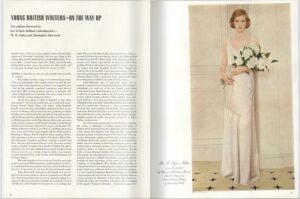 Available in the Vogue Archive (Log-in required)
Auden clearly holds no grudges against Orwell and is keen to praise him when given the chance. Orwell, when literary editor of Tribune, which he joins after quitting the BBC in November 1943, displays a similar inability to sustain personal hostilities over a long period and reprints an article on Kipling by Auden (whose wartime departure for America he deplores) (Bowker 2003: 304).
Much later in his career, just two years before his death in 1973, Auden uses a review in the Spectator of the four volumes of The Collected Essays, Journalism and Letters of George Orwell, edited by Sonia Orwell and Ian Angus, to compose what amounts to a very moving, somewhat idiosyncratic and (in places) misguided, 1,700-word tribute to the author of Nineteen Eighty-Four.ix He writes:
Among the writers of this century, he stands out, like Hilaire Belloc, as a master of unadorned English prose. Even when one disagrees with what he is saying, one has to admire the vigour and lucidity with which he says it. Like the Austrian, Karl Kraus, he knew that corruption of the language must corrupt society: hence his admirable essay on ‘Politics and the English Language’ (I wish he had written one on political and military euphemisms). As a novelist, he is. I think, most successful when he is least ‘fictional’, that is to say, when he narrates what he himself has personally felt and witnessed. Though I am very glad for his sake that he wrote Animal Farm and 1984, since they freed him from financial anxieties, neither, in my opinion, quite comes off. When one compares his encounters with the poor in the early nineteen-thirties with those of his great predecessor, Henry Mayhew, in the eighteen-fifties, one is struck, and saddened, by the decline in their powers of verbal expression. Compared with the Dickensian exuberance of Mayhew’s interviewees, Orwell’s seem almost inarticulate. I rather fear the cause may be universal elementary education, which has destroyed their instinctive native speech, but not trained them to do more than read the cheaper newspapers.
He continues: ‘About other writers he shows keen insights and astonishing fair-mindedness. Though himself a man of strong political and moral convictions, he is always ready to recognize aesthetic merit in those of whose politics and morals he disapproves …’
He goes on to criticise Orwell for failing to understand the poets of the 1930 – including himself. They were, Orwell wrote, didactic, political writers, aesthetically conscious but more interested in subject-matter than technique. Auden writes:
To this, I can only say, that all my life I have been more interested in poetic technique than anything else. What is true is that I am technically more conservative, more conscious of my debt to the nineteenth century (Yeats was too, for that matter) than poets like Eliot and Pound. Then, aside from a few plays, very little of the poetry I wrote in that decade was overtly political: basically I have always thought of myself as a comic poet. More seriously, he charges us with refusing to admit that we were bourgeois. The term bourgeois, like proletariat, has no meaning in English-speaking countries, but if he means that I was ashamed to be, like himself, professional upper middle class, I have never thought of myself as anything else. At times, to be sure, I wrote satires about my class, but one can only satirise what one knows at first hand.
He next challenges Orwell’s views on socialism: ‘What Orwell seems to have hoped for was a Socialist (non-Communist) party which would be elected by an overwhelming majority and, like the Swedish Socialist Party, stay in power for decades, so that it would have nothing to fear from rival political parties. It will crush any open revolt promptly and cruelly, but it will interfere very little with the spoken and written word. Political parties with different names will still exist, revolutionary sects will still be publishing their newspapers and making as little impression as ever.’
Orwell is too optimistic. ‘As a commentator on the contemporary political and social scene, he reminds me of Cobbett: he exhibits the same independence of party and the same vigour. Both of them, too, were not under the illusion that political action can solve all problems.’
Auden still misses Orwell: ‘Today, reading his reactions to events in the war and the immediate years after the war, my first thought is: O how I wish Orwell were still alive, so that I could read his comments on contemporary events.’ Given Auden’s conversion, it is not surprising that he moves on to question Orwell’s views on Christianity:
He did, I think, have one blind spot. His fanatic, essentially religious hatred of Christianity, prevented him from seriously studying the subject. Thus, while I am sure he was well read in Communist literature, I very much doubt if he had read much theology or ecclesiastical history. He seems to have imagined that Christianity, like Manicheism and Buddhism, is an ‘other-wordly’ religion. In fact, from the accession of Constantine to the present day, the charge which all too often can justly be brought against the Churches, both Catholic and Protestant, is that they have been all too ‘worldly’, all too willing to make shady deals with temporal powers that would protect their power and wealth. The English Catholic apologists of this century, Belloc, Chesterton, Beachcomber etc., all had very definite views about politics, society, history. One may disagree with them – I do myself – but the one thing one cannot accuse them of is a lack of concern for the things of this world.
He suspects the cause for his hatred of Christianity probably lies in his experiences at his ‘nasty’ prep- school, St Cyprian’s. ‘I also suspect that his upbringing in early childhood had more effect on his sensibility and character than he realized.’
Yet he ends the review on a surprising and paradoxical note: ‘If I were asked to name people whom I considered true Christians, the name George Orwell is one of the first that would come to my mind.’
Conclusion
The Orwell/Auden relationship is particularly interesting since it shows how two writers can fundamentally disagree on a topic and yet later graciously acknowledge the other’s personal and literary qualities. Orwell regrets using the ‘Nancy poets’ jibe at Auden, Spender and Day-Lewis and after Spender, on the suggestion of Cyril Connolly, visits Orwell while he is recovering from an attack of TB at Preston Hall Sanatorium, in Kent, in 1938, the two men become friends. He apologises for making ‘offensive remarks’ about ‘parlour Bolsheviks such as Auden and Spender’ (Shelden 1991: 322; Crick 1980: 361) and he is never again to use the phrases ‘Nancy’ or ‘pansy’ poets. As Orwell later tells Connolly about Spender: ‘Funny, I always used him & the rest of that gang as symbols of the pansy Left … but when I met him in person I liked him so much & and was sorry for the things I had said about him’ (Bowker 2003: 236). And while working for the BBC as a talks producer from 1941-1943, he praises Auden’s poem ‘Spain’ as a ‘very good’ war poem (Taylor 2003: 314).
Likewise, Auden, despite the spat over ‘Spain’, maintains a constant (though critical) admiration for Orwell – praising him in print when the opportunity arises.
- The author thanks L. J. Hurst for his comments on a draft but remains solely responsible for all the contents.
*
Notes
i In his excellent, wide-ranging talk – and in the Q and A afterwards – McEwan highlights Orwell’s ‘generosity’ towards Henry Miller’s passivity and apolitical attitudes – and compares Orwell’s views on the political engagement of the writer with those of Albert Camus. He makes only a passing reference to Orwell’s critique of the Auden Circle towards the end of the Q and A. See https://t.co/fviIW9uqCi?amp=1
ii See Calver, Katherine Elizabeth (2014) Authors Take Sides on the Spanish Civil War: A Dossier. Part of a PhD thesis, Boston University. Available online at https://open.bu.edu/bitstream/handle/2144/15314/Calver_bu_0017E_10741.pdf p. 63
iii Samuel Hynes comments: ‘The only surprising names here are the last two. Alec Brown was a Marxist who had written The Fate of the Middle Classes (reviewed unfavourably by Orwell in the Adelphi), and a novel, Daughters of Albion (described by Orwell as ‘a huge wad of mediocre stuff’); Henderson was a Marxist literary critic, author of The Novel Today which Orwell had called ‘badly written and thoroughly dull’ in a review in the New English Weekly). The two are inserted here for an obvious reason – to increase the communist content of the list, and to do so with two obviously inferior writers’ (Hynes 1976: 388)
iv L. J. Hurst comments: ‘Davison correctly attributes this to Day-Lewis, but he fails to note that Orwell’s confusion was understandable since Day-Lewis’s poem is almost identical to Auden’s earlier “Since you are going to begin to-day”. Contemporary readers probably would have made the mental correction, keeping up with Orwell’s argument. (It also indicates the breadth of Orwell’s reading that he should have been able to quote poets who were only being published in small magazines and in slim collections.)’ (in email to author, 27 November 2021)
v See Calver, Katherine Elizabeth (2014) Authors Take Sides on the Spanish Civil War: A Dossier pp 364-366
vi Patrick Hamilton makes the same point (controversially) in his 1929 play Rope. Significantly, when Alfred Hitchcock directs a film version in 1948 this aspect of the drama is missing. Perhaps so soon after the war, it is difficult for many to consider all killing (even of Nazis) as ‘murder’
viii Bates’s Lean Men (1936), about olive growers in Spain, has been hailed as a pioneering ‘proletarian’ novel. He fought for a while with the International Brigades during the Spanish Civil War. He later moved to America where he became professor of creative writing and English literature at New York University. Details of MI5 surveillance of Bates is included in Richard Knott’s The Secret War Against the Arts: How MI5 Targeted Left-Wing Writers and Artists 1936-1956 (Pen and Sword, Barnsley, 2020)
ix See http://archive.spectator.co.uk/article/16th-january-1971/18/w-h-auden-on-george-orwell
References
Auden, W. H. and Isherwood, Christopher (1939) Young British Writers on the Way Up, Vogue, 15 August. Available online at https://archive.vogue.com/article/1939/8/young-british-writers-on-the-way-up
Bounds, Philip (2016 [2009]) Orwell & Marxism, London: I. B. Tauris
Bowker, Gordon (2003) George Orwell, London: Little, Brown
Crick, Bernard (1980) George Orwell: A Life, Harmondsworth, Middlesex: Penguin
Dupee, F. W. (1938) The English literary left, Partisan Review, Vol. 5, No. 3 pp 11-21. Available online at http://www.bu.edu/partisanreview/books/PR1938V5N3/HTML/files/assets/basic-html/index.html#18
Hynes, Samuel (1976) The Auden Generation: Literature and Politics in England in the 1930s, London: Bodley Head
Keeble, Richard Lance (2015) Orwell and the war reporter’s imagination, Keeble, Richard Lance (ed.) George Orwell Now! New York: Peter Lang pp 209-224
Lewis, Jeremy (1998) Cyril Connolly: A Life, London: Pimlico
Mendelson, Edward (1977) The English Auden, London: Faber & Faber
Meyers, Jeffrey (2000) Orwell: Wintry Conscience of a Generation, London and New York: W. W. Norton & Company
Orwell, George (1980 [1937]) The Road to Wigan Pier, in the Collected Non-Fiction, London: Secker & Warburg/Octopus pp 123-232
Orwell, George (1980 [1940]) Inside the Whale, in the Collected Non-Fiction, London: Secker & Warburg/Octopus pp 494-520
Osborne, Charles (1995 [1980]) W. H. Auden: The Life of a Poet, London: Michael O’Mara Books
Shelden, Michael (1991) Orwell: The Authorised Biography, London: Heinemann
Taylor, D. J. (2003) Orwell: The Life, London: Chatto & Windus
Thompson, E. P. (1978) Outside the Whale, in The Poverty of Theory and Other Essays, London: Merlin. Available online at https://www.marxists.org/archive/thompson-ep/1978/outside-whale.htm
- Richard Lance Keeble was chair of The Orwell Society 2013-2020. His most recent book is Orwell’s Moustache (Bury St Edmunds, Abramis, 2021).
*
The author may be interested in the following vignette describing Auden in Valencia, from the memoirs of Kate Mangan, who was working in the Republic’s Foreign Press Office :
I was sitting in the Wodka one day, the lights were on so it must have been about five, when I saw a young man at a neighbouring table, also alone, drinking tea and writing notes. He was fair, with short, straight, untidy hair without a parting and out straight across the front. He wore a rough, loose, tweedy suit and a collegiate air. He looked very young. I was sure he was English and supposed he was an ambulance driver from the Medical Aid. This was the poet W.H. Auden but I did not know him by sight.
Assuming he might be feeling lonely and lost, after staring at him for a bit, I went over and said, ‘Are you English?’ He said he was and suggested I join him. He asked me what I was doing in Spain and I told him. He said I might be able to help him as he did not know Spanish.
He told me his name and said he had just arrived and was writing his impressions of Valencia. He told me the Spanish Embassy in London had said that he might perhaps make propaganda for England. He was keen to arrange English broad-casts as well as cultural Spanish ones from Valencia.
‘Do you belong to the Communist Party?’ he asked.
‘No,’ I said.
‘Neither do I,’ he said, a bit regretfully.
‘I’m just an anti-fascist,’ I said.
[…]
To keep Auden quiet Rubio gave him Azaña’s speech, which was very long, to write in good English! He did it as meekly as a lamb and made a speech much better than Azaña was capable of. It was duplicated in a great hurry and then produced as a pamphlet.
[…]
In the end, Auden got fed up with the politics and intrigues in Valencia and went to the front as a stretcher-bearer and one could not blame him.
Extract from “Never More Alive: Inside the Spanish Republic” by Kate Mangan, The Clapton Press, 2020, pp 140-143.
Thanks for sharing this interesting story, Simon.
Great article. Learned a lot.