
Bedaux and Buses
Arriving in revolutionary Barcelona George Orwell immediately noticed the consequences for the transport system:
This was in late December 1936… when one came straight from England the aspect of Barcelona was something startling and overwhelming. It was the first time that I had ever been in a town where the working class was in the saddle…There were no private motor-cars, they had all been commandeered, and all the trams and taxis and much of the other transport were painted red and black.
Later, during the counter-revolutionary period, Orwell noticed again the effect on transport:
… here and there along the Ramblas the trams stood motionless where their drivers had jumped out of them when the fighting started… That afternoon there was a kind of armistice… It was noticeable, however, that the trams did not start running.
Until the Orwells and their ILP colleagues escaped:
And then England… the familiar streets, the posters telling of cricket matches and Royal weddings, the men in bowler hats, the pigeons in Trafalgar Square, the red buses, the blue policemen…
It seems an idyllic place to escape to. As Professor Peter Davison has alluded in a footnote, referring to transport,
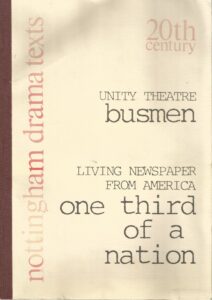
The resultant speed-up of industry in the 1930s on both sides of the Atlantic was opposed by the unions. In London, it led to a major bus strike in 1937, dramatised as Busmen (1938). A document supporting the play’s text, printed in the Nottingham Drama Texts series (1984) refers to Bedaux and provides valuable background to understanding Orwell’s point of view.
however, this idyll was just that – close to a fantasy and an examination of the transport references can guide us there. Most significantly the Orwells had been away for the most important event of 1937 in Britain – the coronation of the new King George VI on May 12th. This meant that they missed the most important piece of working class activism of the period, too: the London bus strike of May 1937, and ultimately its betrayal by the transport union leadership. The connection is “Bedaux” or synonyms of that name.
Bedaux and his company (described in this Orwell Society article by John P Lethbridge) did not work on the London Transport system but similar principles were applied. As late as January 12th 1939 in an article in the Daily Worker an article by “Trolleyman” commented
You people in the factories talk about Bedeaux [sic], but it’s nothing compared to the strain of the London tram and trolley bus operation. [Busmen, page 25]
The informal leader of the striker wrote in the Daily Worker the next day, January 13th:
Tram men, trolley-bus men, men on the Green Line and the country services do exactly the same work as the London men. [Busmen, page 26]
What may not be clear is that this is his objection to his trade union, the Transport and General Workers Union, lead by Ernest Bevin, treating each of these group of workers as separate, even though they were now working for one body, the London Passenger Transport Board. The implication that Professor Davison makes is that had Orwell been there in 1937 he would have contrasted the general strikers acting as one and taking transport into their own hands he had seen in Barcelona with the failure of the Transport leadership in London to do something similar. Why did this happen? Even though the transport system had become public owned in 1933 that was only nominal. It was alleged that the system bought was worth twelve million pounds but eighteen million was to be paid. The new leadership came from the former shareholders and they were tasked with paying the buy-out amount agreed: to find this money profits had to be increased, routes sweated and timetables speeded-up (hence this synonym “speed-up” for Bedaux, or confusion of the two). “Trolleyman” complained that despite the increased company takings the staff received ‘”No Pension”. “No Sick Pay”. “Reduction of Clothing Issue”’, while Inspectors were introduced to enforce the new requirements.
One can find references to the fragmentation of the London transport system in Orwell’s work: almost all the transport references in A Clergyman’s Daughter are to trams, for instance, while some sentences from Keep The Aspidistra Flying explain the financial reasons:
Gordon went up to the top of the Tottenham Court Road and took the tram. It was a penny cheaper than taking the bus.
The next year, though, in a biographical passage within The Road to Wigan Pier, Orwell asked:
Here am I, forty miles from London. When I want to go up to London why do I not pack my luggage on to a mule and set out on foot, making a two days of it? Because, with the Green Line buses whizzing past me every ten minutes, such a journey would be intolerably irksome.
From Orwell’s other remarks about his Wallington home at the time of Wigan Pier, visitors depended on a series of connections. He advised Rayner Heppenstall:
Take either the train from King’s Cross or the Green Line bus (cheaper), which you can catch at Golders Green station, and book to Baldock. You have to get to Baldock in time to catch the bus to Wallington. There are two buses on Tuesday, one at 3.30 and the other at 4.15.
Baldock or thereabouts was the most northerly point of the area covered by the LPTB, though Orwell may not have known that. A decade later Winston Smith took a train, but he had passed a bus-stop, too.
In his journalism George Orwell makes no reference to Ernest Bevin before the Second World War. It is not difficult, though, to take Orwell’s reference to Bedaux Belts in “Inside The Whale”,
To say ‘I accept’ in an age like our own is to say that you accept concentration-camps, rubber truncheons, Hitler, Stalin, bombs, aeroplanes, tinned food, machine-guns, putsches, purges, slogans, Bedaux belts, 9 gas-masks, submarines, spies, provocateurs, press-censorship, secret prisons, aspirins, Hollywood films and political murders
as a metaphor for betrayal. For a time the transport workers of Barcelona had done something that the union leaders of London had prevented the bus men from doing. It was sixty miles from the Orwells’ disembarkation port to the London of red buses: revolution was even further away.
*
Busmen and One Third of a Nation (Nottingham Drama Texts, 1984)
Another fascinating piece, Les. Many thanks. The references to different modes of transport in Orwell’s reportage and novels is certainly worth a substantial essay. But I’m not quite sure you are right when you say ‘almost all transport references in A Clergyman’s Daughter are to trams’. For instance, he writes: ‘The hop-picking season had not much longer to run. In a week or thereabouts Cairns’s would be closing down, and the cockneys would take the hoppers’ train to London, and the gypsies would catch their horses, pack their caravans, and march northward to Lincolnshire, to scramble for jobs in the potato fields.’
And as Neil Smith indicates in his essay ‘Retracing the steps of Orwell and Dorothy Hare’ in the current issue of George Orwell Studies (Vol 6, No. 2 pp 101-114), Dorothy, the central character of the novel, after completing her stint of hopping, takes the hoppers’ train from West Ackworth (a fictional name for West Malling) station:
‘They got to the station about midday, the hoppers’ train was due to start at one, and it arrived at two and started at a quarter past three. After a journey of incredible slowness, zigzagging all over Kent to pick up a dozen hop-pickers here and half a dozen there, going back on its tracks over and over again and backing into sidings to let other trains pass — taking, in fact, six hours to do thirty-five miles — it landed them in London a little after nine at night.’
After Dorothy is sacked from Mrs Creevy’s school and Mr Warburton arrives at Ringwood House they head off in a taxi. Notice here the detail in which Orwell lists the contents of their meal:
‘Presently they got to London, and Mr Warburton took Dorothy to lunch at a restaurant in Coventry Street, where they had a young chicken, roasted, with asparagus and tiny, pearly-white potatoes that had been ripped untimely from their mother earth, and also treacle tart and a nice warm bottle of Burgundy; but what gave Dorothy the most pleasure of all, after Mrs Creevy’s lukewarm water tea, was the black coffee they had afterwards. After lunch they took another taxi to Liverpool Street Station and caught the 2.45. It was a four-hour journey to Knype Hill.’
Orwell continues:
‘Mr Warburton insisted on travelling first-class, and would not hear of Dorothy paying her own fare; he also, when Dorothy was not looking, tipped the guard to let them have a carriage to themselves. It was one of those bright cold days which are spring or winter according as you are indoors or out. From behind the shut windows of the carriage the too-blue sky looked warm and kind…’
Many significant conversations and insights happen in trains in Orwell’s novels and reportage. Here, Dorothy tells Warburton that she has lost her faith, Warburton proposes marriage and she immediately rejects the offer. Warburton, in response, presses his body on her – and she struggles to push him away. All this drama in a train compartment…