
Spain, May 2022
A report by Paul Rowlands
*
Coffee in Huesca – Orwell could only dream. For our group, just one of the many memorable experiences during the Orwell Homage to Catalonia trip in May 2022.
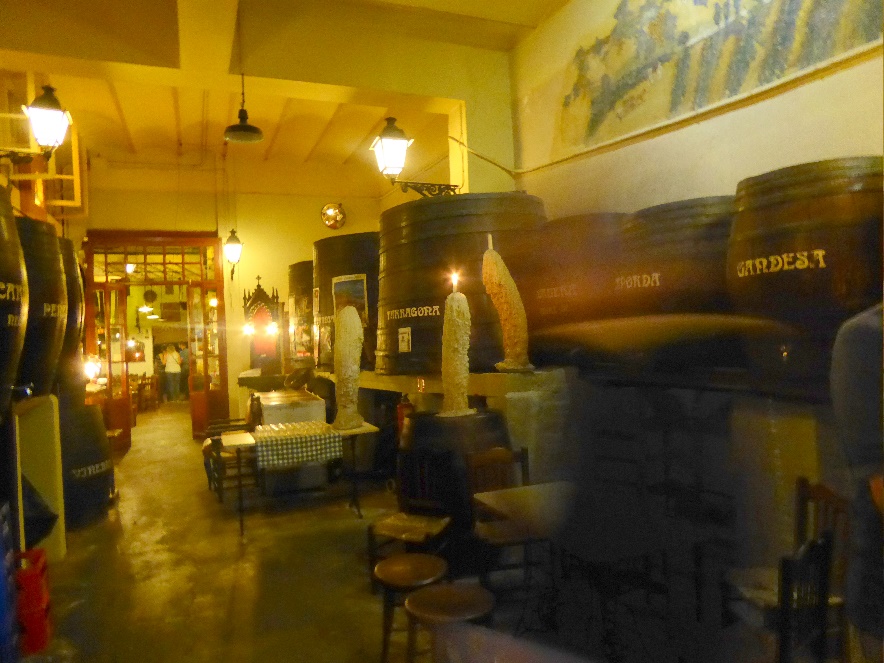
Can Margarit with Wine Barrels
Beginning on a May evening in Barcelona, we immediately plunged into a memorable meal at a Catalan restaurant featuring rabbit as its signature dish accompanied by wine from the barrel. Orwell described in his diaries in 1940 how he and his dog of the time, Marx, had spent a day chasing the local rabbits across the fields near Wallington whilst bombs fell elsewhere over England. He no doubt enjoyed similar dishes and in in the beautiful, peaceful surroundings of modern Barcelona it is hard on the surface, to imagine the turmoil and conflict of the first part of the twentieth century, captured in Orwell’s brief, stark, diary note. We met Nick Lloyd, author of a guide to the civil war in Barcelona, who would share his knowledge and enthusiasm over the following days, bringing to life these resonances from the past and illuminating the text of Homage to Catalonia.
In Barcelona you do not need to look far to see reminders of the Civil War that tore Spain apart between 1936 and 1939. It was pointed out to us that to term it a ‘Civil’ War is perhaps to misunderstand it. It was in fact as much the continuation of the Great War and the aftermath of that conflict and a dress rehearsal for the conflict to come in 1939. It was an international war, as much as a civil war from its earliest days, a war between great powers struggling for the soul of Europe. At the point that Orwell went to Spain to fight, fascism was spreading across Europe and the horrors of totalitarian communism were being inflicted on those caught within what had once been the Russian empire. George Orwell found himself in Spain enmeshed in the internecine conflict that developed on the anti-fascist side especially after he had taken a bullet in the neck fighting with the forces on the front line of the Aragon front somewhere around Huesca.
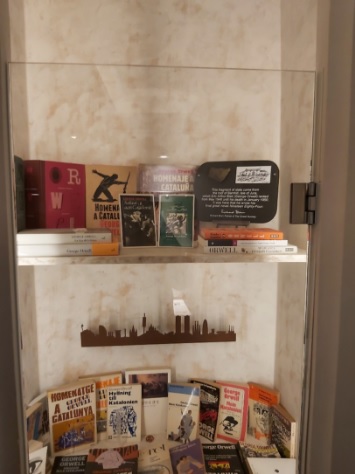
The Orwell Memorabilia in the basement room of the Café Moka
Our tour of Barcelona with Nick, touched on all these themes. It included stories and memorabilia and key landmarks described by Orwell such as the Telegraph Exchange building, the Cafe Moka, the Lenin Barracks and the Poliorama, where Orwell spent three days as the conflict within the Republican side unfolded:
‘…one of the most unbearable periods in my whole life. I think few experiences could be more sickening, more disillusioning, or, finally, more nerve-racking than those evils days of street warfare.’
For us, in contrast, our time in the Poliorama consisted of a graciously hosted tour of a beautiful, venerable scientific institute, the Royal Academy of Science and Arts of Barcelona. The building is undergoing much needed repairs and for the first time we were not able to go onto the roof where Orwell was during the May Days fighting.
We later moved down La Rambla to a book launch documenting every non-Spanish person who had enlisted with the POUM militia, held at a library with a plaque to the political secretary of the POUM, Andreu Nin. Nin ‘disappeared’ and died under torture from Stalinist thugs of the NKVD as the Anti Franco forces fractured. Later in our tour we were to see Stalinist Posters showing POUM figures with masks concealing their ‘true identity’ as fascists, a theme in totalitarian propaganda that Orwell was to develop with some of the most powerful writing of the twentieth century in both Animal Farm and 1984. In Homage to Catalonia, Orwell describes:
‘…a peculiar evil feeling in the air- an atmosphere of suspicion, fear, uncertainty, and veiled hatred’
as he and Eileen managed their final escape from Barcelona, evading the Stalinist police seeking his detention.
For us, the atmosphere was a complete contrast to this. A visit to the Benjamin Franklin School, once the Sanatorium Maurin where Orwell recuperated, was characterised by a warmth typical of everywhere we went complete with a panoramic view of modern Barcelona.

Richard and Quentin with Aurelia Quinto Aznar, the daughter of the Officer in the Sam Brown Belt in the famous Lenin Barracks photo, on the roof of the Sanatori Maurin
The presence of Orwell Society Patron Richard Blair together with our Chairman Quentin Kopp, son of Georges Kopp opened doors that created extraordinary warm memories throughout the tour. Hearing Richard read short passages from Homage to Catalonia out loud, for example at the Sant Felip Neri church, where Italian aircraft bombing on 30th January 1938 killed 42 people including 30 children, brought time past into time present, and perhaps also with a shudder, time future.
More food followed each evening with one of Barcelona’s oldest and most atmospheric restaurants, La Caracoles, a particular highlight providing a setting that could have come out of a film set and food to match.
We moved on from Barcelona into Aragon. The first stop on our tour was a visit to the hospital at Lleida where Orwell received care after his bullet wound. Orwell describes:
‘The sensation of being at the centre of an explosion. There seemed to be a loud bang and a blinding flash of light all round me, and I felt a tremendous shock–no pain, only a violent shock, such as you get from an electric terminal; with it a sense of utter weakness, a feeling of being stricken and shriveled up to nothing’.
Following immediate assistance and treatment at field hospitals, he was taken to Lleida Hospital where he stayed several days:
‘There was a pleasant garden in the hospital grounds, and in it was a pool with goldfishes and some small dark grey fish–bleak, I think. I used to sit watching them for hours…’
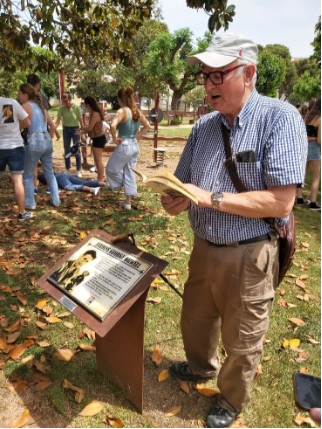
Richard reading at the Lleida Hospital Plaque
The pond is still there, and it is easy to imagine a tall languid man with a bandaged neck and a hoarse voice wandering around reflecting on his situation and the situation of Europe over 80 years ago.
At Alcubierre, a small town which had witnessed massacres of people loyal to the elected government after the town was overrun by Franco’s forces, we were met by our guides Victor Pardo Lancina and Elena Torralba. During the next few days, we stopped at a bewildering range of historical sites, and continued to experience superb food, and a warm welcome everywhere. Victor has been relentless in his pursuit of recording and preserving the local history of the Spanish war and it was privilege to have him guide us. We visited the front lines and restored trenches and the cemetery at Huesca.
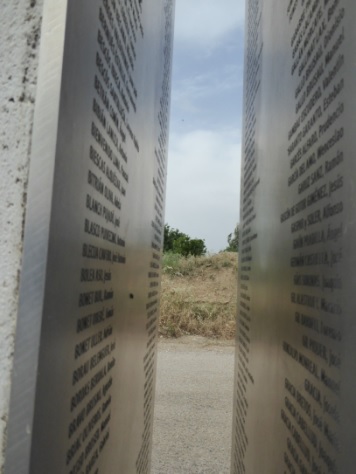
The evocative memorial to the people executed on the far side of the cemetery wall outside Huesca
At San Simon we grasped a sense of what Orwell describes. We visited hills (Tres Huegas) captured and defended by Francoist forces, which became a site of Francoist gathering for decades afterwards, to commemorate falangists killed in a raid by Republican forces. Signs of these difficult undercurrents and even nostalgia in places for the Franco regime still remain. To an outsider visiting Spain these underlying currents of discord are not readily apparent. Written in a code of flags or other symbols, or marked by a flower adjacent to a plaque, these signs are however still there without needing to look too far.
One evening was spent at accommodation at the Albergue Monegros a former religious establishment with sweeping views across the Aragon plain. More outstanding, plentiful food followed with wonderful conversation, culminating with one of our group, John giving a remarkable rendition of a traditional Welsh song, followed by a word-perfect rendition of a Max Boyce balladic poem which will live long in the memory and a reminder in my mind of the fact that Welsh miners made up one of the largest contingents of British volunteers in the war.
A guided visit to the excellent museum at Robres established by Victor to commemorate the 556 victims of the Spanish war from Huesca was a particular highlight. This included a welcome from the Mayor of the small town who was receiving civil war memorabilia from some relatives. Their grandfather had been a medic within the conflict and the donation included battlefield packs of the kind that Orwell might well have carried, and which would have been administered to him as he received attention from his colleagues after the bullet had struck him. Again, this museum was poignant and beautiful and a credit to the work that Victor has done over many years to establish this historical memory.

The Presentation at the Robres Museum
More food followed everywhere. Each restaurant had character, a tremendous welcome and abundant food and drink. It would be quite possible to have a separate gastronomic report for the trip with five star ratings for character, food and wine everywhere. Each meal was a splendid opportunity to meet and talk with the members of our group, learn something of their lives and how they had individually come to George Orwell and the Orwell Society.
A feature of the tour was that extra stops on the itinerary cropped up as the tour proceeded. This was no more evident than with a remarkable trip to the monastery at Lanaja, which has Goya designed Murals on most of the many walls, which were painted by one of his pupils. Formerly in private hands, it is being painstakingly restored and it is now possible to visit it. Lanaja is between Sarinēna and Alcubierre. This was a place that many soldiers and militia passed through and the impact of the war on the building is still apparent. From T26 tank tracks in tiles at the entrance, to engraved graffiti, to bullet marks in the walls and paintings, the impact of the conflict is chiseled into the building. The texture and the dating of the graffiti mark points in time at which an individual dealing with incomprehensible conflict is making a mark in the world. They are recording the fact that they once were there. These markings are profoundly moving.
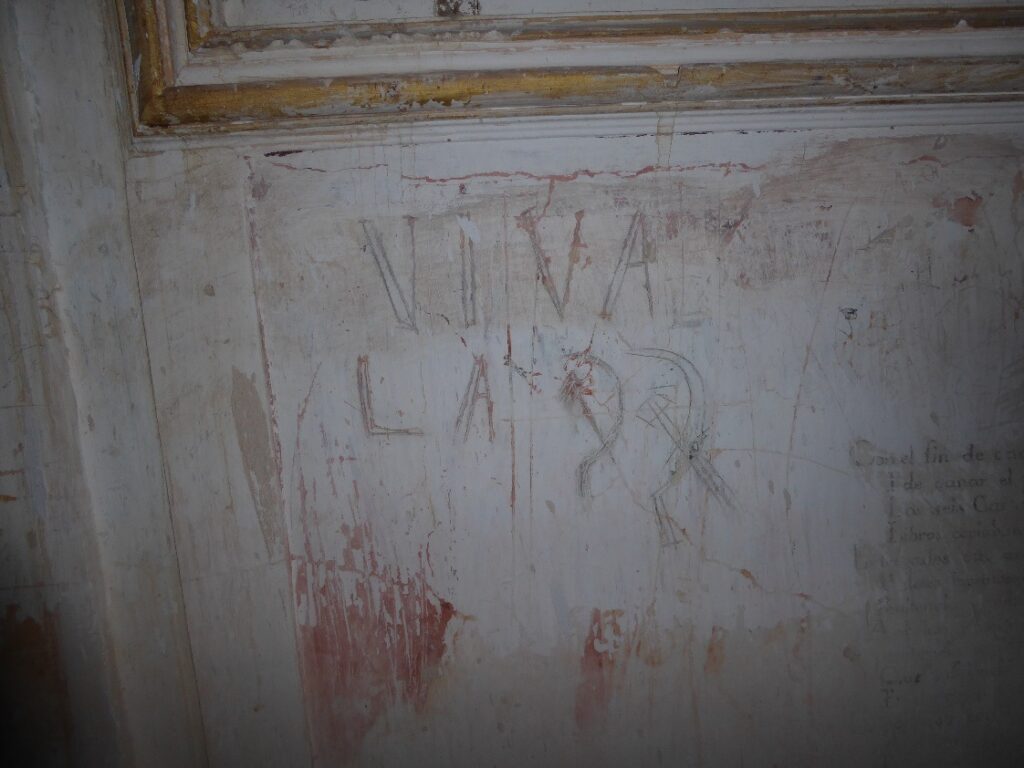
Civil War Graffiti at Lanaja
Much that was written at the time has been lost including all of Orwell’s notes and photographs, which were taken from Eileen’s room in the Hotel Continental in Barcelona by the NKVD and now inaccessible in a Moscow archive. Homage to Catalonia was written from his honest recollections of the time without access to these notes and photographs. There is something that graffiti possesses that has permanence. Orwell’s writing, on Spain in Homage to Catalonia before the Second World War appeared to be slipping into the abyss of the past, with just 800 First Edition copies sold. His post-war success with Animal Farm and Nineteen Eight-Four rekindled the embers such that his personal account and reflections are now one of the most widely read books on the conflict.
And so, to Huesca, a view of the town, imagining the front-line and its encirclement. And finally, the coffee…
The return to Barcelona brought a final farewell and reflections on a great trip, profoundly enjoyable and good humoured, amidst sombre reflections and thoughts of resonances that echo today, centred around one of the greatest writers of the twentieth century.
Huge thanks are owed to many people including Liz Kopp and Quentin Kopp, who drove our minibuses and Richard Blair. Victor and Elena guided us superbly in Aragon and Nick Lloyd similarly in Barcelona.
*
Paul Rowlands. 2022.
A great account of a wonderful week in Barcelona and Aragon. A memorable journey. We look forward to having coffee in Huesca with Orwell and Society members, when the memorial is unveiled.