
From Outside the Whale
A Short History of Ulysses
Featuring James Joyce, George Orwell… and Marilyn Monroe
This year marked the 100th anniversary of the first publication of James Joyce’s Ulysses. Often revered as one of the most impenetrable books of modernist literature, it appears that Ulysses is both, loved and loathed in equal measure among those who have endeavoured to surmount its seven hundred and thirty-odd pages.
*
Ulysses was first published on February 2, 1922, by the Paris-based English-language bookstore Shakespeare and Company on the occasion of Joyce’s 40th birthday. Founded by American ex-pat Sylvia Beach in 1919, the store had become a regular meeting place among aspiring writers and poets of the age, and was affectionately nicknamed Stratford-on-Odeon by Joyce when it relocated to much larger premises in the rue de l’Odeon in 1922. The writers who gathered at Shakespeare and Company were typically American ex-patriots often referred to as ‘the lost generation’; artistes reacting against the carnage of World War I, now endeavouring to promote Anglo-American literary culture and modernism in Paris during a period of conflicting literary movements. Joyce had first become acquainted with Beach when the store had formerly been located at 8 rue Dupuytren on the left bank, – she often referred to him (also affectionately) as ‘the melancholy Jesus.’ He had lately begun using the store as his office, and it was here that he wrote the final episodes of his great one-day epic Ulysses that had originally been scheduled for publication in the autumn of 1921. Set in Dublin in 1904 (June 16 to be precise) the episodes that comprise the novel occur during a typical day in the lives of the central character Leopold Bloom, a part-Jewish advertisement canvasser, and a number of other characters who appear regularly throughout the day. The book is divided into three parts and eighteen episodes, and is cited in the Oxford Companion to English Literature as ‘roughly corresponding to the episodes in Homer’s Odyssey.i
Mired in controversy for a number of reasons, Ulysses was banned in the UK until 1936, and had been the subject of a successful obscenity trial when parts of it were serialised in an American Journal The Little Review from 1918-1920. The Comstock Act of 1873 had previously deemed it illegal to circulate materials of an obscene nature in the US mail.
Beach wasn’t deterred by the court ruling and persuaded Joyce to allow her to publish Ulysses, of which only two copies were printed on the date in question – one for him and one for her, and in the days that followed a further 1,000 copies were published. Thereafter a further eighteen editions were issued with various amendments and corrections, as Ulysses cemented a reputation as a ground-breaking work of modernist literature, a movement vigorously promoted among the regular gathering of artistes at Shakespeare and Company. Literary critic and magazine editor Cyril Connolly wrote of Beach’s ‘little bookshop’ that copies of Ulysses ‘lay stacked like dynamite in a revolutionary cellar.’ii Connolly’s old school friend George Orwell was firmly in the camp of admirers, after he had managed to borrow a copy of Ulysses that an acquaintance had successfully smuggled out of in Paris in late 1932, this at a time when the title was being searched-out eagerly by the custodians of morality at Customs and Excise. The following year he encouraged a former girlfriend Brenda Salkeld to read it, which she did, and thereafter responded to him with the question ‘what do you think Joyce is after?’ Orwell’s reply – a very long letter of almost two thousand words – was a highly perceptive piece of critical writing about the book that had so obviously moved him deeply. Orwell admired Joyce’s ‘marvellous’ observations, and was among the few who immediately recognised the formal structure of the novel in relation to Odyssey. Among the novels other merits that Orwell highlights are the originality of its narrative style, in particular Joyce’s attempts to present life more or less as it is lived – a technique that is typically referred to within the modernist movement as ‘stream of consciousness’. This was not to say (as some commentators claimed) that it was an attempt to describe a day in somebody’s life in completion. Such an approach, Orwell believed, would prove to be ‘quite formless and probably not at all interesting,’ and would not, in his opinion, convey the impression of life at all.
Art implies selection and there is as much selection in Ulysses as in Pride and Prejudice. Only Joyce is attempting to select and represent events and thoughts as they occur in life and not as they occur in fiction.iii
Orwell’s reading of Ulysses and the subsequent analysis he sent to his friend represent an early indication of his developing talent as a very astute and somewhat entertaining literary critic.
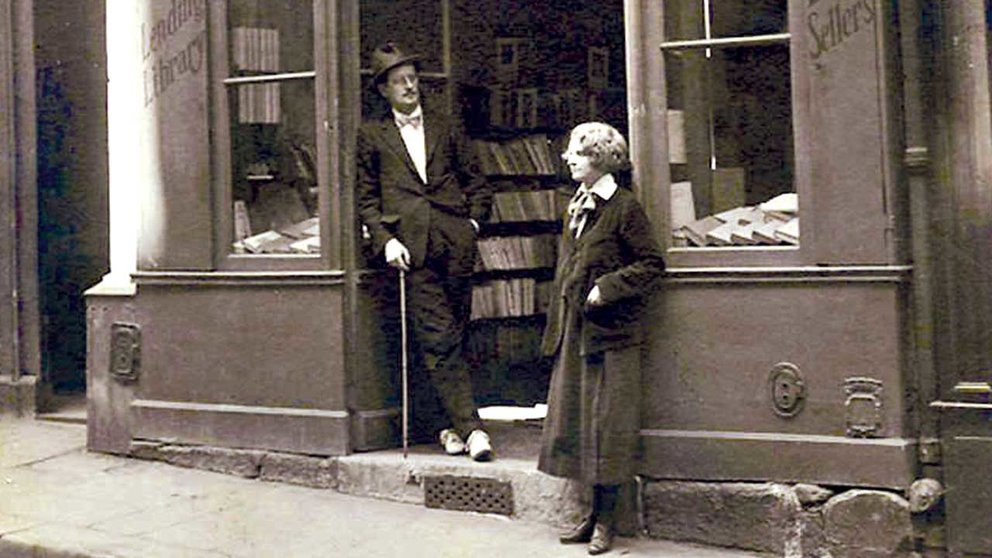
Beach and Joyce outside the original Shakespeare and Company bookstore in rue de Dupuytren in 1921
By 1934 he had finally managed to acquire his own copy after he discovered another one of his friends Mabel Fierz was taking a trip to Ostend. Thereafter Orwell continued to pick away at the novel, and made regular references to the work in the years that followed. He believed he had found in Joyce a different method of thinking, and of representing his own characters’ subjective experiences. It has been frequently argued that Orwell’s attempts to take something from the ‘style’ of Joyce towards the construction of his early novels, in particular A Clergyman’s Daughter, are among the most notable of his mistakes during his early literary development. The Trafalgar Square scene in chapter three has been cited many times as an obvious imitation of the Circe section of Ulysses, a charge that occasionally made Orwell laugh in the face of his accuser. He was known to have been proud of this chapter, however it did not sit well with critics; one such commentator Peter Quennell wrote in New Statesman and Nation that he found it ‘ambitious and unsuccessful,’ and that ‘the Trafalgar Square episode would be more impressive if it were less reminiscent to the Night Town scenes at the end of Ulysses.’iv Orwell was clearly measuring himself against Joyce, and expressed his own dissatisfaction with his experiment in another letter to Brenda Salkeld in 1934:
‘I rather wish I’d never read it (Ulysses). It gives me an inferiority complex. When I read a book like that and then come back to my own work, I feel like a eunuch who has taken a course in voice production and can pass himself off fairly well as a bass or a baritone…but if you listen closely you can hear the good old squeak just the same as ever.’v
Keeping this comment in mind, it amused me that Orwell seems to have been so absorbed in the novel to the point where he was consciously borrowing the dialogue to attack his own work. During the Sirens episode at the Ormond hotel, Bloom remembers his wife Molly’s hysterical laughter on the night Ben Dollard (who was mocked for having barrel-shaped legs) wore tight trousers to perform in a concert:
‘Tight as a drum on him… With all his belongings on show… O, I never laughed so many! Well, of course that’s what gives him the bass barreltone. For instance eunuchs.’ (p262)
It has also been suggested that Orwell lifted the title of A Clergyman’s Daughter from dialogue that takes place during the mock-Shakespeare scene in the Scylla and Charybdis episode –
‘Go to! You spent most of it in Georgina Johnson’s bed, clergyman’s daughter.’ (p182)
Despite his own initial enthusiasm over this much maligned experiment in style and technique, Orwell came to dislike A Clergyman’s Daughter immensely. Believing it to be technically flawed, he famously described it as ‘tripe’ and refused to allow it to be reprinted in his lifetime. My own view here is that Orwell was being unnecessarily hard on himself, for the conversation scene (obviously borne out of his own experiences) is clearly not lacking in artistic merit. Thereafter, when his characters have finished their somewhat dramatic (and occasionally sordid) interactions he employs the simple line ‘and so it goes on,’ to effectively redirect the narration back to himself. Other critics have cited more subtle similarities with characters in Ulysses in his other early novels Keep the Aspidistra Flying and Coming up for Air that went largely unnoticed. One additional point worth mentioning here is that the effect upon Orwell’s writing of having read and admired Ulysses was not entirely negative. Orwell refers to the ‘squalor’ as being among the key themes of the book, and gains from Ulysses the idea that there is no aspect of human behaviour, however revolting, that can be deemed as ‘off limits’ to the novelist.
Orwell was not alone among his contemporaries in his admiration for Ulysses. T.S. Eliot described it as ‘the most important expression which the present age has found; it is a book to which we are all indebted, and from which none of us can escape.’vi Ernest Hemingway, who was also a regular visitor to Sylvia Beach’s Paris bookstore, described Ulysses as simply ‘a most goddamn wonderful book,’ ascribing it a level of appeal that continues to endure among popular writers of today.vii Salman Rushdie described it as ‘one of those books that made little explosions in my mind, showing me literary possibilities I hadn’t dreamed of until I read them.’viii
I am minded that my own first encounter with Ulysses arose out of Orwell’s infectious enthusiasm for the novel in the pages of his essays, and it is worth remembering that he did forewarn us that ‘parts of Ulysses are not very easily intelligible.’ix Had I taken note at the time, I might have been spared my mental connection of Ulysses with the figure of Buck Mulligan standing over a full shaving bowl, complete with razor and mirror, a lamentable reminder that my first attempt at reading Joyce’s seven hundred and thirty-odd pages never got far beyond the opening episode. Should I feel so ashamed when so many more prominent critics also fell by the wayside? Renowned psychoanalyst Carl Jung made it to page one hundred and thirty-five with despair in his heart, falling asleep twice on the way and decried the ‘thoroughly hopeless emptiness’ as being the dominant note of the whole book.x Virginia Woolf capitulated after 200 pages having become ‘puzzled, bored, irritated and disillusioned by a queasy undergraduate scratching his pimples.’xi Aldous Huxley simply called it one of the dullest and least significant books ever written.xii
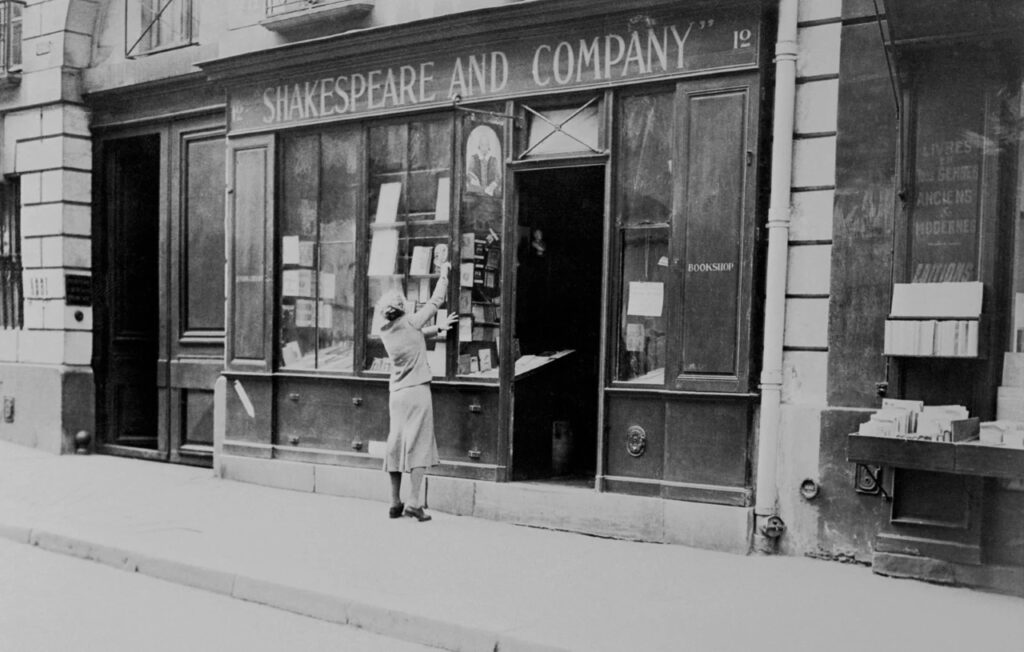
Sylvia Beach outside Shakespeare and company at the new premised in rue de l’Odeon in 1922
Remembering Orwell’s ‘Jonah analogy’ that to remain comfortably the inside of a whale’s belly enables one ‘to keep up an attitude of the completest indifference’, I am reminded of the time a couple of decades later when I finally exited the ‘whale’s belly,’ and confronted my own indifference towards Ulysses. Did I enjoy or admire the work? I have to admit that I did in parts, but confess it is not the kind of book I would recommend to everyone, especially those who would have us believe that a good book should have a beginning, a middle and an end. I’ve also reasoned that no budding novelist should set upon the onerous task of writing his or her masterpiece until they have read Ulysses, or at least acquainted themselves with the master of observation within Joyce. His descriptions of simple everyday occurrences, such as the behaviour of a dog as it follows its owner along the beach, are quite remarkable.
The enthusiastic reception that Orwell afforded the style of Ulysses in not something that noticeably endures among today’s reading public, although there still exists a large degree of fascination about the actual book itself. A signed first edition recently sold for $275,000, and Ulysses is commonly cited among the titles that most people have deliberately lied about having read; alongside Orwell’s Nineteen Eighty-Four and Tolstoy’s four-part epic War and Peace. I can understand how a book such as Nineteen Eighty-Four would make greater demands on the intellect of the reader, particularly the book-within-a-book section outlining Goldstein’s Theory and Practice of Oligarchical Collectivism, which is where I would imagine the casual reader might possibly flounder. Orwell’s own view of Ulysses as a work that challenges the reader’s intelligence is not to my mind an indication that the work is intellectually challenging in the same way as Nineteen Eighty-Four. My assumption would be that Orwell is referring to such passages as Stephen Dedalus’s ruminations on biographical details of Shakespeare that would arguably require the reader to be well read in the works of the bard and dramatist to fully understand. I can imagine a good many critics were left feeling hamstrung over what to write when confronted with a work such as Ulysses that is often described as ‘pure style,’ and I think Orwell was closer than most to uncovering the appeal of the novel in his essay “Inside the Whale“ where he refers to certain passages in Ulysses that make you ‘feel that Joyce’s mind and your mind are one, that he knows all about you though he has never heard your name, that there exists some world outside time and space in which you and he are together.’xiii
This critical aspect of Joyce’s ‘style’ is something that any casual reader could find attractive in Ulysses; to illustrate the point I am reminded of a curious incident involving an unlikely celebrity. In 1955, the pioneering photojournalist Eve Arnold photographed film star Marilyn Monroe reading a worn copy of Ulysses. It has long been wrongly assumed that this was a deliberate attempt to recast the ‘dumb blonde’ image that Monroe’s movies tended to reflect, rather than proof that she actually had a pensive side. Arnold explained some years later that Monroe kept the novel in her car and had been reading it for a long time, and would often read it aloud to herself to try to make sense of it, even though she found it hard going and struggled to read it consecutively. In a 2014 article for Time magazine Richard Conway asserts that ‘the picture still arouses suspicion in those who see literature and celebrity as mutually exclusive cultural spheres.’ In truth Monroe’s love of reading is well-known among her admirers – the 1999 Christie’s auction of her personal belongings included almost 400 books, and she was regularly photographed reading. Despite this, Monroe is evidently not the first person one would consider to have been ‘the typical Ulysses reader’ and challenges elitist assumptions about what kind of people read ‘difficult’ or highbrow literature.
With this in mind, I’m drawn to the view that Ulysses belongs to anyone and everyone and is not the exclusive property of some minor elite. In this instance, aside from Monroe’s presence very effectively promoting Joyce’s book, the image bridges the perceived gulf between highbrow literature and celebrity, and very loudly illustrates that there is not really any such thing as a ‘typical Ulysses reader.’
*
Notes:
i Drabble, M. (1996) The Oxford Companion to English Literature, Oxford University Press, p1023
ii Connolly. C, (1938) Enemies of Promise, Penguin ed (1961) p70
iii Letter from Orwell to Brenda Salkeld (1933)
iv Stansky. P, Abrahams. W, (1979), Orwell: The Transformation, Constable, London. p71
v Letter from Orwell to Brenda Salkeld (1934)
vi Eliot. T.S. Ulysses, Order and Myth (1923)
vii Letter from Hemmingway to Sherwood Anderson (1922)
viii Salman Rushdie The Guardian 26-01-2018
ix Orwell. G. “The Rediscovery of Europe”. (1942)
x Carl Jung reviewed Ulysses for the German Journal Europaische Revue in September 1932
xi Virginia Woolf, in a 1922 diary entry.
xii Aldous Huxley writing in The Los Angeles Times in 1925
Thanks Ron. Most interesting. A couple of follow-up thoughts: you mention the ‘anti-corruption’ Comstock Act in the US of 1873. As an Orwellian joke, he calls his anti-hero of Keep the Aspidistra Flying Gordon Comstock after Anthony Comstock, notoriously opposed to abortion, prostitution, gambling and contraception, who led the campaign for the Act (see Bowker 2003: 171). And while you are right, Ron, to say that Orwell described A Clergyman’s Daughter as ‘tripe’ he was actually ambivalent about the novel (as on many other topics). Earlier he had said he did not want the novel to appear in an ‘official’ form but did not ‘object to cheap editions of any book which may bring in a few pounds for [his] heirs’, as Nathan Waddell points out in the Introduction to his excellent editing and annotation of the novel (2021: xxxv).
Yes indeed Richard, the ‘Comstock Connection’ didn’t escape me, and I’m glad you flagged it up. Thanks also for adding the additional information about ACD.