
Shooting The Elephant
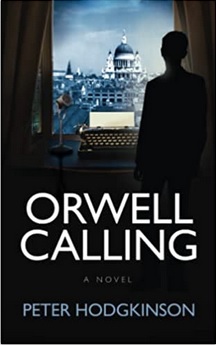
Orwell Calling, by Peter Hodgkinson: a review
On the 10th March 1942 listeners to the BBC Eastern Service in Asia heard that a new series of talks about contemporary literature was forthcoming. The announcer told them:
This evening George Orwell, who is arranging the whole series, is in the studio to give the first talk. He is going to tell you about “The re-discovery of Europe.”
We don’t know the announcer’s name, and have no idea of whether it was a man or woman – the network used members of both sexes with little regard to numbers, partly because of the difficulty in recruiting speakers: in the Eastern Service’s case, though not on this occasion, as the broadcast was in English, finding translators and speakers for the target audience languages (Marathi, Gujerati etc) could be difficult. Orwell’s talk has survived for a number of reasons: it was very good and original, it was transcribed and printed in The Listener, and finally it was published in a book exemplifying the work of the Eastern Service, Talking to India.
Given everything that might have been happening in the life of George Orwell in the previous months, according to Peter Hodgkinson’s novel Orwell Calling, we are lucky to have anything at all. Hodgkinson has set his novel in a literary lacunae: Orwell closed his first war-time diary on 28th August 1941, and he opened his second on 14th March 1942. The events of Orwell Calling fall into the period in-between.
The book is divided into two parts, with brief prologues and epilogues, and an end-note of significant dates. For the BBC team are being asked to think how they can answer Nazi radio which is broadcasting pro-Indian independence propaganda, and worse: the nationalist Subhas Chandra Bose had gone over to the Nazis and had reached Berlin to use his skills on Axis radio. Meanwhile, outside work, Orwell (sometimes he is Orwell, sometimes Blair, sometimes Eric, sometimes George) is finishing an affair with one secretary, and hoping to start another; this time, a new Indian assistant. Eileen Blair is at home still in intense depression over the death of her brother, so Orwell goes looking for a room to hire in the cheapest and consequently nastiest parts of London.
The cheap German alarm clock barely rattled into life at 5am. The bell was tinny and the mechanism had a way of losing time, much like life itself for Inspector Charles Percy of Scotland Yard.
Unfortunately for Orwell, as we leap into the second part of the novel, a number of women have been found murdered, and his inamorata disappears. He will become a suspect. He had encouraged her to read his work; he will be surprised to find that Inspector Percy reads his books, too, looking for evidence that he might be “the black-out ripper”.
Worse for Orwell is that, while he has been having tea with Rana, a colleague from BBC has happened to join them. Fortunately, it is no one from the Easter Section; unfortunately, it is Guy Burgess. Meanwhile, the hunt for “the black-out ripper” has continued, and some clever police work and a helpful passer-by have nabbed a likely suspect. Orwell, elsewhere, has learned more about the machinations of government from the husband of a broadcaster, but in return for the information he is gaining has to pimp his room. His activities make him more suspect. Inspector Percy would like to be more certain of his case, and does not leave Orwell alone, particularly after a man’s body brings the missing Rana back to significance.
And in India, Sir Stafford Cripps is trying to satisfy both the pacific and militaristic nationalists, and the Muslims and Hindus, and join them all in the battle against the Axis. Orwell’s government informant has let him know that at least one way lies disaster.
How can it end? Well, we know. We know that Orwell was able to re-open his diary, and that he could record the “failure” of the Cripps mission, but India continued to play its part in the war effort. The Axis was defeated in Europe and the East. And “the black-out ripper” was convicted. Orwell was to continue to find that Burgess diverted his broadcasters to his own programmes as best he could.
Balzac famously printed “All is true” in English in the middle of his novel Père Goriot. How much of Orwell Calling is true? Certainly you will recognise some names – Eileen Blair, Orwell, his superior Z A Bokhari, Guy Burgess. Even “black-out ripper” Gordon Cummins and his murders happened. Cummins, though, was not caught by an Inspector Percy. The married couple, Balraj and Damyanti Sahni, who attend the planning meetings: they existed though they scarcely appear in Orwell’s biographies, they were particularly friends of E M Forster who used to attend their performances of classical Indian music and dance. Little known real figures hide the introduction of the fictional characters such as Rana Mukurjee and Jahida Doshi (presumably suggested by the real-life Venu Chitale; in the same way “Betty Brown” is based on Nancy Parratt).
With the mastery of an omniscient narrator Hodgkinson can show us Burgess’s final machinations and interventions. Something Inspector Percy has to accept, and which only we today with the benefit of hindsight can know the reasons for. That Burgess could be so Machiavellian is certainly true – how far he applied it to the spoiling of Orwell’s career is much less certain.
Meanwhile, was Orwell the sex fiend and pimp that this story requires? Most of the biographies would not suggest so, though Gordon Bowker’s has suggestions of Orwell’s unfaithfulness to Eileen. The pimping in which he engages is for a fictional character who stands in for a real person: there is no suggestion that Orwell had anything to do with that government official outside their political interests in real life. Consequently, although sharing his name and address with a real person this George Orwell is a fictional character, too.
The narrative looks both backwards and forwards.
As both Rana and Inspector Percy discuss Orwell’s books they look back at Orwell’s career. Orwell, tries to tempt Rana away from his novels, to his short anti-colonial essays “Shooting an Elephant” and “A Hanging”. Why, after the first mention of “Shooting an Elephant”, he twice calls it “Shooting the Elephant” is not obvious; Rana speaks of “The Hanging” but she may be referring to the activity described and not the essay title. “A Hanging” had appeared in a 1931 issue of The Adelphi magazine, while “Shooting an Elephant” had appeared in New Writing, a magazine published as a hardback book in 1936. Neither essay had been collected at this date: could Rana have obtained back issues and read them so quickly?
Perhaps Inspector Percy can see what is coming. In an interview with Orwell he ponders:
… it’s just 1942 and we’ve already had two great wars and the Wall Street Crash. If we both had children today, I’ve a feeling they might not survive the next forty-two years. Do you think they’ll be sharing a pint in 1984?
It is cleverly done: cut “42” from “1942” as Percy does, add the smaller number to the larger date to give a later date, and get something that readers recognise with an “ah-ha!” Orwell himself had referred to Dickens working similarly in A Tale of Two Cities, but here it is a literary trope and not what Orwell called “historic necessity” in his discussion of Dickens. The miserable bedroom in the poor area is a foreshadowing of the same room in Nineteen Eighty-Four, generating another but more obvious “ah-ha!” Percy’s reference to “the Golden Country” after reading Coming Up For Air is an anachronism, however: the phrase does not occur in the 1939 novel, but in Orwell’s as yet unwritten dystopia of 1949.
The people who knew George Orwell, authors such as Anthony Powell, Stevie Smith and Julian Symons, never made him the principle character of their fictions. Perhaps like yeast extract he has to be spread thin to fully appreciate him, anything more and he can be overwhelming, while finding a plot that makes a version of him move must be almost impossible. Orwell may be calling, but will anyone come when he calls?
*
Orwell Calling, by Peter Hodgkinson (Peancobooks, 2022, 9781739123703)
Leave a Reply