
What Is Socialism?
Until the twentieth century, and indeed until the nineteen-thirties, all Socialist thought was in some sense Utopian. Socialism had nowhere been tested in the physical world, and in the mind of almost everyone, including its enemies, it was bound up with the idea of liberty and equality.
Only let economic injustice be brought to an end and all other forms of tyranny would vanish also. The age of human brotherhood would begin, and war, crime, disease, poverty, and overwork would be things of the past. There were some who disliked this objective, and many who assumed that it would never be reached, but that at least was the objective.
Thinkers as far apart as Karl Marx and William Morris, Anatole France and Jack London, all had a roughly similar picture of the Socialist future, though they might differ violently as to the best way of getting there.
After 1930 an ideological split began to appear in the Socialist movement. By this time “Socialism” was no longer a mere word evoking a dream. A huge and powerful country, Soviet Russia, had adopted a Socialist economy and was rapidly reconstructing its national life, and in nearly all countries there was an unmistakable swing towards public ownership and large-scale planning. At the same time for the word “Socialism” [there grew up in Germany the] monstrosity of Nazism, which called itself Socialism and did have certain quasi-Socialist features, but embodied them in one of the most cruel and cynical regimes the world has ever seen. Evidently it was time for the word “Socialism” to be re-defined.
What is Socialism? Can you have Socialism without liberty, without equality, and without internationalism? Are we still aiming at universal human brotherhood, or must we be satisfied with a new kind of caste society in which we surrender our individual rights in return for economic security?
Among recent books, perhaps the best discussion of these questions is to be found in Arthur Koestler’s book The Yogi and the Commissar, published about a year ago. According to Koestler, what is now needed is, “a synthesis of the saint and the revolutionary.” To put it in different words—revolutions have to happen, there can be no moral progress without drastic economic changes, and yet the revolutionary wastes his labour if he loses touch with ordinary human decency. Somehow the dilemma of ends and means must be resolved. We must be able to act, even to use violence, and yet not be corrupted by action. In specific political terms, this means rejection of Russian Communism on the one hand and of Fabian gradualism on the other. Like most writers of similar tendency, Koestler is an ex-Communist, and inevitably his sharpest reaction is against the developments that have appeared in Soviet policy since about 1930. His best book is a novel, Darkness at Noon, dealing with the Moscow sabotage trials.
Other writers who can be placed roughly in the same category are Ignazio Silone, André Malraux, and the Americans John Dos Passos and James Farrell.One might add André Gide, who only arrived at Communism, or indeed at political consciousness, late in life, but, having done so, passed almost at once into the ranks of the rebels. One can also add the French Trotskyist, Victor Serge, and the Italian, Gaetano Salvemini, the historian of Fascism. Salvemini is a Liberal rather than a Socialist, but he resembles the others in that his main emphasis is anti-totalitarian, and he has been deeply involved in the internal struggles of the Left.
In spite of the superficial resemblance that appears at certain moments, there is no real affinity between dissident Socialists like Koestler or Silone, and enlightened Conservatives like Voigt or Drucker. Silone’s book of political dialogues, The School for Dictators, may seem on the surface as pessimistic, and as critical of the existing Left Wing parties as Unto Cæsar, but the underlying world-view is very different.
The point is that a Socialist or Communist, as such—and perhaps this applies most of all to the one who breaks with his own party on a point of doctrine—is a person who believes the “earthly paradise” to be possible. Socialism is in the last analysis an optimistic creed and not easy to square with the doctrine of original sin.
A Socialist is not obliged to believe that human society can actually be made perfect, but almost any Socialist does believe that it could be a great deal better than it is at present, and that most of the evil that men do results from the warping effects of injustice and inequality. The basis of Socialism is humanism. It can co-exist with religious belief, but not with the belief that man is a limited creature who will always misbehave himself if he gets half a chance.
The emotion behind books like Darkness at Noon, or Gide’s Return from the U.S.S.R., or Eugene Lyons’s Assignment in Utopia, or others of similar tendency, is not simply disappointment because the expected paradise has not arrived quickly enough. It is also a fear that the original aims of the Socialist movement are becoming blurred.
It is certainly true that orthodox Socialist thought, either reformist or revolutionary, has lost some of the messianic quality that it had 30 years ago. This results from the growing complexity of industrial life, from the day-to-day needs of the struggle against Fascism, and from the example of Soviet Russia. In order to survive the Russian Communists were forced to abandon, at any rate temporarily, some of the dreams with which they had started out. Strict economic equality was found to be impracticable; freedom of speech, in a backward country which had passed through civil war, was too dangerous; internationalism was killed by the hostility of the capitalist powers. From about 1925 onwards Russian policies, internal and external, grew harsher and less idealistic, and the new spirit was carried abroad by the Communist parties of the various countries. The history of these Communist parties can be conveniently studied in Franz Borkenau’s book The Communist International. In spite of much courage and devotion the main effect of Communism in Western Europe has been to undermine the belief in democracy and tinge the whole Socialist movement with Machiavellianism. It is not only the writers I have named who are in revolt against these tendencies. There is a whole host of others, great and small, who have gone through a similar development. To name only a few: Freda Utley, Max Eastman, Ralph Bates, Stephen Spender, Philip Toynbee, Louis Fischer.
Except, perhaps, for Max Eastman none of these writers could be said to have reverted towards Conservatism. They are all aware of the need for planned societies and for a high level of industrial development. But they want the older conception of Socialism, which laid its stress on liberty and equality and drew its inspiration from the belief in human brotherhood, to be kept alive.
The viewpoint that they are expressing exists in the Left Wing of the Socialist movement everywhere, or at least in the more advanced countries, where a high standard of living is taken for granted. In more primitive countries political extremism is more likely to take the form of anarchism. Among those who believe in the possibility of human progress a three-cornered struggle is always going on between Machiavellianism, bureaucracy, and Utopianism.
At this moment it is difficult for Utopianism to take shape in a definite political movement. The masses everywhere want security much more than they want equality, and do not generally realise that freedom of speech and of the Press are of urgent importance to themselves. But the desire for earthly perfection has a very long history behind it.
If one studied the genealogy of the ideas for which writers like Koestler and Silone stand, one would find it leading back through Utopian dreamers like William Morris and mystical democrats like Walt Whitman, through Rousseau, through the English diggers and levellers, through the peasant revolts of the Middle Ages, and back to the early Christians and the slave rebellions of antiquity.
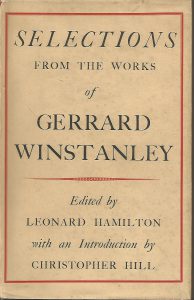
The pamphlets of Gerrard Winstanley, the digger from Wigan, whose experiment in primitive Communism was crushed by Cromwell, are in some ways strangely close to modern Left Wing literature. The “earthly paradise” has never been realised, but as an idea it never seems to perish in spite of the ease with which it can be debunked by practical politicians of all colours.
Underneath it lies the belief that human nature is fairly decent to start with and is capable of indefinite development. This belief has been the main driving force of the Socialist movement, including the underground sects who prepared the way for the Russian revolution, and it could be claimed that the Utopians, at present a scattered minority, are the true upholders of Socialist tradition.
*
A review of:-
Max Eastman: Since Lenin Died, Artists in Uniform.
Louis Fischer: Men and Politics.
Arthur Koestler: The Gladiators, Scum of the Earth.
André Malraux: Storm Over Shanghai, Days of Hope.
Gaetano Salvemini: Under the Axe of Fascism.
Ignazio Silone: Fontamara, Bread and Wine, The Seed Beneath the Snow.
Freda Utley: The Dream We Lost.
Gerrard Winstanley: Selections.
*
Manchester Evening News, 31 January 1946
Transcription based on the Complete Works of George Orwell,
edited by Professor Peter Davison
Leave a Reply