
Orwell, Carlyle and Creasy
In 1931, reviewing a biography of Thomas Carlyle, George Orwell described:
… how Carlyle’s heroes grew more dominant, more grandiose, as he himself grew richer; he passed from Burns to Cromwell, from Cromwell to Frederick—from successful rebels to successful scoundrels.
Thirteen years later, Orwell put Carlyle in a political context.
*
Introduction. In his article “Raffles and Miss Blandish” (Horizon. 1944) George Orwell writes that
… the countless English intellectuals who kiss the arse of Stalin are not different from the minority who give their allegiance to Hitler or Mussolini, nor from the efficiency experts who preached ‘punch’, ‘drive’, ‘personality’ and ‘learn to be a tiger man’ in the nineteen-twenties, nor from that older generation of intellectuals, Carlyle, Creasey and the rest of them who bowed down before German militarism. All of them are worshipping power and successful cruelty.
Thomas Carlyle is well-known. The New Oxford Dictionary of National Biography has a much longer entry for him than for many other important people including Orwell! Thomas Carlyle’s birthplace at Ecclefechan in Scotland, and his Chelsea, London, house, are preserved by the National Trust.
Thomas Carlyle was born, a stone mason’s son, in 1795 and died in 1881 aged eighty five. In 1826 he married Jane Baillie Welsh a doctor’s daughter. Their marriage was childless and it has been alleged that it was never consummated. It was certainly often an acrimonious one. She died in 1866 aged sixty four. Her letters were published posthumously and made her almost as famous as her husband.
Thomas Carlyle began his political life as a radical and sympathised with the Chartists but later moved to the right. During the American Civil War he sympathised with the Confederates who were fighting to preserve slavery. He famously advocated the Great Man theory of history; and wrote well researched and documented biographies of men of violence such as Oliver Cromwell, Frederick the Great and Napoleon.
What angered Orwell was Carlyle’s admiration for Frederick the Great. This was expressed in Carlyle’s History of Friedrich II of Prussia called Frederick the Great. It was published in six volumes from 1858 to 1865.
Frederick the Great was born in 1712 and succeeded his father as King of Prussia in 1740. There followed a generation of wars in which by military skill, treachery and luck, Prussia became a great power. He then worked to develop it economically and culturally; and took part in the 1772 First Partition of Poland along with Austria and Russia. He died in 1786 aged seventy four.
Frederick the Great was a British ally in the Seven Years War (1756-1763). The image of our ally little Prussia fighting gallantly against France, Russia and the Austro-Hungarian Empire appealed to those who sympathised with real or alleged under-dogs.
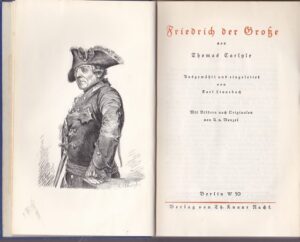
Apart from admiring the early and less ugly stages of Prussian/German militarism many Victorian Britons admired German culture. They did not have hindsight and could not know that the Germany of Goethe and Beethoven would become that of Nietzsche and Hitler.
A Freudian slip. My copy of Orwell’s article “Raffles and Miss Blandish” comes from an anthology of his writings titled Decline of the English Murder and Other Essays (Penguin, 1965). It refers to
… that older generation of intellectuals, Carlyle, Creasey and the rest of them who bowed down before German militarism.
Creasey? The only prominent writer I know of called Creasey was John Creasey (1908-1973) a prolific detective story and other pulp fiction writer. They inspired several radio and TV Series and films. He helped found the Crime Writer’s Association and the 1960’s were his glory days. Presumably a tired and over-worked copy-editor missed Orwell’s slip. Every writer, including myself, makes typos.
Sir Edward Shepherd Creasy was who Orwell meant. Edward Shepherd Creasy was born at Bexley in Kent on 12 September 1812. His father Edward Hill Creasy an estate agent later moved to Brighton, became an auctioneer, and founded the Brighton Gazette in 1821 to publish his own adverts.
Edward Shepherd Creasy studied at Eton; won a scholarship to King’s College, Cambridge; became a Fellow of it in 1834; and was called to the bar in 1837. He practised on the Home Circuit and was an Assistant Judge at the Westminster Sessions Court. In 1840 he was appointed Professor of Modern and Ancient History at London University.
In 1846 Edward Shepherd Creasy thirty three married Mary Maria Cottam, twenty one, the daughter of George Cottam, a civil engineer. Edward Shepherd and Mary Maria Creasy were to have eight children. One of their grandsons was Admiral of the Fleet Sir George Elvey Creasy (1895-1972).
In 1860 Edward Shepherd Creasy was appointed Chief Justice of Sri Lanka (Ceylon) and knighted. He remained in that post until 1875 with one holiday in Britain in 1869. He retired and returned to Britain permanently in ill health in 1875. He died in London on 27 January 1878. His wife Lady Creasy died on 24 March 1912 in Surrey aged eighty seven.
Edward Shepherd Creasy, an old Etonian (like Orwell), wrote Some Account of the foundation of Eton College and of the past and present condition of the school (1848), and Biographies of Eminent Etonians (1850). He wrote articles for Bentley’s Miscellany, a literary journal, and comic verse for the Tipperary Hall Ballads.
Edward Shepherd Creasy wrote The Textbook of the Constitution (1848); the fifteen Decisive Battles of the World from Marathon to Waterloo, (1851); The Invasions and the Projected Invasions of England, from the Saxon times. With remarks on the present emergencies (1852); and The Rise and Progress of the English Constitution (1853) which sold well and was a school and college textbook for many years.
In 1854-1856 Creasy’s History of the Ottoman Turks chiefly founded on Von Hammer was published in two volumes. This was after the Crimean War when Britain and Turkey were allies. Von Hammer was Joseph Freiherr von Hammer Purgstall, an Austrian scholar on whose work Creasy’s book was based. Von Hammer argued that the first European civilisation, Ancient Greece, was culturally intertwined with the ancient Middle Eastern cultures such as Egypt and Babylonia.
Being Chief Justice of Sri Lanka was time consuming but in 1869 two volumes of Creasy’s planned five volume History of England were published. His novel trilogy The Old Love and the New appeared in 1870, and his The Imperial and Colonial Institutions of England in 1872.
Sir Edward Shepherd Creasy was a Whig historian who believed in gradual progress. His only military history books was his most famous book, The Fifteen Decisive Battles of the World from Marathon to Waterloo. The fifteen were:-
1. The Athenian victory over the Persians at Marathon in 490 BC
2. The Athenian defeat at Syracuse on Sicily in 413 BC
3. Alexander the Great’s victory over the Persians at Arbela in 331 BC
4. The Roman victory over Carthage on the Metaurus in Italy in 207 BC.
5. The German victory over Varus’s Roman legions in AD 9
6. The Roman defeat of the Huns at Chalons on the Marne in 451
7. The French victory over the Arabs and Moors at Tours in 732
8. The Battle of Hastings 1066
9.Joan of Arc’s victory over the British at Orleans in 1429.
10. The defeat of the Spanish Armada in 1588
11. Marlborough’s victory over the French at Blenheim in 1704.
12. Peter the Great of Russia’s victory over the Swedes at Poltava in 1709
13.The American victory over the British at Saratoga in 1777.
14. The French revolutionary victory at Valmy in 1792.
15. Wellington’s defeat of Napoleon at Waterloo in 1815.
The only German victory listed was a revolt by the German tribes on German soil against the Romans. Six of the battles were fought in ancient times, three in the Middle Ages, and six in modern times. Six involved British forces including three British defeats. All involved European armies. Thirteen were fought in Europe; one was an American victory over the British; and one a European victory in Asia against the Persians. None of Frederick the Great’s victories were included.
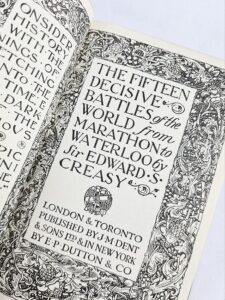
Of the fourteen victorious armies and one victorious navy all but one were European. The exception was the American army that defeated the British at Saratoga in the American War of Independence. Nine of the defeated armies and the defeated fleet were European. Two of the defeated armies were Persian, one was Carthaginian, one Hun, and one an Arab and Moorish Army. The Huns in question were Attila’s Asiatic nomadic horsemen, not Germans. The use of Hun as a nickname for Germans began after Creasy was dead.
The victory of Arminius (in German Herman) and his tribesmen over Rome in the German forests is glorified by Creasy as the heroic victory of a brave if brutal free people, over a decadent, corrupt and brutal slave empire; and Creasy argues that since the Anglo-Saxons were originally Germans we owe our existence to it. However he criticised extreme pro-Germans who denied the Celtic and Roman contribution to Britain.
Creasy was Eurocentric but can be acquitted of admiring modern German militarism let alone despotism. For geo-political reasons, such as the Roman reliance on sea and river transport, they probably could not have ever permanently conquered Germany; but if they had England would not exist, though Britain would.
If Caractacus or Boadicea had been victorious, modern historians would probably argue that Rome could never have conquered Britain. They would not, of course, be writing in English.
Finally Sir Edward Shepherd Creasy’s book The Fifteen Decisive Battles of the World from Marathon to Waterloo was certainly read by Gilbert and Sullivan’s Modern Major General who knew all the fights historical from Marathon to Waterloo. Gilbert’s lyric was gently hinting that the average Victorian British officer was not an intellectual.
*
Leave a Reply