
The Wigan Diary Celebrated
In the 120th year after the birth of George Orwell, Richard Lance Keeble celebrates his Wigan Diary as literary journalism
*
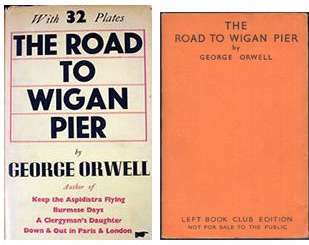
One of the most remarkable pieces George Orwell ever wrote (and one of my favourites) was never intended for publication. The diary he composes while in the north of England over two months in early 1936 researching the plight of the miners and unemployed – on a commission from the publisher Victor Gollancz – has drawn nothing like the attention given to The Road to Wigan Pier (1937). Orwellian biographers and critics have tended to consider the diary (first published by Sonia Orwell and Ian Angus in the Collected Essays, Journalism and Letters, of 1968) largely as a ‘factual’ back-up to The Road. Its qualities as a blend of literary journalism, investigative reporting and sociological survey have never been adequately acknowledged.
The length of the diary is particularly striking: it is divided into twelve sections in the Complete Works, edited by Peter Davison (X: 419-467) and takes up 49 pages in CEJL (Vol. I: 194-243). Orwell clearly cares for many of the people he meets and is determined to record as much as possible of their lives – quite simply because he feels his readers need to know about the economic injustices he witnesses. This view contrasts with that of D.J. Taylor who, in his new biography of Orwell, writes: ‘For all his assiduousness in collecting housing statistics, it is remarkable how little Orwell actually sees there.’ Rather than portraying Orwell as determined to record people’s individual features, Taylor stresses Orwell’s keenness on ‘types’, ‘his trick of fitting the people he meets into generalised patterns of human behaviour and somehow subsuming their individuality into the mesh of his own controlling logic’ (2023: 352).
In fact, the diary is packed with details: about his travel arrangements (buses, trains, cars, trams – together with lots of long walks), the weather, the places he visits, his sleeping arrangements, the clothes people wear, the public meetings he attends, the workers he chats to, his meals, descriptions of natural life and so on.
Profiling – and showing solidarity
The many profiles of both named and unnamed people (I count 24 in the first category and 41 in the second), in particular, reflect Orwell’s genuine interest in and empathy for the working class and are clearly the result of many detailed, informal conversations. As biographer Bernard Crick comments: ‘… being taken round by political activists, mainly Marxists, whether Communist Party, Trotskyist or ILP persuasion, it is likely that the homes they knew they could enter easily would be those of supporters. He was meeting almost all the time a special section of the most politically conscious of the working class’ (1980: 289).
The profile (often based on a formal interview) has emerged as a dominant genre, reflecting the essential ‘human interest bias’ of the corporate media (see Joseph and Keeble 2015). But the profile serves a very different purpose for Orwell. He is listening intensely, determined to learn and record accurately – and to show his solidarity. Orwell is unlikely to have noted down these chats on the spot and so had to rely on his memory when later writing them up: this, in itself, was quite a feat!
On 11 February, while staying at Warrington Lane, Wigan, and sharing a room with another lodger (an unemployed railwayman), he writes of Joe, another lodger (CEJL I: 200):
… single. Unemployed on 17s a week. Pays 6s. a week for his room and sees to his own food. Gets up about 8 to give his bed up to ‘our Joe’ [son of the couple running the lodging house] and remains out of doors in Public Library etc most of the day. A bit of an ass but has some education and enjoys a resounding phrase. Explaining why he never married, he says portentously, ‘Matrimonial chains is a big item.’ Repeated the sentence a number of times, evidently having an affection.
Orwell must have worked quickly to gain Joe’s trust for he is prepared to share the (quite personal) information about his unemployment benefit and lodging payment. He also observes closely Joe’s daily routine – and how seeking refuge in the relatively warm library is a result of his impoverishment and joblessness. While Orwell is determined to confront the class prejudices dominant at the time (through living with beggars and down-and-outs in Paris and London and the working class in the north of England, ‘submerging himself amongst the oppressed’) a part of him remains forever an old-Etonian. Indeed, does not dubbing Joe ‘a bit of an ass’ have an old-Etonian ring to it? But Orwell was throughout his career fascinated with language, accents, vernacular and witticisms. So typically he goes on to record Joe’s idiosyncratic way of talking.
Orwell’s ability here and throughout the diary to sum up a personality in a few words perhaps stems from his time as an Imperial policeman in Burma (1922-1927) where the writing of such profiles was an integral part of his job. As John Sutherland points out (2016: 104-105):
The Burmese police force, like its parent Indian force, was not primarily an instrument for maintaining law and order but one for gathering intelligence and nipping any possible uprising in the bud. … [Orwell] was not moved around because he gave dissatisfaction but because he was good at his job: a competent spy in policeman’s uniform. He was shrewd, fluent in native language and observant, and could write the kind of clear English that made for a good analytic report.
Orwell’s solidarity with the activist workers (many of them recommended to him by Richard Rees, editor of the Adelphi) shines through his affectionate portraits. When he arrives in Liverpool on 25 February 1936 he feels ‘ignominiously sick’ (CEJL I: 213) and John Deiner, who ran the city branch of the Adelphi circle, and his wife, May, quickly put him to bed. He goes on to meet George Garrett, a black-listed, unemployed communist – and he is greatly impressed. The profile that follows is packed with fascinating biographical details and captures Orwell’s profound sympathy for the man (ibid 213-214):
Had I known before that it is he who writes under the pseudonym of Matt Low in the Adelphi and one or two other places, I would have taken steps to meet him earlier. He is a biggish hefty chap of about 36, Liverpool-Irish, brought up a Catholic but now a Communist. He says he has had about 9 months’ work in (I think) about the last 6 years. He went to sea as a lad and was at sea about 10 years, then worked as a docker. … He also worked in an illicit brewery in Chicago during Prohibition, saw various hold-ups, saw Battling Siki immediately after he had been shot in a street brawl etc etc. All this however interests him much less than Communist politics. I urged him to write his autobiography but as usual, living in about 2 rooms on the dole with a wife (who I gather objects to his writing) and a number of kids, he finds it impossible to settle to any long work and can only do short stories.
In her essay ‘Orwell – paterfamilias or Big Brother’ (1984: 126-138), Beatrix Campbell, in presenting an important feminist critique, suggests that his attitude to the working class ‘edges on contempt’. But the evidence throughout the Wigan Diary suggests, rather, the very opposite. In Sheffield, he stays with the Searle family and says of them: ‘I have seldom met people with more natural decency. They were as kind to me as anyone possibly could be, and I hope and trust they liked me’ (CEJL 1: 219).
Eye-witness reporting
The diary also incorporates wonderful examples of eye-witness reporting. With Garrett, Orwell visits the Liverpool docks to see dockers being taken on for an unloading job. His report of what he witnesses – over 198 words – captures all the drama of the event. It begins:
When we got there we found about 200 men waiting in a ring and police holding them back. It appeared that there was a fruit ship which needed unloading and, on the news that there were jobs going, there had been a fight between the dockers which the police had to intervene to stop. After a while the agent of the company (known as the stevedore, I think) emerged from shed and began calling out names or rather numbers of gangs whom he had engaged earlier in the day (ibid: 214).
Earlier, on 20 February 1936, Orwell records the ‘astonishing sight’ of unemployed miners robbing a ‘dirt train’ (or as they call it ‘scrambling for the coal’) at Fir Tree Sidings outside Wigan. It’s a nightmarish scene of desperate men and boys risking their lives to steal coal – simply in order to survive. Orwell writes: ‘Only recently a man slipped under the train and had both legs cut off. Considering the speed the train goes at, it is remarkable that accidents do not happen oftener’ (ibid: 2019).
I always feel that Orwell erred in opening The Road to Wigan Pier with the description of the Brookers’ tripe shop and lodging house at 22 Darlington Street in all its horrific filth. Here his sympathy for the plight of the Wiganers he meets eludes him: ‘On the day when there was a full chamber-pot under the breakfast table I decided to leave. The place was beginning to depress me. It was not only the dirt, the smells and the vile food, but the feeling of stagnant meaningless decay, of having got down into some subterranean place where people go creeping round and round, just like the blackbeetles, in an endless muddle of slovened jobs and mean grievances’ (1980 [1937]: 130). As Crick writes: ‘Wigan is, to this day, collectively touchy on the tripe shop issue’ (1980: 282). How much better it would have been to have started with the account of the ‘astonishing scene’ of coal scrambling – highlighting so powerfully the desperate plight of the unemployed.
Orwell’s long piece of eye-witness reporting about his trip underground at a coal mine that features prominently in The Road to Wigan Pier is unforgettable (1980 [1937]: 132-139). Here in the diary he actually records three trips underground – another indication of his dedication to experience as closely as possible the life of the miner. Travelling for long distances through the tunnels is for Orwell, at 6ft 3ins, no easy task. At the first pit, Crippen’s, he records: ‘After a few hundred yards of walking doubled up and once or twice having to crawl, I began to feel the effects in a violent pain all down my thighs. One also gets a crick in the neck … but the pain in the thighs is worst’ (CEJL I: 211). He continues: ‘On the way back my exhaustion grew so great that I could hardly keep going at all, and towards the end I had to stop and rest every fifty yards’ (ibid: 212). But he remains intent on understanding the operations of the mining machines: ‘Here there was one of the larger machines which have a crew of 5 men to work them. This machine has a revolving wheel on which there are teeth about a couple of inches long set at various angles; in principle it is rather like an immensely thickened circular saw with the teeth much further apart, and running horizontally instead of vertically. … Two men called “scufters” shovel the coal on to a rubber-belt conveyor which carries it through the tunnel to the tubs on the main road where it is hauled by steam haulage to the cages’ (ibid: 211-212).
Women and Wigan
Beatrix Campbell compares Orwell’s celebration of the miners’ manly labour with his denigration of the work of women: ‘Women do not appear as protagonists in Orwell’s working class’ (1984: 129). And yet women do feature in the diary. On 15 February 1936, having just visited a caravan park in Wigan, he writes with compassion: ‘What chiefly struck me was the expression on some of the women’s faces, especially those in the more crowded caravans. One woman had a face like a death’s head. She had a look of absolutely intolerable misery and degradation’ (CEJL I: 202). In Sheffield, he has a long conversation with Mrs Searle (judging by the length of his profile of her) and comments: ‘I was surprised by Mrs S.’s grasp of the economic situation and also of abstract ideas’ (ibid: 220). On 16 March 1936, Orwell writes colourfully of the meeting he attends the previous night at a packed Barnsley Public Hall addressed by the fascist leader Oswald Mosley. A number of protestors are violently thrown out by some of the 100 Blackshirts on duty and Orwell later notes that a women ejected ‘was hit on the head with a trumpet and was a day in hospital’ (ibid: 233).

Historic map of Barnsley (extract): National Library of Scotland
On 18 March, he makes a special mention of a very old Lancashire woman ‘who in her day has worked down the pit, dragging tubs of coal with a harness and chain. She is 83, so I suppose this would be in the seventies’ (ibid: 234). When he attends a social evening organised by the National Union of Mine Workers to raise money for the defence fund of Ernst Thaelmann, chairman of the German Communist Party who had been arrested in 1933, he notices that most of the 200 people present are women. But here he doesn’t hold back on his criticism: ‘I suppose these people represented a fair cross-section of the more revolutionary element in Wigan. If so, God help us. Exactly the same sheeplike crowd – gaping girls and shapeless middle-aged women dozing over their knitting – that you see everywhere else’ (ibid: 2007). And on 22 March, he reports on a ‘disappointing’ communist meeting in Wigan Market Place though ‘the usual handful of women a little more animated than the men – I suppose because no woman would go to a political meeting unless exceptionally interested in politics’ (ibid: 241).
Orwell even shows himself sensitive to gender politics in the home and beyond. On 5 March, he records the controversy he causes when he helps Mrs Searle with the washing up (ibid: 222). The two men of the house disapprove. Orwell continues: ‘Mrs S. seemed doubtful. She said that in the North working class men never offered any courtesies to women (women are allowed to do all the house-work unaided even when the man is unemployed and it is always the man who sits on the comfortable chair) and she took these things for granted but did not see why it should not be changed.’ Men, he says, would lose their manhood if they stooped to doing any housework (except carpentering and gardening).
The most celebrated representation of a woman in The Road to Wigan Pier comes when he leaves Wigan by train. He writes:
At the back of one of the houses a young woman was kneeling on the stones, poking a stick up the leaden waste-pipe which ran from the sink inside and which I suppose was blocked. I had time to see everything about her – her sacking apron, her clumsy clogs, her arms reddened by the cold. She looked up as the train passed, and I was almost near enough to catch her eye. She had a round pale face, the usual exhausted face of the slum girl who is twenty-five and looks forty, thanks to miscarriages and drudgery, and it wore, for the second in which I saw it, the most desolate, hopeless expression I have ever seen (1980 [1937]: 131).
Interestingly, the account differs in the diary. Rather than seeing the woman from a train, Orwell, on 15 February 1936, records seeing her while on a walking tour with NUWM officials collecting facts about housing conditions: ‘At the moment she looked up and caught my eye and her expression was as desolate as I have ever seen; it struck me that she was thinking just the same thing as I was’ (CEJL I: 2013). So why did Orwell make this change? According to Crick, Orwell transformed the ‘flat’ account in the diary into literature, showing his ‘growing skill as a writer, his ability to use, not to be dominated by his material, to keep the essentials in mind, not to lose the wood for the trees’ (1980: 287). ‘… the train leaving Wigan is itself a symbol of the writer’s almost desperate pain at being merely an observer, a member of another class who, having done his contracted task, is carried off remorselessly and mechanically simply to write about “what can be done”’ (ibid).
Extraordinarily detailed research for the book
Orwell spends quite a time in Wigan Reference Library going laboriously through census reports, newspaper cuttings, trade directories, health officers’ reports, relevant books and council reports compiling facts about the mining industry, unemployment, the phenomenally high rate of accidents and local housing conditions – but there is no mention of this in either the diary or book. Davison carries in an Appendix all the notes Orwell makes – and they cover 44 pages (CWGO X: 540-584). The detail is extraordinary. Orwell (complete with tape measure), for instance, has inspected a vast number of houses and made meticulous notes – all simply as background to his book project. Inevitably, only a small selection of statistics carefully taken down are used in the first section of The Road.
Moreover, it is interesting to see what appears in the diary but fails to make the book. For example, Orwell reports in his diary on 7 March 1936 staying with his sister Marjorie and husband Humphrey Dakin at 21 Eastcourt Avenue, Headingley, Leeds (CEJL 1: 223) – but there is no mention of this in The Road. Having submerged himself in working class culture, Orwell is now significantly highly sensitive to class distinctions. He reflects: ‘Conscious all the while of difference in atmosphere between middle class home even of this kind and working class home. The essential difference is that here there is elbow-room, in spite of their being 5 adults and 3 children, besides animals, at present in the house. The children make peace and quiet difficult, but if you definitely want to be alone you can be so – in a working class house never, either by night or day’ (ibid: emphasis in the original).
Conclusion
In short, the Wigan Diary, which Peter Stansky and William Abrahams praise as ‘unselfconscious’ and ‘unexaggerated’ in their pioneering biography (1979: 149), amounts to a superb example of meticulous, reflective, investigative, literary reporting and worth celebrating in this – the 120th anniversary year of Orwell’s birth. It is time it was brought out from under the shadow of The Road to Wigan Pier. It certainly should be on the Essential Reading List of every journalism student.
References
Campbell, Beatrix (1984) Orwell – Paterfamilias or Big Brother? Norris, Christopher (ed.) Inside the Myth – Orwell: Views from the Left, London: Lawrence & Wishart pp 126-138
Crick, Bernard (1980) George Orwell: A Life, Harmondsworth, Middlesex: Penguin
Joseph, Sue and Keeble, Richard Lance (2015) The Profiling Handbook, Bury St Edmunds: Abramis
Orwell, George (1980 [1937]) The Road to Wigan Pier, Collected Non-Fiction, London: Secker & Warburg/Octopus pp 123-231
Orwell, George (1998) The Complete Works, XX Vols, Davison, Peter (ed.) London: Secker & Warburg
Orwell, Sonia and Angus, Ian (1968) The Collected Essays, Journalism and Letters of George Orwell, Vol I: An Age Like This, London: Secker & Warburg
Stansky, Peter and Abrahams, William (1979) Orwell: The Transformation, London: Constable
Sutherland, John (2016) Orwell’s Nose: A Pathological Biography, London: Reaktion Books
Taylor, D.J. (2023) Orwell: The New Life, London: Constable, Kindle edition
- The author would like to thank Darcy Moore for his comments on a draft. He remains entirely responsible for the final version.
Richard Lance Keeble, a dedicated diary writer himself,
was chair of The Orwell Society from 2013-2020.
Leave a Reply