
A Solzhenitsyn without a Gulag
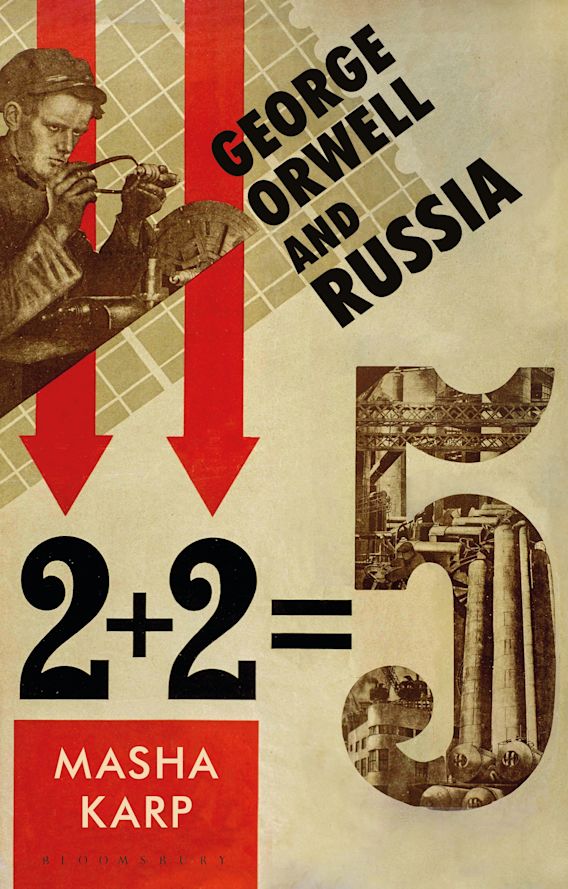
George Orwell and Russia: 2+2=5 by Masha Karp
*
In his book The Captive Mind, written in 1951-2, the Polish-American Nobel Prize-winning poet and essayist Czeslaw Milosz paid George Orwell one of the greatest compliments that one writer has ever bestowed upon another. Milosz had seen the Stalinisation of Eastern Europe from the inside in his role as a cultural official. He wrote of his fellow-sufferers:
“Few have become acquainted with Orwell’s 1984; because it is both difficult to obtain and dangerous to possess, it is known only to certain members of the Inner Party. Orwell fascinates them through his insight into details they know well, and through his use of Swiftian satire. Such a form of writing is forbidden by the New Faith because allegory, by nature manifold in meaning, would trespass beyond the prescriptions of socialist realism and the demands of the censor. Even those who know Orwell only by hearsay are amazed that a writer who never lived in Russia should have so keen a perception into its life.”
From the moment he returned from Spain in July 1937, right up until his death in January 1950, Orwell’s career as a writer was largely dominated by his attempts to explain the betrayal and ultimate failure of the Soviet Socialist utopia. In George Orwell and Russia, the key question that Masha Karp endeavours to answer is ‘How did Orwell know so much about what was happening?’ How did he assimilate that extraordinarily keen perception into Russian life to which Milosz referred? A member of the St Petersburg Writer’s Union – the former city of Leningrad in which she was born and home to the university in which she gained her MA in philology, Karp’s impressive list of credits includes the Russian translation of Animal Farm and a first biography of George Orwell published in the Russian language. One cannot help but think she is uniquely qualified to tackle these questions.
Karp starts out by exposing how the pre-pseudonym Eric Blair’s initial belief in the Soviet experiment was first challenged by the Russian writer Eugene Lanti who founded an Esperanto organisation as a tool for assisting in overturning the capitalist order. Lanti lived with Orwell’s Aunt Nellie Limouzin in Paris (they would eventually marry), and after having witnessed the failings of the revolution and turned his back on the Soviet Union, Lanti became the first person to dampen Orwell’s relatively uncontaminated enthusiasm for the Worker’s State. A few years later in the early 1930s Orwell learned a lot more about conditions in the Soviet Union from bookshop proprietor Myfanwy Westrope who had visited the USSR and been deeply disappointed by what she saw. Myfanwe Westrope’s husband Francis was known to the authorities as ‘a man who holds Socialist views and considers himself an intellectual.’ Orwell was soon on the security radar himself, due to his associating with the Westropes after he had taken up employment in their bookstore.
Following on from a discussion on The Road to Wigan Pier, and Orwell’s frustrations with the current brand of Socialism that he was still not quite ready to embrace, we move on to Spain where Orwell very soon felt the cold hand of Stalin during his involvement in the Spanish Civil War. He originally attempted to enlist through the Independent Labour Party who furnished him with a letter of introduction to British Communist leader Harry Pollitt. Karp asserts that Pollitt saw immediately that ‘he was not the stuff reliable comrades were made of’ – he was indeed, too independent, and considered to be politically unreliable. When Orwell eventually succeeded in getting to Spain; the climactic stage of his six months with the POUM Trotskyist-revolutionary unit was the most decisive experience of his life. Having gone to Spain to fight for common decency against Fascism, his war had engulfed him in the confusing intricacies of political in-fighting among the Republican factions. He had suddenly found himself at far greater risk from a communist bullet than a Fascist one, requiring himself and wife Eileen to flee from the terror that ensued. Karp believes that many of the items listed among the possessions discovered and seized by NKVD agents when Eileen’s hotel room was raided, were likely planted to incriminate him. She further states that it is also probable that a letter from John McNair discovered among the possessions of Orwell’s colleague and friend in Spain Charles Doran likely exposed him as a Trotskyist.
The insight Orwell gained during the Spanish Civil War and its aftermath transformed him, and ultimately enabled him to accomplish the works for which he is best remembered. That said, however, it turned out to be a long and tricky path. The poet W.H. Auden wrote in 1955 that ‘nobody I know who went to Spain during the Spanish Civil War who was not a dyed in the wool Stalinist came back with his illusions intact.’ This was certainly true of Orwell, who having witnessed with his own eyes how the hidden hand of Stalin had destroyed Republican unity, soon discovered he could not get a true account of the political turmoil into print. His review of Franz Borkenau’s The Spanish Cockpit was rejected by Kingsley Martin at New Statesman as ‘liable to cause trouble,’ and was eventually published in the much lesser publication Time and Tide. Having read the review, Borkenau praised Orwell for getting to the essential point that other reviewers had deliberately skipped over. This alluded to the realisation of the two regimes of Bolshevism and Fascism starting at opposite ends of the political spectrum, gradually evolving towards the same system – a totalitarian hell described by Orwell as a form of Oligarchical Collectivism. Karp proceeds to explaining how works by Borkenau and Koestler – in particular Darkness at Noon, confirmed Orwell’s belief that the two opposing regimes had become virtually indistinguishable. In the opening chapter of Koestler’s book, Rubashov is unsure of whether he is in a prison run by the NKVD or the Gestapo.
Not until the final years of World War II was Orwell fully able to fully reflect upon the events of Spain and the great Soviet betrayal, and accept the view that the inevitable consequence of revolution would be the betrayal of the working class. Rather than be used to further the causes of the revolution, the power gained by its instigators would ultimately be used to further exploit the workers. The revolution that would lead to the society Orwell describes in Nineteen Eighty-Four represented no more than a stepping stone along the road to tyranny: ‘One does not establish a dictatorship in order to safeguard a revolution; one makes the revolution in order to establish a dictatorship.’
Karp points to ‘Soviet mole’ Peter Smollitt as a key figure in stifling any attempt to criticise the Soviet Union or expose the corruption of the regime. She effectively explains how he used his position at the head of the Russian Section at the Ministry of Information to monopolise all incoming and out-going information about Russia. The threat he posed was multiplied by the fact that he also had the ear of notorious spies Guy Burgess at the BBC and Kim Philby and Anthony Blunt at MI6 and MI5 respectively.
The story of the difficulties Orwell experienced in his efforts to get Animal Farm published is dealt with by Karp comprehensively, leaving no doubt as to the reasons behind its continual rejection. To begin with, Lenin had originally sold the Soviet people a Socialist illusion of a state in which the working class would eventually triumph. In Animal Farm Orwell very effectively illustrated the degree to which such an illusion had been turned on its head through authoritarian rule by means of deception and terror at the hands of Stalin. The key problem for Orwell when trying to get his fable published lay in the fact that there were still many among the British intelligentsia who would ‘fall over themselves’ to heap praise upon Stalin’s head, in the belief that he really had abolished injustice and exploitation and that he was a man who simply had no failings. These Russophiles, as Orwell described them, turned a deaf ear to the more perceptive of left-wing intellectuals who claimed that Soviet communism under Stalin had evolved into a ruthless regime implementing the sinister deeds of a collectivist ideology via ruthless brutality and unashamed corruption under the guise of Socialism. It came as no surprise when Karp informs us that the same Peter Smollitt figured largely as one of the main protagonists who deliberately impeded its path to publication.
Orwell’s essay ‘The Prevention of Literature’ (1946) is frequently mentioned throughout Karp’s study; chiefly in relation to the destruction of literature under totalitarian rule, and the ‘poisonous effect’ of the Russian myth that results in deliberate suppression and distortion of ‘known facts’ – essentially the system of organised lying that Orwell saw as being a key tenet of totalitarianism: ‘Totalitarianism demands a disbelief in the very existence of objective truth.’ Inside Russia writers took enormous risks to communicate to the outside world something of what was happening. In her discussion of Zamyatin’s We (1919-20) Karp prefers to focus on the key differences, rather than the frequently-discussed ‘borrowings’ or similarities to Nineteen Eighty-Four. Aside from highlighting the obvious differences in the technical construction of the two novels, Karp makes the important point that at the time Orwell questioned whether Zamyatin even intended to base his novel on the Soviet Union – the date of publication which was not known at the time certainly supports this view. Orwell was challenged for thinking as such, yet his doubts are also reflected in a key difference that separates Nineteen Eighty-Four from We (also identified by George Woodcock in The Crystal Spirit, his memoir of his friend) being that the pretence of providing happiness as compensation for loss of freedom is not maintained in the novel that Orwell based chiefly (but not exclusively) on the Russian model.
In ‘The Prevention of Literature’ Orwell also launched an attack on scientists as ‘uncritical admirers of the USSR’ and accused them of being self-centred to the extent that they were ignorant to the destruction of liberty. Karp makes due reference to the Russian Scientist Trofim Denisovich Lysenko, who in 1940 had been appointed by Stalin as Director of the Soviet Academy of Agricultural Science. Karp adds significant additional information to research carried out by Peter Davison into Lysenko, who had rejected traditional hybridisation theories, and advanced outrageous alternative concepts that farmers were forced to adhere to. As a result there were serious consequences for agricultural output to the extent that Lysenko played an active role on the famines that killed millions of Russians and tens of millions more in China where his methods had also been adopted. Opposition to Lysenko’s theories had been outlawed by Stalin in 1948, a development that eminent British biologist John, R. Baker used to underline his theory of the degradation of science under totalitarian regimes. Orwell re-defined Baker’s theory as Bakerism, and it was a key trigger that prompted him to begin serious work on Nineteen Eighty-Four. Just as Lysenko’s work depended on the denial of science, Orwell ensured there would be no word for science in the Newspeak dictionary, as science, in the old sense, had ceased to exist.
Part II commences with ‘Opposing the Soviet Menace’ – an examination of Orwell’s activities in relation to the early post-war years of the Soviet Union. This includes attempts by him and Koestler to bring the tragedy of the Katyn Massacre of 22,000 Polish officers and intelligentsia to the attention of the world, as there had been no appetite among the other victors during the trials at Nuremburg to bring the USSR to justice. There is much discussion on Orwell’s attempt with Koestler to found a new anti-totalitarian organisation to warn off intellectuals everywhere from embracing Stalinism as a better way forward. The Cold War that Orwell foresaw was now in progress, and, aside from the occasion cry of frustration over the Americans (he once referred to them as gangsters), Orwell conceded that in any straight choice between the two new super-powers, he would always chose America – although mainly out of necessity.
As to the worrying appeal of Stalinism throughout Britain during the post-war years, Karp takes the more sensible approach to Orwell’s much maligned list of crypto-Communists ‘not to be trusted’ that he forwarded to the Information Research Department in May1949. Such is her thoughtful handling of the issue, that it rather makes those opportunist pressmen who used Orwell’s name for sensationalist headlines at the time look rather ridiculous. She looks at the ‘list’ through late 1940’s’Cold War’ eyes, rather than twenty-first century eyes as other critics tend to have done. There were good reasons why Orwell’s somewhat ‘politically improper’ comments alongside the names were included, as trusting such persons could be a pretty serious business, especially among those who might leave themselves open to blackmail. Orwell made it clear in a letter to Celia Kirwan that the likes of Smollett might never have got as close to causing Britain real harm if such lists or warnings had existed previously.
There again follows some discussion on Orwell’s confusing, and sometimes, love-hate relationship with Socialism and its adherents, during which Karp makes clever use of the author’s own statements to try and guide us through his seemingly ever-changing ideas of how best a planned economy might work. Next up in part two is a detailed discussion on the foreign translations of Animal Farm, in particular the Ukrainian translation for which Orwell provided a preface containing a most detailed explanation of his motives. The Polish-born translator Ihor Szewczenko regrettably cut certain passages from Orwell’s original draft that did not survive; meaning the preface we have today is simply a back-translation of the published Ukrainian edition.
‘Alone with the Forbidden Book’ finds Karp examining Nineteen Eighty Four more closely within the context of Stalinist Russia. Returning to Milosz’ words at the outset, Orwell’s novel was both difficult to obtain and dangerous to possess inside the Soviet Union, and known only to certain members of the Inner Party. The irony of this was certainly not lost on Christopher Hitchens that only one or two years after Orwell’s death, his book about a secret book circulated only within the Inner Party was itself a secret book circulated only within the Inner Party. Orwell’s biographer Bernard Crick categorised Nineteen Eighty-Four as post-totalitarian, a reflection that Orwell saw the logical consequences of the Stalinist brand of totalitarianism as going so far as to bring history to a standstill. He considered the likelihood that such an all-powerful oligarchy might have power over the past, as well as the present – an experiment in thought control leading to a divergence from objective reality into subjective nightmare.
Personally, I have always been of the opinion that Orwell gained much more from reading Eugene Lyons’ Assignment in Utopia than he made known in his 1938 review. Masha Karp’s book is the first book on Orwell to concur with this view. As chief Soviet correspondent to the United Press Agency, Lyons had arrived in Moscow in the late twenties full of enthusiasm for the new regime, and returned some years later with his illusions in tatters. Orwell could not resist commenting that the system Lyons was describing seemed not much different from Fascism. Karp proceeds to list some parallels between what Lyons describes and Nineteen Eighty Four, including the absence of a free press, the frequent denunciations, including children denouncing their own fathers, a practice that became routine procedure throughout the many show-trials. Orwell seized upon the absurdities of these trials, those which are classifiable as being the unique Bolshevik contribution to the art of propaganda. It was also in the pages of Lyons book dealing with Stalin’s ‘five year plan in four’ that we learn of the foot-high electric lights displaying the formula 2+2=5 on the Moscow house-fronts. Karp also draws attention to the likelihood that Orwell drew upon Lyons’ description of hysterical crowd reactions to the 1930 trial of The Industrial Party towards the concept of ‘The Two Minutes Hate.’
One interesting afterthought, Lyons was also granted an interview with Stalin that unexpectedly lasted for nearly two hours. He returned disgusted with himself that he had not found the courage to confront the General Secretary with his crimes. In fact, the only person I know of that did was the first sitting British woman MP Lady Astor who asked Stalin “How long are you going to go on killing people?” to which he replied “For as long as it takes.”
The final chapter brings us back around to the present, and the realisation that the same totalitarian traits that Orwell was familiar with have since returned in 2022. Karp very effectively leads us through the steps by which Vladimir Putin has dragged The Russian Federation back to the days and practices of the Soviet Union. She rails against the complacency of the West in turning a blind eye to political developments since the fall of Communism, and especially to Putin’s conduct throughout the gradual re-establishment of totalitarianism.
I cannot for the life of me remember who described Orwell as ‘a Solzhenitsyn without a Gulag’, but as somebody reminded me, he did at least leave us with some answers; unlike Churchill who dismissed Russia as ‘a riddle, wrapped in a mystery, inside an enigma.’ In George Orwell and Russia Masha Karp has accomplished here as complete an account of Orwell’s relationship with Russia as one could possibly achieve with the material she had available. Nobody could deny that this was a tough assignment, achieved through careful investigation of Orwell’s view and interpretation of the Soviet Union throughout his most productive years as a writer. I confess that in 3,000 words I could only but scratch the surface of what this book had to offer. An additional pleasure for me lies in the fact that her book represents the latest in a remarkable collection of recent books about Orwell, written by long-standing society members. Long may it continue…
*
George Orwell and Russia by Masha Karp (Bloomsbury Academic, ISBN13: 9781788317139)
.
Ron, thanks for your thorough and thoughtful review.
A wonderful review!
Thanks for such a thorough and enlightening review. It prompts me to order Masha’s book, which I really should have got hold of by now. Cheers too for quoting “Assignment in Utopia”, a book I don’t know but clearly should read!
I read this excellent review more than once.
And, sorry to get political, but… ‘Totalitarianism demands a disbelief in the very existence of objective truth.’ George Orwell
This certainly rings a bell of late.