
Squire Rules
*
Introduction. In his March 1940 essay ‘Inside the Whale’ Georg Orwell wrote:
Even more than at most times the big shots of literary journalism were busy pretending that the age-before-last had not come to an end. Squire ruled the ‘London Mercury’, Gibbs and Walpole were the gods of the lending libraries, there was a cult of cheeriness and manliness, beer and cricket, briar pipes and monogamy , and it was at all times possible to earn a few guineas by writing an article denouncing ‘high-brows’. But all the same it was the despised high brows who had captured the young. The wind was blowing from Europe and long before 1930 it had blown the beer-and-cricket school naked, except for their knighthoods.
George Orwell assumed that his well-educated readers knew who Squire, Gibbs and Walpole were. Sir John Collings Squire, Sir Philip Armand Hamilton Gibbs, and Sir Hugh Seymour Walpole, were alive and active in 1940. For modern readers it is different.
Squire conjures up an image of a Georgian country gentleman lording it over his village. I knew who Gibbs was because in my childhood I read his 1946 autobiography The Pageant of the Years. When I read the name Walpole I thought of Britain’s first Prime Minister Robert Walpole who died in 1745; and his writer son Horace Walpole who died in 1797. I was surprised to discover that Hugh Walpole was a twentieth century writer. So who were they? In this and succeeding articles I will look at them and their links to Orwell. Here I look at Squire.
As early as September 1932 Orwell wrote to Brenda Salkeld that:
I thought the Observer would be a little less dull when Squire stopped infesting it, but they seem deliberately to seek out the dullest people they can get to review the dullest books.
In the August 1933 Adelphi Orwell reviewed Baudelaire, a biography of the French poet Charles Baudelaire by Enid Starkie, an Oxford Don.. Orwell wrote that it:
displays enormous knowledge of French literary life in the nineteenth century. The publishers claim that it will upset the “Baudelaire legend” presumably meaning that Baudelaire is generally thought of as a mere scoundrel and pornographer. If any such legend still exists this book should certainly help to end it; it may also save Baudelaire from some of the consequences of being patted on the head by Sir John Squire.
On 5 March 1939 in a typewritten letter to Herbert Read Orwell wrote that
a thought that cheers me a lot is that each generation, which in literature means ten years, is in revolt against the last, and just as the Audens etc. rose in revolt against the Squires and Drinkwaters, there must be another gang, about due to rise against the Audens.
‘Drinkwater’ referred to the actor, poet, dramatist, literary critic, biographer and stamp collector John Drinkwater. He died in 1937 aged fifty four of heart disease leaving a widow and a daughter who became a wine journalist. As a poet he belonged to the Housman era nature poets who by 1937 were what Orwell called the last literary generation but one.
The 4 January 1941 Time and Tide contained a long Orwell review of a shortened performance of Shakespeare’s The Merry Wives of Windsor; and a short Orwell review of a revival of Berkeley Square a play written jointly in 1926 by an American playwright John Lloyd Balderston and J.C. (John Collings) Squire. George Orwell writes that the Berkeley Square revival was a:
Revival of a very sentimental play with a good basic idea but a weak ending. The hero “goes back” to the eighteenth century and re-awakes a hundred and fifty years later to contemplate tearfully the tombstone of the girl whom he fell in love with in the vanished past and who died of grief in 1786. Good acting by Miss Jean Forbes-Robertson, and competent acting spoiled by rather ugly gestures by Mr Andre Van Gyseghem in the principal parts.
This three act play was loosely based on a 1917 posthumously published Henry James novel. It premiered at the St Martin’s Theatre in the West End of London in 1926 and ran for 179 performances. It opened on Broadway in New York in 1929 and ran for 229 performances. Film versions appeared in 1933 and 1951 and a BBC TV version in 1959.
George Orwell’s next mentioned Squire in a review article about T. S. Eliot in the October-November 1941 issue of Poetry, a London literary magazine. George Orwell wrote that,
The mood of lassitude, irony, disbelief, disgust and not the sort of beefy enthusiasm demanded by the Squires and Herberts, was what sensitive people actually felt.
‘Herbert’ meant Alan Patrick A. P. Herbert a First World War veteran, humourist, novelist, dramatist, writer of light verse and divorce law reform campaigner, who sat for Oxford University as an Independent MP from 1935 to 1950 when university seats were abolished. In another article Orwell classed Herbert as a Neo Tory.
Jonathan Cape a publishing house in 1943 published the Collected Poems of W. H. Davies with an Introduction by Osbert Sitwell. W. H. Davies was William Henry Davies (1871-1940) a tramp, poet and novelist best known for his 1908 Autobiography of a Super Tramp. Osbert Sitwell was Sir Francis Osbert Sacheverell Sitwell two of whose siblings were also well known literary figures. George Orwell wrote in his review of this book in the 19 November 1943 Observer that:
On the blurb of this book, Sir John Squire, is quoted as preferring Davies to “the fashionable poets of today” (at the time of writing this probably meant Mr T. S. Eliot) and Mr Basil de Selincourt as seeing in Davies “an upholder of our English literary tradition”. Davies has had much praise of this kind, and has been used as a stick to beat many another contemporary, basically because he does not force anyone to think. Not to be made to think – and therefore if possible to prevent literature from developing – is often the aim of the academic critic. But Davies is not, as Sir John Squire and Mr de Selincourt claim, the restorer of an ancient tradition.
‘de Selincourt‘ was Basil de Selincourt, a literary critic, writer and amateur musician.
John Collings Squire was born in Plymouth on 2 April 1884 the only son of Jonas Squire a veterinary surgeon and Elizabeth Rowe Squire née Collings. Jonas Squire deserted his family when his son was young so his mother ran a lodging house.
Squire studied at Plymouth Grammar, Blundell’s School in Tiverton, and St John’s College Cambridge, where he got a second in history in 1905. That year he was a founder member of the Cambridge University Fabian Society. After graduating he returned to Plymouth and was a journalist for the Western Daily Mercury, a Liberal paper. In 1907 he moved to London to work for the Sheffield Independent and became a parliamentary reporter for the National Press Agency.
On 28 November 1908 Squire married Eileen Harriet Anstruther Wilkinson, twenty four, whose father was the rector of Hintlesham, Suffolk. Two of her uncles were Sir Arthur Conan Doyle of Sherlock Holmes fame and Ernest William Hornung of Raffles fame, who featured in Orwell’s August 1944 article ‘Raffles and Miss Blandish’ published in the October 1944 Horizon and the November 1944 Politics. John and Eileen Squire were to have three sons and a daughter.
New Age Press published Squire’s first volume of poetry Poems and Baudelaire in 1909. It made little impression. Two volumes of parodies titled Imaginary Speeches (1912) and Steps to Parnassus (1913) got more attention. He wrote for literary journals such as New Age, a Fabian weekly; and helped found the Howard Latimer Publishing Company to publish new poets. It published his own collection The Three Hills in 1913. He was a second echelon poet of the school of Housman or Rupert Brooke.
In 1913 Squire was appointed literary editor of the New Statesman . He also wrote literary critical essays under the by name Solomon Eagle. They were published in three volumes in 1918-1921.
Poor eyesight meant that the British Army rejected Squire for service in the First World War. He served in the Volunteers, the First World War equivalent of the Home Guard. His poetry volume The Survival of the Fittest was published in 1916 and contained the earliest poetic protest against the war to get much attention in England. Among the poets he supported and encouraged were the war poets Siegfried Sassoon and Edward Thomas.
At the December 1918 General Election Squire stood for Labour in the Cambridge University constituency but lost his deposit. In 1919 he founded and became editor of the London Mercury, a literary weekly.
Squire disliked poets such as T. S. Eliot and wrote about Eliot’s poem The Wasteland that
I am still unable to understand it…it is a pity that a man who can write as well as Mr Eliot does in this poem should be so bored (not passionately disgusted) with existence that he doesn’t mind what comes next, or who understands it.
At the 1924 General Election Squire stood for the Liberals at Chiswick but narrowly lost his deposit. In 1933 he was knighted at the behest of a Conservative dominated National Government. He made many literary enemies. There was talk of the Squirearchy, and he was ridiculed as Jack Spire, editor of the London Hercules, in Evelyn Waugh’s novel Decline and Fall (1928) but treated more gently in A G Macdonnell’s England Their England (1933).
John Squire ran a literary cricket club The Invalids and became a heavy drinker hence Orwell’s jibing references to beer and cricket. The Observer terminated his contract (see above). In 1934 he resigned as London Mercury editor. He became an Illustrated London News reviewer and in 1937 published his autobiography The Honeysuckle and the Bee.
John Squire’s marriage broke down and he lived with friends and in clubs; travelled; in Italy met Mussolini; briefly flirted with fascism; and continued writing. He disliked Auden-type poets even more than T. S. Eliot types. John Squire’s son Sub Lieutenant Maurice William Hilary Squire, Fleet Air Arm, was killed in action on 4 April 1943 in the Second World War. In 1947 Squire went bankrupt and in 1950 his cottage home burnt down. He became an alcoholic and died on 20 December 1958 at Warbleton in Sussex aged seventy four.
*
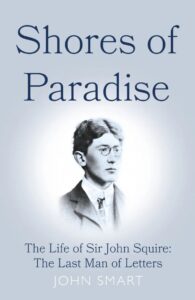
John Smart’s biography Shores of Paradise: The life of Sir John Squire, the Last Man of Letters was published by Troubador in 2021.
*
Leave a Reply