
2025 Runners-Up II: Reading The Light
Reading The Light
by Joshua Shortman
*
I live in a small village in the south-west of England. It’s the kind of place frequented by lost seagulls and forgotten pensioners: mentally rearrange the pub, church and village shop, and you will have travelled much of the area. I first picked up a copy of ‘The Light’ at my local station and, slightly unsure of what I was holding, searched its name.
It has the appearance of a newspaper – turn the pages, and it quickly falls apart. Reports date from 2020 of a ‘truthpaper’ distributing Covid-19 misinformation in small towns – northern initially, later those with alternative credentials (Glastonbury, Stroud, Totnes). It’s full of not only wild speculation, but factual errors; a misreading of a pilfered Spiked article results in Magnus Hirschfeld (gay, Jewish pioneer of trans surgery) being described as ‘a Hitler Youth leader’. Authors frequently use pseudonyms, from Darren Nesbit / Smith, to Tyler Durden.
Articles about The Light have done their job well. The paper has both called for a ‘Nuremburg 2.0’ (in which ‘MPs, doctors and nurses’ associated with Covid-19 ‘can be hanged’), and been linked to far-right conspiracy paper Demokratischer Widerstand (itself connected to a failed coup). It’s not only dangerous politically; I was advised to prevent cancer by ingesting over double the safe daily intake of Vitamin D and avoiding LED lights. Following a 2023 BBC podcast, the paper has largely been forgotten; since then they’ve continued to publish a ‘History Relit’ feature with John Hamer, who’s published elsewhere that ‘Jews need to be excluded from civilization, permanently’.
There’s something else you get from reading the paper though, that these articles don’t convey. It’s far from the most important thing. But it’s there – when Henry Widdas writes about experiencing a ‘blue funk’ and suggests re-naming depression might help with escaping the ‘maze of despair’. Or, in an account of ‘electrohypersensitivity’ authored by Sue Atkinson, where she describes the crippling pain of her symptoms, living out of a ‘Faraday canopy’ on her sofa, and slowly losing all connection to the outside world.
The postscript states that Sue Atkinson died on June 18th, 2024. It’s possible she never existed – I can’t find any other records or obituaries. It’s less likely her disease existed – double-blind studies repeatedly fail to provide evidence for EMS. But if Atkinson existed, her symptoms probably did too; aside from the fact she mentions having lung cancer, EMS is often considered psychosomatic. Worst of all, she’s fully aware of the consequences of avoiding electricity: stranded from ‘libraries, cafes … the internet’, losing ‘not only … my own life and independence, but … my friends, my neighbours, and my loved ones’. She just believed the alternative was worse.
The thing that comes across – hidden behind insecure ‘in-the-know’ language and scare quotes – is a desire to communicate. One author reassures himself that ‘the WEF, UN, WHO, OECD, NATO, or even our own NHS… are staffed by people just like you and me … [who must yearn for] a future not based on fear and constant war’. He’s trying to understand why more people don’t get The Light and concludes illiteracy rates might be to blame.
The conspiracy theorist wants, above all, to be understood. Doing so is difficult – sympathy can only stoop so far in cases of antisemitism or fascism. But read the paper, and you get an insight into how these views emerge: fears about non-consensual digital surveillance; inexpressible frustration with politicians and oligarchs; an inability to cope with the existential threat of climate change, or to comprehend international hypocrisy on Gaza.
The Light’s print-run is part of its contagion-like risk – the bottom of each page reads ‘Please pass on The Light’. But in aspiring to be a newspaper The Light also reveals how short it falls. That we can read it – the paper and readers aren’t only trapped online – gives us a chance to understand the kinds of communities, readers, and fears that The Light relies upon. That the readers can be pitied – their fears and hopes not always entirely removed from reality – may not prove much comfort. But compared to the pitiless, dislocated, and hopeless alternative: perhaps it’s a single ray of light, from a very rocky shore.
*
Target Audience/Publication: I would publish this on my Substack as is; were I pitching, I would ask the Byline Times due to their focus on free press and UK media. Rewritten to include the reflections on Orwell, I think this piece would be more appropriate for somewhere like the LRB Blog.
*
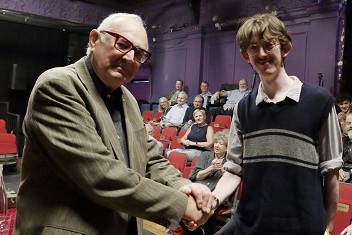
‘Reading The Light‘ by Joshua Shortman is the Runner-Up in the Column Category of the 2025 Orwell Society/NUJ Young Journalists Awards. Joshua will be returning to the University of Cambridge for an M.A. He currently works freelance as a researcher and does work experience at the London Review of Books.
This post is the fourth of a series of the winners and runners-up in 2025.
Photographs of Anna, Sunny and Joshua at the OS AGM by Ben Cooper.