Jura-based Small Isles Primary School’s Orwell Project (I) By Jonathan Pye
 Jonathan Pye, teacher at the Small Isles Primary School on Jura, was the winner of the Orwell Society’s Teacher-in-School Bursary for the academic year 2022-23. In the following report Jonathan outlines the aims and content of the Orwell Project he has designed to suit the children he is teaching. The pictures have been shared with kind permission of the Small Isles Primary School and all interested parties.
As a teacher at the Small Isles Primary School on Jura I was very fortunate to have been awarded the Orwell Society’s Teacher in School Bursary for the academic year 2022-2023. The importance of the island in the life of George Orwell is undeniable and there is no doubt that Orwell is worth studying at Small Isles Primary School given the island’s connection and history to the author himself. We now have two children attending the school who reside at Barnhill itself. In terms of what can be brought to the curriculum, in addition to the children becoming more aware of Orwell’s affinity with the island, there was always huge scope. The children of Jura always write with honesty and are very expressive and encouraging them to be critical thinkers, interrogating sources and evaluating what they read are key aspects of Literacy taught here at the school.
Given that Nineteen Eighty-Four as a novel would be too advanced for children ranging from 8 to 11, the initial “way in” was something that I gave considerable thought to. I really wanted to expose the children to a children’s book with a dystopian theme that could then be used as a “Launchpad” into studying the life and work of George Orwell.

After some searching, I settled upon the novel Floodland by Marcus Sedgwick and The Society have been kind enough to fund the purchasing of individual copies for the 11 children in my class. If Orwell was preoccupied with the future political landscape facing the world in the 20th century then the current generation have environmental issues facing them in the 21st century. Floodland is a book that imagines a young girl surviving in an England that has been devastated by flooding and rising sea levels. We titled our topic for the term “Into The Future” and I found that the children were really engaged with the idea of dystopias through the novel; these terms were not too challenging for them and that this challenge was something they embraced when studying dystopian vocabulary, setting and character and that they were really engaged with the (sometimes quite mature) themes within the novel and never wanted to put it down.
From the “reading phase” the children embarked on planning and writing their own stories with a dystopian theme. I kept the “dystopian future” that the children would write about deliberately open and flexible so the children could have personal ownership and choice over their setting and characterisation. As a result, the children settled not just on imagined worlds ravaged by earthquakes and wildfires but also ones with political surveillance and splashes of science-fiction.
Then came the writing. The children were so enthusiastic and their engagement really was excellent. They spent a whole week writing the stories, concentrating on a different part of the story on each day. As a teacher with a particular passion and interest for the subject of English (having studied it as subject as an undergraduate at Durham), I have seen children being asked to simply “write a story” within lessons in an unrealistic time-frame of one hour with no real planning or purpose behind this. Letting children follow a process that an author might do, with time to develop their plots and tinker with them at the same time meant that they really did feel like their stories were “their own”. It was lovely to see. We concentrated on writing conventions such as setting descriptions, dialogue between characters and linking paragraphs within stories amongst other individual writing targets that the children have as part of their progress and attainment.
The children then completed the “writing phase” by redrafting their stories and producing a final piece for a “Dystopian Literature” display as well as a personal copy that they could take home and read with their family. A “Class Book” was also produced for the school library and the children were proud to see their final pieces.
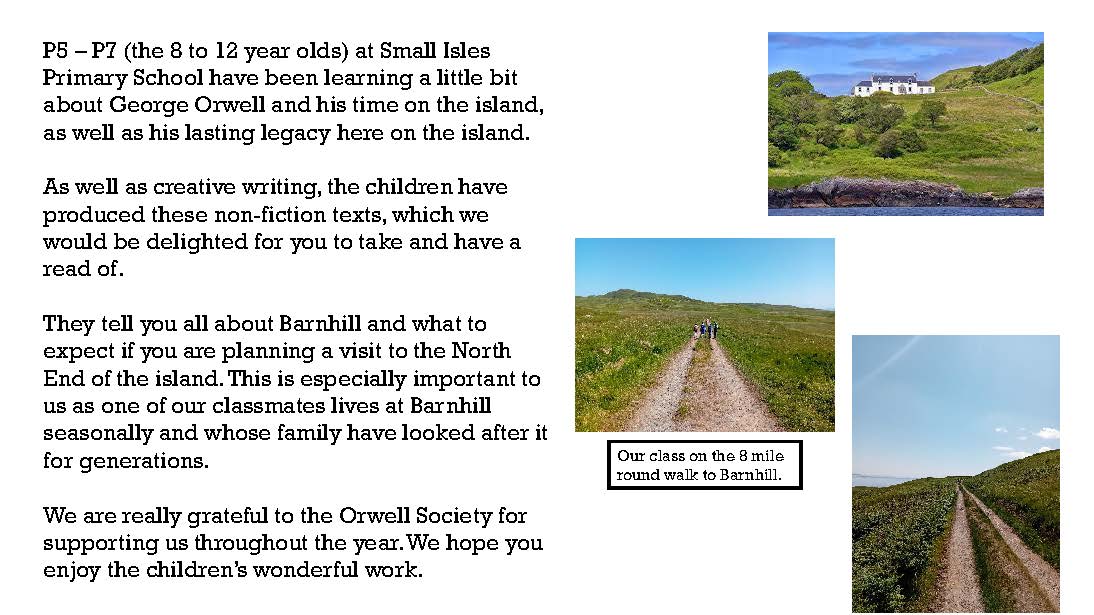
We can now move forward in the project to looking at the life of Orwell, his diaries – including extracts from his time here on Jura – and a walking trip to and tour of Barnhill itself.
The journey continues…
Jura school uplifted by special visit an article in the Oban Times about Quentin Kopp and Richard Blair’s visit to the Small Isles School on Jura
An update June 2023
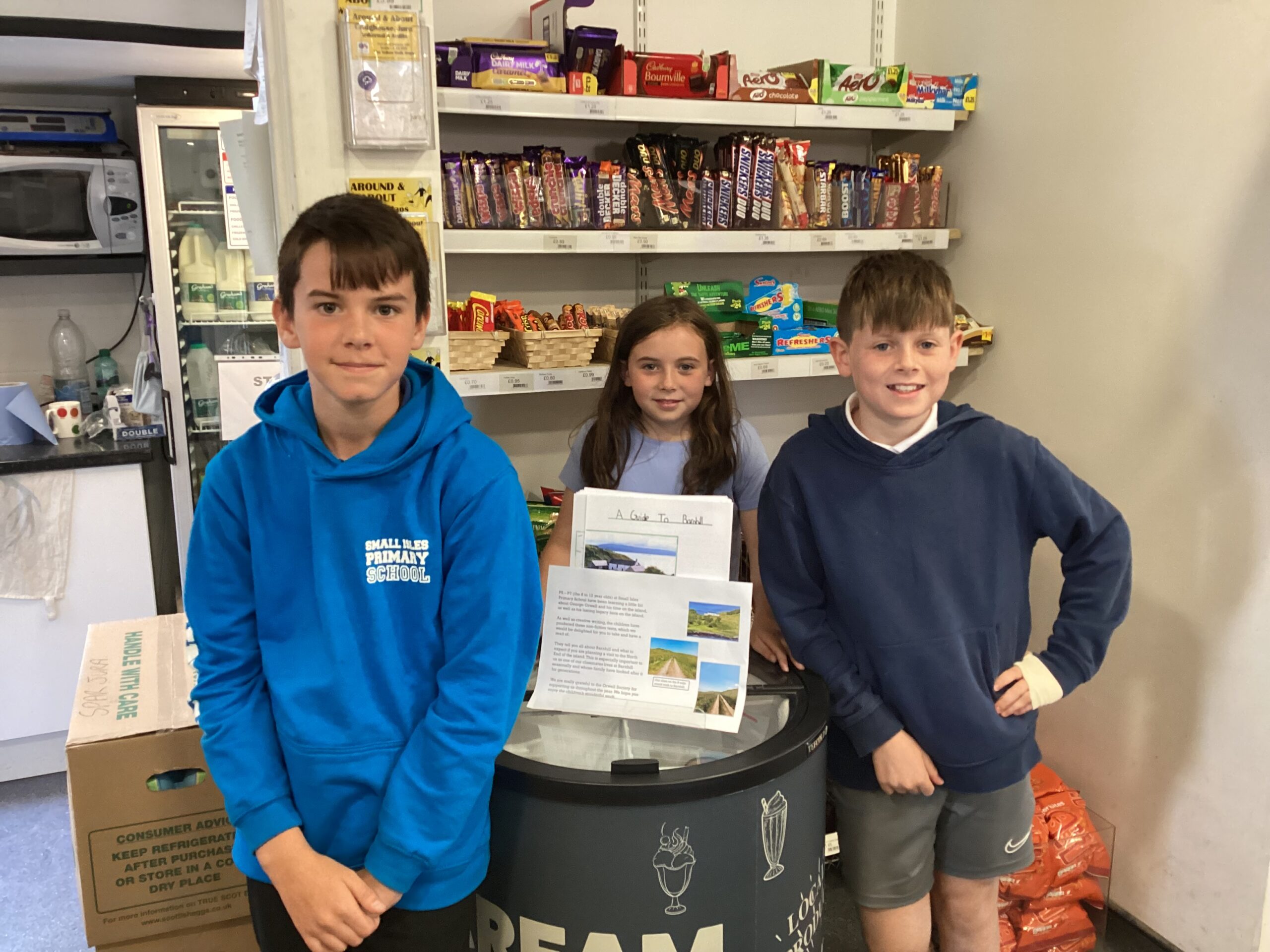
At the Community Stores; the information posters about Barnhill and the legacy of Orwell are now proudly on display alongside a little explanatory note. The children, I am told, have been dragging their parents in to see and there have been plenty of positive comments from tourists already.