
The Orwell Project at Trinity Academy St Edward’s
Amy Minney is the Curriculum Leader of English at Trinity Academy St Edward’s, Barnsley. This update explores how utilising local links to literary works, such as The Road to Wigan Pier, and pursuing external opportunities, like that with the Orwell Society, can develop an appreciation, enthusiasm and curiosity for the subject.
*
Over the last ten years, my experience of education and the curriculum offer has varied immensely. Specifically, the English curriculum and how the writers that young people are exposed to shape their very understanding of the world around them. It is our job as educators to instil a sense of pride and confidence in the pupils in our care. With that very skillset, they can then strive for academic excellence and pursue an array of exceptional life experiences.
Therefore, when it came to shaping the curriculum offer at Trinity Academy St Edward’s, I endeavoured to seek opportunities to make local connections with the literature that is studied. Studying texts or writers from your local area can enhance understanding of your community’s history, culture, and identity. It fosters a sense of place, promotes local pride, and allows pupils to relate to the stories and perspectives reflected in the texts. Furthermore, the choice to use relatable content can improve reading comprehension, vocabulary, and critical thinking skills due to the individual experiences that a pupil has with the writer, place, speaker, etc.
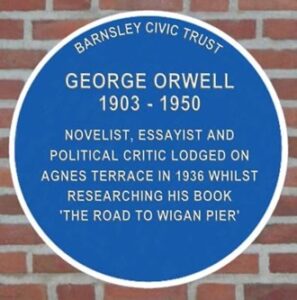
Within our curriculum offer, Year 8 students study the classic novella, Animal Farm. Pupils work towards the crafting of literary essays through their analysis of language, structure and exploration of contextual information and allegory. This idea formed the basis for me to pursue our local connections with George Orwell who visited Barnsley in 1936. Orwell, legally known as Eric Blair, had a two-week stay in Barnsley in March 1936 while gathering information for his book The Road to Wigan Pier. Orwell’s choice to visit Barnsley was influenced by the writing of this text and seeking exposure to the living conditions of working-class people and mining communities. He stayed at a house in Agnes Terrace, which is still there today. This piece of non-fiction work was published the following year and highlighted the destitution of working-class northern towns in the 1930s. Although his stay was brief, Orwell spoke about Barnsley with affection. He commented on his comfortable and welcoming lodgings and the admiration for the exhausting and extensive work of the mining community, having spent time at several collieries in the Barnsley area. In April 2024, a blue plaque commemorating Orwell’s Barnsley links was unveiled on Day Street (at the end of Agnes Terrace) in Barnsley.
Not only have students been able to learn and investigate the local connections with the author of ‘Animal Farm’ but also, they have strengthened their knowledge of the text and writer through the school’s collaboration with The Orwell Society. I proposed an application for the in-school bursary with the society and was successful in gaining a budget to enhance our curriculum offer alongside subject expertise from Richard Blair, Orwell’s son, and Quentin Kopp (the son of Orwell’s commander in the Spanish Civil War) and Scholars from the Society. This opportunity has been an immense asset as it has allowed students to fully immerse themselves in the novella and explore the allegorical ideas suggested by Orwell.
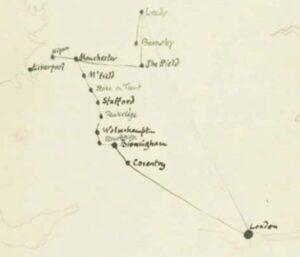
The Orwell Society provided us with a copy of a hand-drawn map that was produced by Orwell on his travels through Barnsley. This provided pupils with a physical link to the author and allowed them to fully engage with the curriculum unit. In addition to this, we had the opportunity to invite Richard and Quentin, the Chair of The Orwell Society, to the school site and a selection of our students had the pleasure of taking them on a tour and discussing his father’s writing influences and family relationships with Richard. It was in this meeting that it was revealed to the students that Orwell had his wife, Eileen, proof each chapter of Animal Farm. Richard explained that Eileen would read a chapter and then discuss with Orwell whilst sat in bed each evening. He believes that Eileen had a substantial influence on this novella. He suggested that this is one of the reasons why it is dissimilar to some of Orwell’s other works. The students were in awe of this information and were enthusiastic to speak to Richard Blair about his father and the creation of Animal Farm.
This external collaboration has not just strengthened our curriculum within English; it has also been an opportunity to celebrate an appreciation of academic research and reading for pleasure. The Orwell Society kindly donated a myriad of non-fiction and fictional literature based on George Orwell. These resources are exhibited in our library. Students can access and use them to research the writer during their study of Animal Farm but also, enjoy Orwell’s writing on a greater scale. Moreover, the bursary has allowed the school to purchase copies of an Orwell text, Nineteen Eighty-Four, that we can use in our Y10 form time reading programme to further elicit an appreciation for a writer with a local connection.
The success of the collaboration is not only recognised within pupils’ literary essays and student voice, but in the parental feedback we have received this year too. Students continuously speak about their study of Animal Farm with enthusiasm and have a clear knowledge recall. Showing their appreciation for the author of this unit, numerous pupils decided to visit the local areas which have links to George Orwell. Parents and carers have also fed back to English staff that it has been a topic of conversation at home and their child/children have been eager to share their views on the novella and how Orwell’s satire contributes to the themes of power and leadership. The unit has fostered a range of in-depth conversations in the classroom and at home.
It is imperative that the English curriculum exposes young people to a diverse range of voices and perspectives to develop an awareness of the world around them. As English specialists, we want the young people in front of us to be captivated by a vast range of literature to pursue an appreciation of the subject. One way of doing so, is by drawing upon those local links around you and seeking out external collaboration with scholars, projects, educators, such as the Orwell Society, who can enrich subject knowledge and in turn, offer support in cultivating students’ interest and appreciation of literary works.
*
Examples of student work produced:
Students explore the concept of transactional writing through the form of letter writing. They utilised letters taken from a non-fiction text supplied by the society: George Orwell A Life in Letters selected and annotated by Peter Davison. One letter in particular that was used was from Orwell to Richard Usborne regarding the contribution to a journal entry. This strengthened their understanding of Orwell in preparation for the study of Animal Farm and in their letter writing tasks too.
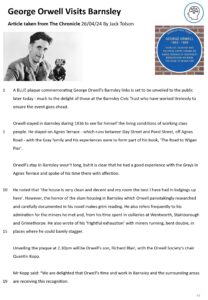

Y8 students have crafted academic essays exploring Orwell’s choices of structure and language. The use of the non-fiction texts supplied by the society have been a huge advantage to our students. It has developed their research of the text and enhanced their overall academic writing.
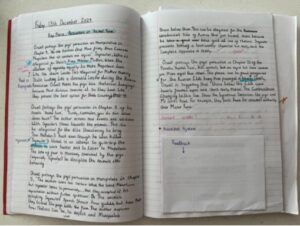
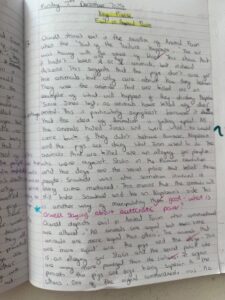
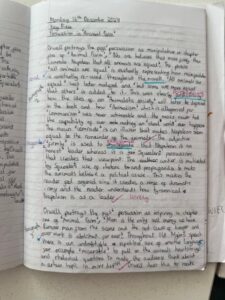
Y9 students have been their own crafting opinion articles; we have studied the power of place and how the use of plaques as a form of commemoration can be considered as an art form. Students studied the use of the plaque in Barnsley to commemorate Orwell’s stay on Agnes Terrace.
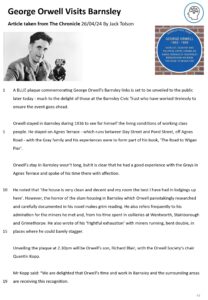

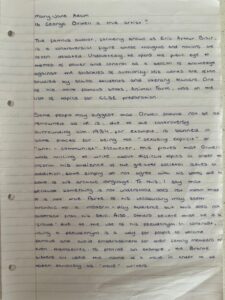
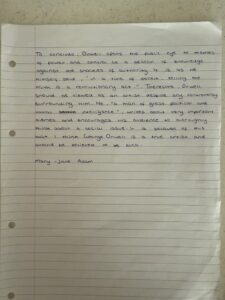
Y10 students have considered how they could use their knowledge of Orwell through their speaking and listening components. Attached is an image of a piece of work considering the role of Orwell’s work in society. Students drafted their writing and then performed it to their peers to develop not only their written, but also their oral skills..
Overall, the bursary has enabled the exploration of a locally-connected prestigious writer and his work. It has also strengthened the foundations of our curriculum – through research, classic novellas, use of rhetoric, the spoken form, journalism and non-fiction writing.
*