
“Gone down into utter silence”
*
George Orwell on Gladiators, Slavery and Revolt
*
“Civilisations founded on slavery have lasted for such periods as four thousand years.”
*
A new film about a gladiator (Gladiator II), a recent television series about the Roman circuses (Those About To Die), follow a popular movie (Gladiator) and a classic (Spartacus). There have been more, but what is notable is that while the period in which the Roman films were set varies over more than a century, the subject and even the character names barely change. Why is this? George Orwell tied it to slavery: gladiators bound themselves to their masters with oaths, but most came from captivity and slavery. Orwell looked back from the threats of his own time, to what we could learn from the past:
When I think of antiquity, the detail that frightens me is that those hundreds of millions of slaves on whose backs civilisation rested generation after generation have left behind them no record whatever. We do not even know their names. In the whole of Greek and Roman history, how many slaves’ names are known to you? I can think of two, or possibly three. One is Spartacus and the other is Epictetus… there are only two slaves whose names I definitely know, and probably few people can remember more. The rest have gone down into utter silence.
(“Looking back on the Spanish War”, written 1942/43)
A year later Orwell repeated this:
… how tiny is the number of slaves of whom anything whatever is known. I myself know the names of just three slaves—Spartacus himself, the fabulous Æsop, who is supposed to have been a slave, and the philosopher Epictetus, who was one of those learned slaves whom the Roman plutocrats liked to have among their retinue. All the others are not even names. We don’t, for instance—or at least I don’t—know the name of a single one of the myriads of human beings who built the Pyramids.
(‘As I Please,’ 28 July 1944)
Orwell was writing, he said, because:
I have just been reading Arthur Koestler’s novel The Gladiators, which describes the slave rebellion under Spartacus, about 70 B.C.
That is, Orwell explicitly associated gladiators with slavery, and with rebellion. In his best, polemical manner, he concluded this section of his article with this observation:
Yet when even so much as the name of a slave survives, it is because he did not obey the injunction “resist not evil,” but raised violent rebellion. I think there is a moral in this for pacifists.
(Quoting Gospel of Matthew 5:39)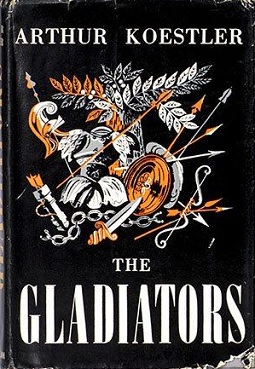
Koestler’s novel was published by Jonathan Cape in 1939. In 1931 Lewis Grassic Gibbon had published his own Spartacus.
Orwell said that The Gladiators was not one of Koestler’s best books, which events and the subsequent success of Howard Fast’s novel Spartacus (the basis of Kubrick’s 1960 film) have confirmed. Fast’s novel was published in 1951, a year after Orwell died, but its origins lie in Fast’s experience with American politics:
He began writing it as a reaction to his imprisonment for charges stemming from his earlier involvement in the Communist Party USA. He had refused to disclose to Congress the names of contributors to a fund for a home for orphans of American veterans of the Spanish Civil War. He was imprisoned for three months in 1950 for contempt of Congress.
In his essay-study of Arthur Koestler Orwell returned again to The Gladiators, beginning with a comparison:
The Gladiators is in some ways an unsatisfactory book. It is about Spartacus, the Thracian gladiator who raised a slaves’ rebellion in Italy round about 65 B.C., and any book on such a subject is handicapped by challenging comparison with Salammbô.
One can get an idea of Orwell’s intellectual milieu that he did not feel the need to give the author or date of publication of Salammbô: written by Gustave Flaubert, his only long historical novel, it appeared in French in 1862. It is set in North Africa during one of the Carthaginian wars, about two hundred years before Spartacus’s rebellion: the Romans were intent on defeating their Phoenician rivals using their powerful armies, while the Carthaginians relied on armies of mercenaries to resist the attacks, the mercenaries turning on their masters when they went unpaid. In the most ghastly chapter of the novel the Carthaginians perform the ceremony of Moloch, calling on supernatural assistance by the sacrificial consigning of their infants to the flames.
How could Flaubert bring himself to write this? Orwell answered while only alluding to the brutality (“Moloch” occupies the complete tenth chapter of Salammbô), and compared the two authors:
Flaubert could think himself into the stony cruelty of antiquity, because in the mid-nineteenth century one still had peace of mind. One had time to travel in the past. Nowadays the present and the future are too terrifying to be escaped from, and if one bothers with history it is in order to find modern meanings there. Koestler makes Spartacus into an allegorical figure, a primitive version of the proletarian dictator.
(“Arthur Koestler”, 1944)
Orwell goes into an examination of the motives of Koestler’s Spartacus, and argues that the author “faltered between allegory and history.” We cannot be sure of Orwell’s last word on The Gladiators, since it exists due to the peculiarities of publishing in two forms:
The story partly fails because the central problem of revolution has been avoided, or at least has not been solved.
Or,
The story partly fails because the central problem of revolution has been avoided, or at least has not been resolved.
There is, of course, a difference between solution and resolution.
Post-war we find a letter by Orwell to a German correspondent recommending The Gladiators among other works by Koestler. What Orwell would have thought of Daniel P Mannix’s Those About To Die (published in the US in 1958, then by Panther as a paperback in the UK), the inspiration allegedly for the television series of the same name, we cannot know. It is a “pop” history, with Mannix admitting where he has filled in gaps from other knowledge (despite claims in publicity for the television series it is not a novel): Orwell himself, with his classical education might have read the historical accounts of Martial, Juvenal etc. in the original Latin.
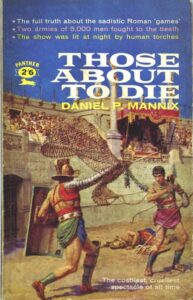
Cover illustration, as Mannix’s text makes clear, shows a gladiator (left) versus a retiarius (right) – sword and shield versus trident and net.
Mannix must have seem some of the correlations between Roman games, cruelty and slavery: four years after Those About To Die, he co-authored with Malcolm Cowley Black Cargoes: A History of the Atlantic Slave Trade 1518–1865. No book on the subject had been published in the previous sixty years. It took literary outsiders such as Fast and Mannix to break the silence in the USA that horrified Orwell wherever he encountered it.
What lessons can we draw from the work of Orwell and Mannix? Perhaps that Orwell’s seemingly throw-away observation is relevant all the time:
… if one bothers with history it is in order to find modern meanings there
One cannot look to historical films only for entertainment: there is education in every one. The weakest have no resolution.
Leave a Reply