
John Drinkwater
Introduction. George Orwell mentioned in his writings many people who were once household names, at least to the educated, but who are today only remembered by specialist historians. One such man was John Drinkwater, mentioned twice by Orwell in his non-fiction, while Gordon Comstock the central character of Orwell’s 1936 novel Keep the Aspidistra Flying refers to “Sir John Drinkwater”. In fact Drinkwater was never knighted.
On 5 March 1939 Orwell wrote to Herbert Read that:
A thought that cheers me a lot is that each generation, which in literature means about ten years, is in revolt against the last, and just as the Audens etc. rose in revolt against the Squires and Drinkwaters, there must be another gang about due to rise against the Audens.
One of my earlier articles on this website discussed John Squire and the London Mercury which he edited.
Early Life. John Drinkwater was born on 1 June 1882 at Dorset Villa in Leytonstone in West Ham Registration District then in Essex. His parents were Albert Edwin Drinkwater a schoolmaster who became an actor, theatre manager and playwright five of whose works are listed in the British Library Catalogue; and Annie Beck Drinkwater née Brown. John Drinkwater had two sisters.
Albert Drinkwater came from a line of Oxfordshire and Warwickshire farmers, publicans, coach drivers and coach owners. Annie was an Oxford ironmonger’s daughter. The Browns for many generations had been Oxfordshire and Buckinghamshire farmers. Annie died in 1891. John Drinkwater, nine, moved to live with his ironmonger maternal grandfather; and attended Oxford High School. He left school aged seventeen and at his father’s insistence became a Northern Assurance Company Clerk and then an Inspector based at its Nottingham headquarters.
John Drinkwater became an amateur actor and on 11 January 1906 aged 23 married Kathleen Walpole, twenty four, an actress whose stage name was Cathleen Orford, at St Luke’s Anglican Parish Church at Cheetham near Manchester. Her father William Christopher Walpole was an estate agent. The marriage was childless.
Through amateur acting Drinkwater became a friend of Barry Vincent Jackson. They set up an amateur troupe, the Pilgrim Players, which inspired the building of the Birmingham Repertory Theatre. It opened in 1913 in Station Street behind New Street Station. The building was financed by Barry Jackson’s inheritance from his father George Jackson, who founded Maypole Dairies and died on 17 August 1906 leaving £222, 660 5s 4d. The first play staged at this theatre was Shakespeare’s Twelfth Night. John Drinkwater played Malvolio and Kathleen Drinkwater Maria.
Drinkwater became a professional actor, theatre manager, poet, playwright, biographer and literary critic. As a poet he wrote Georgian style nature poetry inspired by Alfred Edward Housman of A Shropshire Lad fame.
There were six Dymock (a Gloucestershire village) poets. They flourished 1913 to 1915, of whom Drinkwater was one. The others were Lascelles Abercrombie; Rupert (Chawner) Brooke who died on active service in 1915; Wilfrid Wilson Gibson; (Philip) Edward Thomas who was killed in the First World War in 1917 aged thirty nine leaving a widow and three children; and the American Robert Lee Frost. This literary generation was followed by modernists such as Ezra Pound and T. S. Eliot who were followed by Auden and others. Orwell’s second reference to Drinkwater comes in a 1946 review of an anthology of animal poetry:
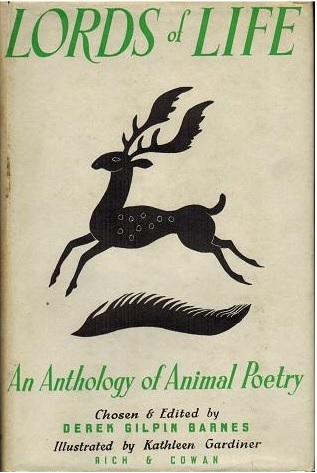
The poems in “Lords of Life” belong largely to the “Georgian” period—between 1910 and 1920, that is to say—and to look through them is to realise how very little that is good has been written about animals, at any rate in verse. Among the poets selected are John Masefield, Siegfried Sassoon, Wilfred Wilson Gibson, Sir John Squire, Harold Monro, John Drinkwater, W. H. Davies, and D. H. Lawrence.
It is curious how Lawrence’s poems stand out from the others.
Here Orwell correctly gives Squire his knighthood, and avoids that incorrectly given to Drinkwater by Gordon Comstock. He has nothing more to say about the man.
Drinkwater’s first book of poems The Death of Leander and Other Poems was published in 1906 and in the next twelve years he published three more volumes of his poetry and contributed to anthologies and magazines. His first verse plays the one act Cophetua (1911) and the three acts Rebellion, (1914) were performed at Birmingham Repertory Theatre of which he was co-founder and General Manager. He also had published William Morris; A Study (1912); and Swinburne; A Study (1913).
By autumn 1914 Drinkwater was respected enough that two of his poems Nocturne and The Ships of Grief were published in the Times Literary Supplement. In 1918 his most celebrated play Abraham Lincoln was performed in Birmingham and then at the Lyric Theatre in Hammersmith which had opened in 1888. In 1917 the USA, where it’s Civil War and Lincoln’s assassination were bitter living memories, had entered the First World War on the allied side.
In 1918 Drinkwater left Birmingham for London. By then he had played about forty parts at the Birmingham Repertory Theatre and directed sixty plays there in six years. On Saturday 5 July 1919 he was awarded an Honorary MA at a ceremony at Birmingham University. Later that year he went to New York to present his play Abraham Lincoln there. In 1920 he returned to Britain. In later life he travelled widely visiting and lecturing in the USA, Egypt and Persia (Iran).
Drinkwater wrote seventeen plays. They included biographical plays such as Mary Stuart (1921) about Mary Queen of Scots; Oliver Cromwell (1921); Robert E. Lee (1923); Robert Burns (1925).
On 8 August 1923 Kathleen sued Drinkwater for divorce on the grounds of adultery with an unnamed woman. Adultery was then the only legal grounds for divorce. The divorce was made absolute on 28 July 1924. The Anglo-Russian Jewish pianist Benno Moiseiwitsch born in Odessa in 1890 in 1914 married Daisy Fowler Kennedy an Australian concert violinist born in 1893. Her father was Joseph Arthur Kennedy an Adelaide schoolmaster. Benno and Daisy Moiseiwitsch had two daughters. On 8 February 1924 Benno sued Daisy for adultery with Drinkwater. The divorce was made absolute on 1 December 1924.
In 1924 Drinkwater visited Greece to attend the hundredth anniversary commemoration of the death of Lord Byron at Missolonghi of fever, during the Greek War of Independence. It then took much longer to travel to Greece and back than it does today. On Wednesday 16 April 1924 he was made an Honorary Doctor of Literature of Athens University. Thirteen other Britons, including Rudyard Kipling, were awarded Honorary Doctorates at this ceremony.
John Drinkwater, forty two, married Daisy Fowler Moiseiwitsch née Kennedy, thirty one, on 16 December 1924 at Kensington Registry Office. They were to have one daughter Penelope Ann Drinkwater born on 26 July 1929 in London.
John Drinkwater’s comedy Bird in Hand was performed at Birmingham Repertory Theatre in 1927. It starred Laurence Kerr Olivier and Peggy Ashcroft. They were both twenty in 1927.
John Drinkwater had published six more poetry volumes; prose biographies of Charles II (1926), Charles James Fox (1928), and Samuel Pepys the Admiralty official and diarist (1930) The Pilgrim of Eternity: Byron a Conflict a critical study of the poet Byron (1925); general literary criticism in Patriotism in Literature (1924) and The Muse in Council (1925); The Gentle Art of Theatre Going (1927) which was part of a series; and two volumes of autobiography – Inheritance (1931), and Discovery (1932).
On principle Drinkwater disliked cinema, which eventually caused most theatres to close. However, in 1931 his biography the Life and Adventures of Carl Laemmle was published. Carl Laemmle a German Jew was born in 1867; in 1884 moved to the USA; became a bookkeeper in Chicago; in 1889 became an American citizen; in 1906 opened a Chicago cinema; founded the Universal Film Studios in Hollywood in 1915; was married with two children; and died of heart disease in 1939 aged seventy two.
In 1932 Sidgwick and Jackson published Drinkwater’s most controversial work. This was a translation from Italian into English of a play about Napoleon and the hundred days between his escape from Elba and his defeat at Waterloo. The Italian version was written by Benito Mussolini, the Italian dictator, in co-operation with the Italian playwright Giovacchino Forzano.
Apart from writing and acting Drinkwater belonged to many societies and sat on committees. He supported his old friend Barry Jackson and George Bernard Shaw in setting up the Malvern theatre festival. This was held from 1929 to 1939 and was revived after the Second World War. There is still a Festival Theatre in Malvern. He was a keen stamp collector. According to his Times obituary he was well known in the international stamp collecting world. He had many other interests. His last published work The King’s Reign; A Commentary in Prose and Picture (Methuen, 1935) celebrated King George V’s Silver Jubilee.
On 24 March 1937 Drinkwater watched the Boat Race and attended a party at which some of the crews were guests. He died that night on 25 March 1937 aged fifty four of a heart attack at his home North Hall in Mortimer Crescent in Kilburn in North London. The death was widely reported in Britain and the USA. Many tributes were paid to his memory including ones from the American and Greek ambassadors. He was buried at Piddington in Oxfordshire.
John Drinkwater left £1,567 16s 6d. – £50 to his cousin George Carr Drinkwater to whom probate was granted; £50 to the publisher Frank Sidgwick; £50 to Drinkwater’s secretary Winifred Edith Gwyn Jeffreys; and the remainder to his widow Daisy Drinkwater. His last works were published posthumously in 1938.
Frank Sidgwick had established the publisher Sidgwick and Jackson in 1908. His business partner Robert Cameron Jackson was killed in action aged thirty five on the Western Front on 24 September 1917. Frank Sidgwick published many of Drinkwater’s works; and died on 13 August 1939 aged sixty of pneumonia. The firm is now a Macmillan imprint.
George Carr Drinkwater an architect, portrait painter, and journalist studied at Rugby and Wadham College, Oxford; served in the Boer War; twice rowed for Oxford in the Boat Race; and won the Military Cross in the First World War. He was mortally injured at his home 6 Radnor Place, in a Nazi air raid on London on the night of 10-11 May 1941. He died aged sixty in St Mary’s Hospital in London on 12 May 1941.
The actress Kathleen Drinkwater née Walpole whose stage name was Cathleen Orford and who was John Drinkwater’s first wife died in 1962 aged eighty one. On Monday 25 February 1963 his second wife Daisy Fowler Drinkwater opened an exhibition at Birmingham University, in honour of the twenty fifth anniversary of John Drinkwater’s death. She died in 1981 aged eighty eight. One of her surviving cousins is the violinist Nigel Kennedy.
John and Daisy Drinkwater’s daughter Penelope Ann Drinkwater became a wine journalist, married Hugh Michael Self in 1950, and was widowed in 1998. She died in London in 2005 aged seventy six.
The Birmingham Repertory Theatre is still open. It is called the Old Rep to distinguish it from the Birmingham New Repertory Theatre which opened in Broad Street in 1971. The old Rep is one of the three surviving of the thirteen Birmingham pre-cinema city centre theatres. The others are the Hippodrome (1899) and the Alexandra (1901). Most theatres were unprofitable after talking films were invented. It was a generation before the Arts Council publicly funded theatres. During this gap some covered day to day running costs but major capital expenditure on them was not commercially justifiable. Birmingham’s oldest theatre, the Theatre Royal, opened in 1774. It closed in 1956 because it needed serious capital expenditure. This was not commercially viable and the city council had no powers to fund it. The Alexandra, the Hippodrome and the Old Rep were then relatively modern buildings and held out until public funding was available.
The Lyric Theatre in Hammersmith was due to be closed and demolished in 1966. There was a protest campaign against this. As a result the auditorium was dismantled and installed within a modern theatre building with the same name close to the original site.
Leave a Reply