
Strange Meeting
Orwell and Henry Miller
by Dr. Jennifer Cowe
Henry Miller arguably has a lot to thanks George Orwell for, at least posthumously. He is rarely read in university level courses and is most often included in the mid- twentieth century dinosaur category of writers who have become somewhat passé of late. It is his inclusion in ‘Inside the Whale’ (1940) that has ensured that he is not mostly forgotten except by a small group of Miller scholars. Miller and Orwell only met in-person once, but carried on a lengthy correspondence and reviewed each other’s work in literary magazines. Their one meeting took place on December 23, 1936 as Orwell stopped off in Paris on his way to the Spanish Civil War. The meeting was captured by Alfred Perlès, Miller’s lifelong friend in My Friend Henry Miller: An Intimate Biography (1955):
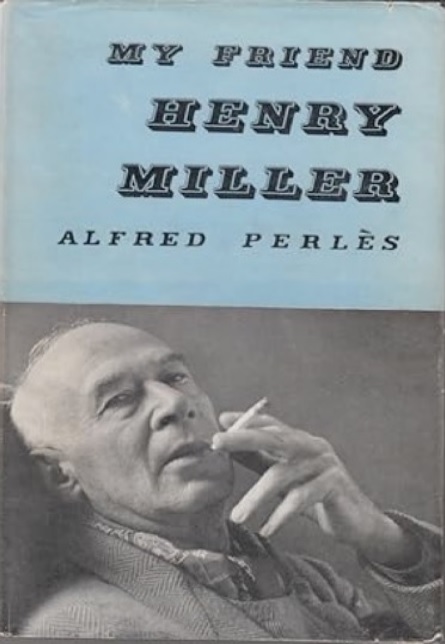
The meeting between the two writers didn’t quite come off as one might have expected it to. On the face of it they should have had a lot in common, both having been through the mill, both having been ‘down and out’ in Paris and elsewhere. But what a difference between them in their outlook on life! It was almost the difference between East and West. Miller, in his semi-Oriental detachment, accepted life, all the joys and all the miseries of life, as one accepts rain or sunshine. Orwell’s detachment was less innate than inflicted upon him by force of circumstance, as it were. Miller was vulnerable and anarchic, expecting nothing from the world at large. Orwell was tough, resilient and politically minded, ever striving in his way to improve the world…. Miller was a citizen of the universe…. Orwell, a typical Englishman. (156)
Perlès’ account of their meeting perfectly illustrates the different paths that Orwell and Miller were on. Their positive interest in each other’s work would not wholly survive the political maelstrom of the period especially by Orwell and it is telling that the beginning of this is present in their only meeting. Their initial connection was through both having written books that related to their lives on the margins of Parisian society, Down and Out in Paris and London (1933) and Tropic of Cancer (1934) respectively. This desire to represent the lives of ordinary, working people without moralising or sanitising them was what sparked the interest in the other’s work yet their divergent perspectives were already clear to see. Miller was distinctly perturbed by Orwell’s ideological framing of poverty whilst Orwell rather disapproved of the seedier side of working-class life that Miller fully embraced. This difference between a writer who was exposing inequality and seeking action with one who accepted the reality of inequality and pursued an individual accommodation with it is clear to see in their reviews of both books, but also in their meeting. Orwell was on his way to Spain to fight for a political cause he believed to be vital and Miller is well on his way to complete detachment from the political realities of the period. Miller was already an active Buddhist and is was practicing non-attachment: a state in which the individual overcomes their attachment to worldly concerns. Miller regarded Orwell’s trip to Spain as meaningless and saw no point to his fighting as it merely reinforced a fantasy of collective change when only individual change is possible. Miller tried to gently dissuade Orwell from going and Perlès recalled the outcome:
To this Orwell made the classic reply that in such momentous situations, where the right and the very existence of a whole people are at stake, there could be no thought of avoiding self-sacrifice. He spoke his convictions so earnestly and humbly that Miller desisted from further argument and promptly gave him his blessings…. Henry discreetly refrained from adding that Orwell would have been welcome to the jacket even had he chosen to fight for the opposite side. (158-159)
Until his death Orwell would continue to review Miller’s new works, but would find the focus excessively preoccupied with Miller’s interior life and lacking in any relevance to the world as it actually was. He was especially relentless in his attacks upon Miller’s ‘quietism’ during WW2 and refused to see it as a matter of personal conscience, but rather one of selfish cowardice.
That Miller’s reputation is still greatly affected by Orwell’s criticism of his work (and life) is a double-edged sword, simultaneously keeping Miller relevant whilst denying his work the opportunity to by read and studied divorced from Orwell’s looming shadow.
Dr Jennifer Cowe is a Lecturer in the School of Journalism, Writing and Media at the University of British Columbia, Vancouver Campus.

Her chapter on George Orwell and Henry Miller appears in the Oxford Handbook to George Orwell, edited by Professor Nathan Waddell (2025).
Dr. Cowe, this was a great read!