
2051, Aaronson’s Disquisition: I
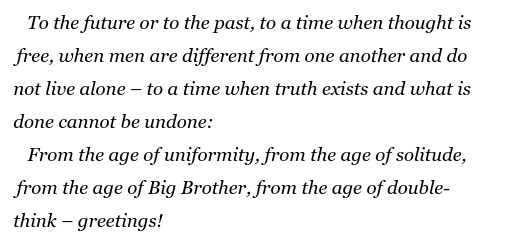
What will happen in that future?
SYMPOSIUM TERRITORIA
Excerpts and Annotations from
Aaronson’s A Disquisition of Thought
Library of Territoria
July 2051
The effects of aging in reverse did not affect the intellectual acumen of the symposium delegates. Of all the principals who were invited, three prominent custodians of the manuscripts found in the ruins in the catacombs of the Llandaff Cathedral in Wales had the most intimate knowledge and experience as survivors of Oceania’s terrible reign and as leaders of the resistance that toppled IngSoc and Big Brother.
The appearance of Iliana Dixon-Smith, Pilar of Holes, and Albert Mast as teenagers did not subtract from their esteemed presence. Just as the forward movement of time brought the surprise of the future, reversal offered remembered experiences and learned lessons, the often calamities of surprise fading with each new resurrection.
Delegates from New Oceania, Africanto, Alasia, New Americano, Ozzealia, and Asiatica arrived in Territoria unified and eager in their search for authentic history. Territoria—once the Confederacy of American States—was chosen to host this symposium because of the shock of its collapse, for which there was little history. Before the formal lecture, delegates moved quietly about the thirty glass archive encasements, each containing a single page of a dusty and deteriorating manuscript. It had been more that 100 years before this kind of care was afforded to the written word. After the delegates were seated, Iliana approached the podium and a hush fell over the crowd.
Iliana: Welcome. Thank you for coming from such great distances. First, I’d like thank our dear friends, Pilar and Albert, for their ceaseless work on behalf of the Library of Territoria. My mother and father, Julia and Winston, could not make the trip. My mom runs a transreversal pediatric hospice center in Liverpool, and my father obsessively scours the old clubs of Liverpool and London in search of resurrected pop icons from the 60’s. Methinks he’s daft, but he’s happy. Anyway, Pilar and Albert know better than most that the study of history is the puzzling out of events. With the recent discovery of the partial texts of A Disquisition of Thought found in the Llandaff Cathedral library catacombs, we strive to learn more about all the cataclysmic declines of once powerful and hopeful nations—declines that brought about the scourge of the superstate. It is our hope that this information serves as something to jog our remembrance and conscience and can be considered as a moral blueprint to avoid in our efforts to rebuild what The Party brought asunder. Ladies and Gentlemen, please welcome Pilar of Holes.
Pilar: Thank you, Iliana. Over the years, separate portions of a long-discredited illegal manifesto surfaced in several areas of Oceania. Authentic and Party-contrived texts fell into the hands of three individuals: Inner Party Chief Inquisitor, O’Brien; Julia Dixon, a former autark of the Remnant Resistance; and Winston Smith, one of the many persecuted thought criminals whose curiosity about the past inspired all of us.
When The Brotherhood split into The Column and its constituent autark groups—Remnants and Holes—their shared belief was that the path to defeating Big Brother and eviscerating the principles of INGSOC lay in resurrecting culture. I was a former Brotherhood double agent sabotaging Inner Party interrogations of Eurasian thought criminals, treating them humanely in the hope of recruiting them. Kindness increased our ranks significantly.
The Holes—Remnant cultural archeologists and anthropologists—had discovered caches of documents through ‘knowledge mining’ in Wales, formerly, Airstrip 6. One cache of documents were the writings of a renown thought criminal, August Aaronson, whose collaborators were Rutherford and Jones. All three were considered disciples of Emmanuel Goldstein—a fictional personage who functioned as bait to infiltrate and destroy The Brotherhood. The Party had broken these men and disappeared them, except for Aaronson, whose writings gave rise to the Remnants who believed Territoria, for the time being, was at its infancy and was in administrative disarray—providing us an opportunity to establish a resistance stronghold against Oceania. I believed in the power of cultural resurrection, which was something reinforced by Aaronson.
 *
*
Partial Preface
A Disquisition of Thought
By August Aaronson
i. Echo
This sound of memory—this ricochet of the memory of place—bounced aimlessly between Inner and Outer Party members, whose own peculiar willful and imposed restrictions on community created a forced indifference to this sound, to this memory of place. Once a dream of all sentient beings, the actualization of home eluded the individual; the realization of community was now inert as a power to rise above the substandard existence that all mini-states had to endure. Except for the Proles—who were unbusy, disabused of meaning, and prone to sleeplife, yet who moved about in time with simmering resentment—there was little trace of the anxiety that would possess most humans to act on their own behalf. But for the echo of home, everything had been taken away from the Proles. In this state, history naturally imposes itself upon the indolent mind by rearranging it. While history has to be taught, the teaching of history was no longer legal. However, memory persists in the cells that carry forth the essential functions of remembrance and, as such, forms the mental condition of the narrative state, keeping alive the idea that the story is unfinished.
iv. Ancient Stories
Within every state narrative are nearly indestructible myths that once sustained citizens, tribes, and outliers, creating cultures that nourished the future through stories of the past, told, sung, and performed by voices from the present. When those voices are stifled, silenced, made illegal, or corrupted—in the way the superstates manufactured stories, songs, and slogans whose architecture was meaningless and rooted in nothing but machine-contrived drivel—culture ceases to have a living, perpetual narrative thread to its own history and future. In this way, the present is like a stillbirth: dead.
xi. The Lying Truth
The manufacturing of anything—even things without meaning or function, or memories that have been systematically erased—must be derived from raw materials, even in their cultural absence. Larger truths and realities build upon smaller truths and realities; big lies and fantasies support smaller lies and fantasies. Despite the efforts of even the most nefarious Party operatives to erase the memory from any person who deviates from functioning as a mindless automaton, when deprived of cultural or tribal needs to assemble through narrative impulses, consequence will reach below those memories that are shattered to assemble new stories of meaning without the initial evidence of previous literature or art buried in memory.
Stories are organic. The subconscious allows the idea of ancient stories to surface and take on new forms, no matter how crushing attenuating forces act upon them. Culture manifests itself through its own absence. That is, new gods, new worlds, and new destinies manifest themselves by the very absence of what has been corrupted or forgotten. Mass extermination and mass suicide are the only means to end the narrative of thought. If the Party stomped on the heads of every thought criminal, there would be no functionaries to facilitate the nihilism pursued with unrelenting vengeance by the priests of power: no slaves for the slave state.
This is the Party’s greatest dilemma, tri-partitioned in their own maxims: If Freedom Is Slavery, the slave narrative cannot exist without the evidence of freedom; if War Is Peace, war cannot be sustained without the idea of peace; and if Ignorance Is Strength, ignorance must draw from the potential of the comparative strength of knowledge. It was not enough for the indoctrinating corrosion of doublethink to eradicate meaning; it had to eradicate possibility. Crushing spirit is one thing; crushing will is another. Will always finds the words. As long as there is potential for a narrative passing from thought to words, deeds follow that will slip through the cracks of fear and cowardice. The spine of a story is not as easily broken as is the spine of a person. In a long-forgotten story about a tragic prince whose confrontation with his own fate was a yearning economized with few words, these surviving words—“To be or not to be”—would forever be pulsing in the bloodstream of being.
Thank you. Iliana . . .
Iliana: Thank you, Pilar. O’Brien possessed incomplete portions of the chapter, “The Fall of Territoria,” a client state Oceania was planning to administer and grow into a younger population of fanatical loyalists, far away from the false and forgotten histories of Europe. The Inner Party Inquisitor thought most of Aaronson’s “soft writings” were doubleplus ridiculous, but was keen to understand the thought criminal’s insights into Territoria.
Territoria was mostly a vast wasteland within the North, specifically the United States and Canada. The interior was decimated over the years by limited nuclear wars sponsored by Oceania and Eastasia, but the costal areas were spared as a future headquarters for the Inner parties of these superstates—Oceania would control East Territoria and Eastasia would control West Territoria. O’Brien thought that Aaronson’s hard rhetorical narrative had merit and should stand as a Party warning to any resistance to—let me quote him—“Oceania centralized supreme organizational benevolence.” My father, Winston, had what O’Brien was studying as Party Inquisitor, which was given to him by the head of the Thought Police, Charrington, who wanted to trap Winston for a second time. All three copies were the same.
Albert Mast was part of the Holes who excavated the catacombs of Llandaff Cathedral and was instrumental in saving the lives of Julia and Winston. He will present the nexts documents. Albert . . .
Albert: Thank you, Iliana. I will get right to it. This history is as surprising as it is devastating—a warning to future generations of reverslings, however long they—sorry, we—may last.
*
_______________________________
*
These excerpts are from Edward Morneau’s forthcoming novel, A Conspiracy of Ravens. The annotations serve to give a basic context to these excerpts. This experimental work explores four intersecting stories: “Honeyboy,” a Holocaust parable; “Remnants,” an extension of George Orwell’s Nineteen Eighty-Four; “The Holes,” the strange effects of a cosmic singularity; and “Territoria,” the collision and culmination of the these stories through the establishment of a new world and the discovery of an impactful cultural relic.
Leave a Reply