
D. N. Pritt Part Two
Introduction. Part one of my article about Denis Nowell Pritt (i.e. D. N. Pritt) left him as married with a son and adopted daughter; and as having been the Hammersmith North Labour MP until he was expelled from the Labour Party for taking the Russian line over the Russo-Finnish War. He became an Independent Labour MP and co-operated with William Willie Gallacher the West Fife, Scotland, MP, the one open Communist in parliament.
The People’s Convention was set up in January 1941. D. N. Pritt was one of its founders. Working through Hammersmith Labour Party and Trades Council he called for a People’s Convention to be held. Its ostensible aims were defending human rights in Britain, protecting working class wages and conditions, improving air raid precautions particularly air raid shelters, and improving relations with Soviet Russia. The People’s Convention supporters claimed that Britain was still led by those who through appeasement had caused the war; that the government only cared for the rich; and that war profiteering was widespread. In February 1941 it held a conference in Manchester to discuss setting up a people’s government and making peace. The Labour Party opposed the People’s Convention and expelled members who supported it. It faded from view after the Germans invaded Russia on 22 June 1941. In January 1942 the Communist Party officially disowned it. Only Nazi sympathisers, some Trotskyites and hard core pacifists continued to oppose the war.
George Orwell was very critical of the People’s Convention. However, some of its supporters got useful results. It was Philip Phil Piratin, an East End Communist, who got the London Underground Stations opened as air raid shelters (see below).
Personal Tragedy. On Friday 24 October 1941 D. N. Pritt’s only son Francis John Pritt died aged eighteen of a rare form of cancer, after a long illness, in Wokingham in Berkshire. According to Dermot Morrah writing in the Saturday 27 October 1941 Times Francis John Pritt was a boy of uncanny perception.
The Blackout Ripper. Gordon Frederick Cummins an RAF ground crew man had trained to be a flier and was about to join a bomber crew. He was married but childless. Although of ordinary middle class background he called himself the Honourable Gordon Cummins. This attracted hostility in the RAF and he was nicknamed the Duke or the Count.
On 14 February 1942 Cummins was arrested. He was charged with four murders and two attempted murders. It is strongly suspected he also did another two murders. The trial opened on 24 April 1942. His defence counsel was to be D. N. Pritt KC; but the trial was postponed due to a technicality and resumed on 27 April 1942. The defence counsel this time were John Flowers KC and Victor Durand KC.
The evidence was overwhelming and after a two day trial Cummins was convicted of murder. His appeal was rejected and on 25 June 1942 he was hanged at Wandsworth Prison during a Nazi air raid.
The Son in Law. On 7 December 1944 D. N. Pritt’s adopted daughter Susan Elizabeth Pritt, eighteen, married Lieutenant Eugene Auguste Lucian Giacomini twenty five, a Free French paratrooper, at the City of London Registry Office. Lieutenant Giacomini was born on 4 November 1919 in Algiers which was then French ruled. His father the late Hyacinth Henri Edmond Eugene Giacomini was called an exporter on his son’s marriage certificate.
Eugene and Susan Giacomini produced one son Rene Mark Giacomini born in 1945. I understand that Eugene Giacomini died in 1949. I have been unable to discover where or how he died.
1945. Once Russia was our ally Pritt’s views were more acceptable. Trotskyites sometimes called the Communist Party of Great Britain, His Majesty’s Loyal Communists. Pritt was a hard working Hammersmith North MP as even Orwell admitted. At the July 1945 General Election D. N. Pritt held Hammersmith North as an Independent Labour MP getting 18,845 votes. The Conservative Lieutenant Colonel Leonard Caplan, a barrister and Second World War veteran, got 7,516. The official Labour candidate William Henry Church JP, a former Mayor of Hammersmith, got 3,165 and lost his deposit.
At this election Labour won 393 seats and its leader Attlee became Prime Minister. The Conservatives held 213 seats and their leader Churchill became Leader of the Opposition. The Liberals held twelve seats.
There were now two open communists in parliament. Willie Gallacher was joined by Phil Piratin the Communist MP for Mile End in the East End. A small group of Labour MPs gathered around Pritt.
Egypt. Demobilisation of British Armed Forces was slow after the Second World War. It was hampered by shipping shortages and the desire to keep troops stationed in actual or potential trouble spots. On Monday 11 November 1946 the men of 610 Vehicle Group, stationed at Tel el Kebir in Egypt, staged what they called a strike and the army a mutiny. Only thirty out of 350 men turned up for parade.Ten men were court-martialled on Tuesday 28 January 1947. D. N. Pritt was the defence counsel. Lieutenant Colonel Strong, who commanded 610 Vehicle Group, admitted not having made it clear to the men that what they called a strike the army called mutiny. He said he had been too busy to do this. He admitted that despite having just returned from two months leave in Britain he had spent the weekend before the incident on leave in Ismailia.
The court martial acquitted four men but convicted six of conspiring to cause a mutiny. In April 1947 their conviction was quashed because inadmissible evidence was used at the court martial.
The Cold War. During the late 1940’s the Communists took over one Eastern European country after another. In 1949 the Chinese communists defeated the Chinese Nationalists who withdrew to Taiwan. In 1949 there came the Korean War. Communist guerrilla insurgencies were waged in Greece, Malaya, Vietnam and elsewhere. NATO was founded. Britain’s Labour government gave India, Pakistan, Sri Lanka and Burma their independence and Ghana was set on the road to independence. However it supported the suppression of Mau Mau in Kenya and the communist insurgency in Malaya.
D. N. Pritt continued taking the Soviet line. Most of his Labour friends fell away through conviction or pressure from the Labour leadership. Four Labour MPs refused to follow the official Labour line and were expelled. They were:
- John Faithful Fortescue Platts-Mills a barrister the Labour MP for Finsbury in the East End. He was expelled in 1948.
- (Hugh) Lester Hutchinson the Rusholme, Manchester, MP. In March 1946 he had spoken at a public meeting calling for the release of Spanish Republicans detained in French camps. George Orwell had also spoken at this meeting. In 1949 Hutchinson was expelled for opposing the pro-American foreign policy of Ernest Bevin, the Labour Foreign Secretary.
- Leslie Judah Solley, a barrister, the MP for Thurrock in Essex. He too opposed Bevin’s foreign policy and was expelled in 1949.
- Konni Zilliacus the Gateshead MP. When Tito’s Yugoslavia broke from Stalin Zilliacus supported Tito and was vilified by the communist press. Nevertheless Zilliacus was expelled the Labour Party in 1949 for opposing British foreign policy.
These four men joined Pritt and formed an Independent Labour Group. Konni Zilliacus soon broke from it and followed his own line.
The 1950 General Election. At this election the official Labour Party Hammersmith North candidate, Frank Tomney, a night watchman and trade unionist, got 13,346 votes and won the seat. He was right wing in Labour terms, supporting capital punishment, opposing the legalisation of homosexuality and opposing immigration. He stood down in 1979 and died in 1984 aged seventy six.
The Conservative 1950 Hammersmith North candidate, Thomas Gee, an electrician, First World War veteran, trade unionist and Warwickshire County Councillor, got 10,406 votes. D. N. Pritt got 6,457 votes and kept his deposit. The Liberal Hyman Mark Pick, a carpenter, got 1,402 votes and lost his deposit.
Lester Hutchinson, John Platts Mills, Leslie Solley and Konni Zilliacus lost their seats. Nationally the Labour Party remained the largest party in parliament but did not have a working majority. John Platts Mills, Solley and Zilliacus later re-joined the Labour Party. Konni Zilliacus was the Manchester, Gorton, Labour MP from 1955 to his death in 1967 aged seventy two.
Later Life. D. N. Pritt became President of the Society for Cultural Relations with the USSR, the International Association of Democratic Lawyers, the British Rumanian Friendship Association, the Friendship with Bulgaria Society, and the British Peace Committee; a World Peace Council member; a Freeman of Leipzig in East Germany; and an honorary doctor of law of several Eastern European universities.
In 1954 Pritt was awarded the Stalin Peace Prize. His Who Was Who entry called it the Lenin Peace Prize which it was later renamed. In 1964 he was awarded the Bulgarian Order of Georgi Dimitrov, and in 1968 the Gold Medal of the Czechoslovak Society for International Relations.
Kapenguria. Jomo Kenyatta led was the Kenyan African Union (KAU) which wanted Kenyan Independence. Its military wing the Land and Freedom Army i.e. Mau Mau, started in 1944 over land disputes when white farmers evicted long standing black communities as squatters. By 1952 it was rampant. In September 1952 a new Governor of Kenya (Charles) Evelyn Baring ordered the arrest of Kenyatta and five associates on charges of managing a proscribed society (Mau Mau) which had conspired to kill white civilians. Many other real or alleged KAU and Mau Mau members were gaoled without trial under emergency laws.
D. N. Pritt the lead defence counsel was assisted by five Asian and African lawyers. They fought hard; but their task was, to quote an Irish saying, like going to law with the devil and the court in hell. All six defendants were convicted and got long prison terms.
KAU won Kenya’s first free election in 1961. It demanded Kenyatta’s release before it formed a government. The British governor reluctantly agreed and first Kenyatta and then his colleagues were freed. Kenya became independent in 1963 and Kenyatta was its first President. He was pro-western and Kenya is one of tropical Africa’s better countries.
The Second Son in Law. Susan Elizabeth Giacomini née Pritt, twenty six, married Maurice Victor Bates at Westminster Register Office on 7 January 1953. He worked for his family’s Buckinghamshire furniture making business. They were to have two children.
1954. Singapore. In May 1954 eight Fajar Editorial Board members were accused of publishing a seditious article. Fajar was the University of Malaya Socialist Club Journal. D. N. Pritt QC, the main defence counsel, was assisted by Lee Kuan Yew a future President of Singapore. The defendants were freed after a three day trial.
1958. Rawson Macharia a Kikuyu shopkeeper had been the main prosecution witness against Kenyatta claiming that Kenyatta personally administered the Mau Mau oath to him. In 1958 Macharia revealed proof that he was heavily bribed to lie in court. The government admitted he was paid but only to testify, not to lie. He was charged with perjury. In 1959 Pritt got Macharia acquitted.
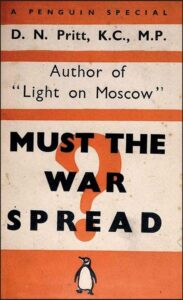
Later Years. In 1960 Pritt retired from the bar where his practice had declined. In 1965-1966 he was briefly a Professor of Law at the University of Ghana. He continued campaigning for trade union rights and on international issues; for instance he opposed the Vietnam War. His three part autobiography was published in 1965-1966. He had had many other books and pamphlets published.
The End. On 17 May 1972 Hammersmith Borough Council made Pritt a Freeman of Hammersmith. Its leader veteran Labour councillor Alfred Henry Little had good memories of Pritt as a hard working constituency MP.
D. N. Pritt died on 23 May 1972 aged eighty five at his Basingstoke home of a heart attack, hypertension and diabetes. His adopted daughter Susan Elizabeth Bates informed the authorities of his father’s death. He left £16,173. He was cremated at Golders Green Crematorium on Saturday 27 May 1972. On 10 October 1972 a well-attended Memorial Service was held for him at the Middle Temple, his Inn of Court, with which he had maintained close links as he had with Winchester School. He had loved good food and beautiful countryside. He wanted everybody to have the same privileges he enjoyed.
D. N. Pritt’s widow Marie Frances Pritt née Gough died at a Bury St Edmund’s, Suffolk, nursing home on 24 October 1999 aged a hundred and four of old age. Her adopted daughter Susan Elizabeth Bates informed the authorities of the death. Marie Frances Pritt had supported her husband in all his activities and was often lonely.
Leave a Reply