
D. N. Pritt Part One
Introduction. My previous article looked at Orwell’s references to D. N. Pritt, i.e. Denis Nowell Pritt a remarkable man with a massive blind spot. In this article I look at Pritt’s life.
Family Background and Early Life. D. N. Pritt was born on 22 September 1887 at Fern Bank, Greenhill Park, Willesden, in Middlesex. He was the younger of two sons of Harry Walter Pritt a metal merchant; and Mary Owen Pritt née Wilson who registered the birth on 28 October 1887 when the baby was a month old.
Pritt won a scholarship to Winchester in 1901; left in 1905; learnt French and German at Geneva; joined the Middle Temple in 1906; became a pupil of Robert Frederick Colam the Recorder of Croydon; was called to the bar in 1909; obtained a University of London pass degree in law in 1910; and specialised in worker’s compensation cases and appeals from British colonies to the Privy Council. Robert Frederick Colman was made a KC (King’s Counsel) in 1912 increasing Pritt’s prestige.
In 1910 Pritt was a junior member of the legal team that represented Sekgoma Letsholathebe a Bechuanaland chief in the case of The King v: The Earl of Crewe; exparte Sekgome (sic) at the Court of Appeal in London regarding an Appeal to the Privy Council. Chief Sekgoma had defended his people’s interests against the British South Africa Company. He was detained and a pliant chief installed.
Chief Sekgoma applied for a writ of habeas corpus but lost. The Court of Appeal decided that political expediency must come first. The Earl of Crewe was Robert Offley Ashburton Crewe the 1st Earl of Crewe the Colonial Secretary. His subordinate William Waldegrave Palmer the 2nd Earl of Selborne the British High Commissioner in South Africa had ordered Sekgoma to be detained. Chief Sekgoma was released in 1912 and died in 1916.
Although he began his political life a Conservative, and worked for the Conservatives at Bromley in 1910, Pritt joined the Liberals in 1914. He decided he would never appear for an employer against a worker, a landlord against a tenant or for a political opponent of the working class. He charged high fees but sometimes waived them for poor clients especially in political cases. He was known for using very subtle logic where appropriate but was sometimes impatient with hostile witnesses or judges.
Marriage and Family. By 1914 Pritt earned £400 pa (about £80,000 pa in our terms). On 27 July 1914 aged twenty six he married Marie Frances Gough aged eighteen at Billericay Registry Office in Essex. She was born at West Hackney in London on 10 October 1895, the daughter of Walter Maurice Gough, an accountant, and Sarah Gough née Bagley.
During the First World War Pritt was exempted from military service on medical grounds. Instead he was a War Office postal censor. In 1918 when the Labour Party was founded as a party with individual members he joined it.
After the First World War Pritt mainly did commercial law work especially involving appeals to the Privy Council. His fluent French was very useful in dealing with appeals from French Canada. In 1923 his son Francis John Pritt was born. In 1924 Pritt changed practise to work for Robert Alderson Wright KC a leading commercial law specialist.
In 1926 the Pritts adopted a daughter born on 24 September 1926. They named her Susan Elizabeth Pritt. In 1927 Pritt was made a KC.
Vietnam and India. In 1930 Vietnam was a French colony. The French government applied to the Privy Council to authorise the extradition of Ho Chi Minh, the Vietnamese communist leader, from Hong-Kong to Vietnam. D. N. Pritt KC successfully represented Ho Chi Minh and the French government lost its case.
India was under British rule. In 1931 three Hindustan Socialist Republican Association members, Baghat Singh, Sukhdev Thapar and Shivaram Rajguru, appealed to the Privy Council. A Special Tribunal had condemned them to death for murdering a British policeman John Saunders in Lahore in the Punjab in 1928. They argued that the ordinance which established the tribunal was unconstitutional. Despite Pritt’s efforts they lost their case and were hanged on 23 March 1931.
The Kylsant Case. During the First World War the Royal Mail Steam Packet Company made big profits. It put much money into reserves to cover taxes. After these were paid there was money left over which it put into special reserves. After the war, when it began to make trading losses, it withdrew money from these reserves to cover its losses, pay dividends, and make it look as if it was profitable, so deceiving investors. During the Great Depression this came to a head. On 20 July 1931 the Royal Mail Steam Packet Company Chairman, Owen Cosby Phillips, the 1st Baron Kylsant, and its auditor Harold John Morland, a Price-Waterhouse partner, were put on trial at the Old Bailey. They were accused of larceny.
The judge Mr Justice Robert Alderson Wright was appointed a judge in 1925. The prosecution counsel were William Allen Jowitt KC, the Attorney General; D. N. Pritt KC; and Eustace Cecil Fulton.
Lord Kylsant’s defence counsel were Sir John Allsebrook Simon KC; John Edward Singleton; and Wilfrid Lewis. Harold John Morland was defended by Sir Patrick Hastings KC who had been the Attorney General in the 1924 first Labour government; Stuart James Bevan; Frederick James Tucker; and Joseph Conway Conway (sic) KC.
Sir John Simon was a very formidable lawyer. The scientist John Burdon Sanderson Haldane once asked his uncle the eminent lawyer Richard Burdon Haldane, the 1st Viscount Haldane of Cloan, who he would hire as a defence lawyer if he was accused of murder. The alleged reply was: It would depend on the circumstances but if I had done the murder it would most certainly be Sir John Simon.
Harold John Morland was acquitted of larceny. His defence was that he had followed what was then standard accountancy practise. This was backed up by good evidence. I know something about accountancy and an accountant is supposed to be a watchdog, not a blood-hound.
Lord Kylsant was convicted of larceny and sentenced to a year in gaol with hard labour. He appealed and was granted bail. In November 1931 the Appeal Court upheld the conviction and sentence. He served it working as Wormwood Scrubs prison librarian. He died on 5 June 1937 aged seventy four at his Welsh estate leaving £62,567 7s 5d.
Sunderland. At the 1931 General Election Pritt was one of two Labour Candidates at Sunderland. It was one of the few remaining two member constituencies.
The sitting Sunderland Conservative MP Luke Thompson, a coal merchant, had taken his seat at a by election earlier that year. He held it, getting 53,386 votes. The other Conservative candidate Samuel Storey, a barrister, got 52,589 votes. The sitting Sunderland Labour MP Marion Phillips, had been elected at the 1929 General election. At this election she got 29,707 votes. D. N. Pritt got 29,680 votes.
At the 1931 General Election the Labour Party kept most of its core vote but was faced with a Conservative, Liberal and some renegade Labour, coalition; and was reduced to fifty seven seats. The only Labour cabinet minister who had stayed loyal to the party and held his seat was George Lansbury, a pacifist. He became Leader of the Opposition making it difficult for Labour to oppose appeasement.
The crypto-communist. In 1931 D. N. Pritt joined G. D. H. (George Douglas Howard) Cole’s Society for Socialist Inquiry and Propaganda; and in 1932 Pritt was a member of a New Fabian Research Bureau mission to Russia. He researched the Russian legal system, was impressed and published a report on it.
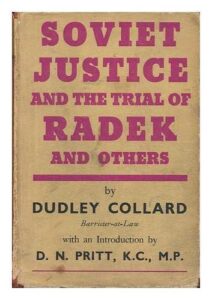
Another member of this mission G. D. H. Cole’s wife Margaret Isabel Cole née Postgate, noted privately that the eminent KC swallows it all; he’ll be some communist before he’s done. D. N. Pritt never officially became a communist but remained a fellow traveller all his life.
In 1933 D. N. Pritt chaired the International Commission of Inquiry into the Clarification of the Reichstag Fire. It was organised by the communist fixer Wilhelm Willi Munzenberg and held in London. It concluded that the Bulgarian communist leader Georgi Dimitrov and the other accused were innocent of starting this fire; and that it was a Nazi provocation.
In January 1934 D. N. Pritt obtained £30 damages and costs against Lord Trenchard, the Metropolitan Police Commissioner. The police had raided the NUWM (the National Unemployed Workers Movement) London offices on 1 November 1932; seized documents; and not returned them even after the NUWM leader the communist Walter (Wal) Hannington and his colleague Sidney Elias were acquitted of sedition.
In July 1934 at Glamorgan Assizes Pritt got the Communist Party General Secretary Harry Pollitt and the veteran communist Thomas (Tom) Mann, the NUWM Treasurer, acquitted. They had allegedly made seditious speeches at Trealaw in South Wales.
Hammersmith North. At the November 1935 General Election Pritt was the Labour Hammersmith North candidate. He got 15,464 votes. The Conservative Norman Adolph Henry Bower, a barrister, got 13,830 votes.
Pritt spoke in the House of Commons on local, national and international issues 1,632 times speaking in debates and asking questions. He first spoke there on 27 February 1936 on Colonial and Middle Eastern Services. His last speech there was on 14 December 1949 about the film industry. He was a hard working local MP as even Orwell noted.
D. N. Pritt was a founder member of the National Council for Civil Liberties; and belonged to the Howard League for Penal Reform and the Bentham Committee for Poor Litigants. He visited Russia in 1936 and observed the first of the Moscow Show Trials. He concluded that it was fair and the accused were guilty. He wrote an account of it (The Zinoviev Trial). Zinoviev was Grigory Evseyevich Zinoviev the former Saint Petersburg/Leningrad communist party secretary. Lenin had named six possible successors to himself in his testament – Stalin, Trotsky, Zinoviev, Kamenev, Bukharin and Pyatakov. Stalin had the other five possible leaders and many more people killed.
In 1936 Pritt was voted onto the Labour Party National Executive Committee Constituency Section at the Labour Conference. He lost his place on it in 1937.
The Parting of the Ways. In August 1939 there came the Hitler-Stalin Non-Aggression Pact. On 1 September 1939 the Nazis invaded Poland. On 17 September 1939 the Red Army invaded Eastern Poland. They later occupied the Baltic Republics; took Ruthenia off Slovakia; and Moldavia off Rumania.
In 1939 Penguin published D. N. Pritt’s book Light on Moscow – Soviet Policy Analysed in which he sought to justify Stalin’s foreign policy. It made some valid points.
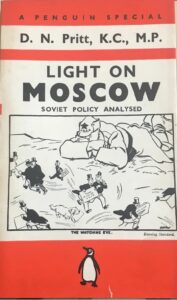
Between 1934 and 1939 Stalin had tried to get a pact with the Western democracies. The French and Czechs were willing, but the Conservative British Prime Minsters Baldwin and Chamberlain had not wanted to know. They had appeased Fascist Italy, Nazi Germany and militarist Japan. This was true up to a point but the reality was more complex. In early 1939 Hitler broke the Munich agreement and mocked Chamberlain for trusting him. Neville Chamberlain then tried to make an agreement with Stalin. However Stalin in return now wanted Britain and France to let Russia retake the Baltic Republics, which were under Russian control before 1917. Neville Chamberlain refused to do this so Stalin made a pact with Hitler.
The world’s Communist parties were controlled by the Comintern (the Third Communist International) in Moscow. They changed their line in line with the new Russian foreign policy. This cost them many members and discredited them with the non-communist left.
D. N. Pritt remained a Labour MP but in early 1940 he supported the Russian attack on Finland. Communists and fellow travellers sincerely believed that the Finns had attacked Russia and the Russians had retaliated. In fact, Stalin had staged a false flag incident. This was similar to Nazi claims that they invaded Poland because the Poles had attacked a German radio station.
Clement Attlee the Labour Leader of the Opposition had Pritt expelled from the Labour Party. D. N. Pritt became an Independent Labour MP. The next part of this article will look at D. N. Pritt’s later life.
Leave a Reply