
The Ghosts: 1, Bruce Bairnsfather
*
Introduction. In his Searchlight Books February 1941 pamphlet The Lion and the Unicorn; Socialism and the English Genius, Orwell wrote in Part II Shopkeepers at War that:
Nothing was more desolating at the beginning of this war than the way in which the whole of the older generation conspired to pretend that it was the war of 1914-1918 over again. All the old duds were back on the job, twenty years older with the skull plainer in their faces. Ian Hay was cheering up the troops, Belloc was writing articles on strategy, Maurois doing broadcasts, Bairnsfather drawing cartoons. It was like a tea party of ghosts.
The men Orwell named as taking part in this tea party of ghosts were well known to his readers. They are largely forgotten today. In this article I will look at (Charles) Bruce Bairnsfather.
Family Background. (Charles) Bruce Bairnsfather was born on 9 July 1887 at Strawberry Bank Cottage at Murree in the Punjab in what was then British India. His parents were Lieutenant (later Major) Thomas Henry Bairnsfather, a Scottish infantry officer in the Cheshire Regiment; and Thomas Bairnsfather’s second cousin Amelia Jane Eliza Bairnsfather née Every. Thomas and Amelia Bairnsfather’s common great grandfather was Sir Edward Every, an 8th baronet i.e. a hereditary knight. The first Every baronet was Sir Simon Every a Derbyshire royalist in the civil war. Lieutenant Bairnsfather composed comic songs and Amelia Bairnsfather was a talented painter.
Bairnsfather had two younger brothers. Malcolm Harvey Bairnsfather was born in 1890. He died of meningitis in infancy in 1891. Thomas Duncan Bairnsfather was born on 18 October 1896; served in the British Army in the First World War and the Royal Australian Air Force in the Second World War; had scrapes with the law in Britain and Australia for forgery and bigamy; and died on 18 April 1949 at Woollahra in New South Wales aged fifty two.
Early Life. Bairnsfather returned to Britain in 1895 and stayed with his maternal uncle by marriage, the Reverend John Todd Atkinson, the Rector of Thornbury, a Herefordshire village. From 1896 to 1904 the boy studied at Rudyard Kipling’s old school, the United Services College (the USC), at Westward Ho! North Devon. It opened in 1874 for sons of military officers and civil servants. Kipling hated the school but based his novel Stalkey & Co. (1899) on his time there. After various name changes and moves the United Services College merged with Haileybury College in 1942.
Bairnsfather was often caned for doodling, did badly academically but won a prize for drawing. His parents returned to England in 1899. One of the United Services College staff in Bairnsfather’s time there, Reginald John Leakey, the Junior Department head, was allegedly the model for Bairnsfather’s cartoon figure of Old Bill, a First World War British soldier, though many other people have claimed or been nominated for this honour.
From 1904 to 1905 Bairnsfather studied at Trinity College, Stratford upon Avon, an army crammer. He also took evening art classes at Stratford upon Avon Technical College. In 1904 aged seventeen he sold his first drawing, an advertisement for Players’ cigarettes for two guineas, about £400 in our terms.
In 1905 Bairnsfather failed his entrance exams for the Royal Military College at Sandhurst which trained infantry and cavalry officers; and the Royal Military Academy at Woolwich which trained artillery and engineer officers. He passed a simpler exam for the Militia, the predecessor of the Territorial Army, and joined the 3rd Militia Battalion of the Royal Warwickshire Regiment. In 1907 he was commissioned a Second Lieutenant in a regular battalion of the Cheshire Regiment his father’s old regiment. Second Lieutenant Bairnsfather fell ill, left the army, remained a reserve officer, and enrolled at the John Hassall School of Art in London, which had been founded in 1905 by John Hassall, a poster designer and book illustrator, who died in 1948 aged seventy nine.
Bairnsfather initially failed as a poster designer and joined Spencer’s, a Stratford upon Avon electrical engineering firm as an apprentice. He helped install electricity at the Stratford Shakespeare Memorial Theatre (which had opened in 1879 and burnt down in 1926. The present Stratford Shakespeare Memorial Theatre opened in 1932). His main job was helping install electricity in country houses.
Meanwhile Bairnsfather acted in amateur theatricals, specialising in drag; was befriended by the wealthy best-selling novelist Marie Corelli, a Stratford resident, who introduced him to Sir Thomas Lipton, the chain grocery magnate; drew adverts for Lipton’s, Player’s Cigarettes and Keene’s Mustard; and won an opera company poster competition.
The First World War began in August 1914. Bairnsfather, a reservist, joined the 1st Warwickshire Regiment as a Second Lieutenant, soon rising to be a Captain and Machine-Gun officer. The first of his Fragments from France cartoons, Where did that one go to? was published in The Bystander in January 1915. In April 1915 at the Battle of Second Ypres he suffered hearing damage in his left ear and shell shock.
Captain Bairnsfather was attached to the headquarters of the 34th Division, a Kitchener’s New Army formation, at Sutton Veney on Salisbury Plain. On 15 September 1915 his most well-known character the pipe smoking, walrus-moustached Midlands soldier Old Bill ‘dim, dull and honest’ first appeared in a Bystander cartoon captioned When the ell is it going to be strawberry?. 34th Division was one of those that were shattered on 1 July 1916 the first day of the Battle of the Somme.
On 24 November 1915 Bairnsfather’s most famous cartoon appeared in The Bystander. It showed Old Bill in a wet shell hole during a bombardment with a younger, less experienced and frightened fellow soldier. ‘Old Bill’ tells him companion Bert: Well, if you knows of a better ‘ole go to it. Old Bill has two younger friends Bert and Alf. Another cartoon showed Old Bill and a younger companion sheltering in a trench with a big shell hole in the wall. The young soldier asks Who made that? Old Bill replies: Mice.
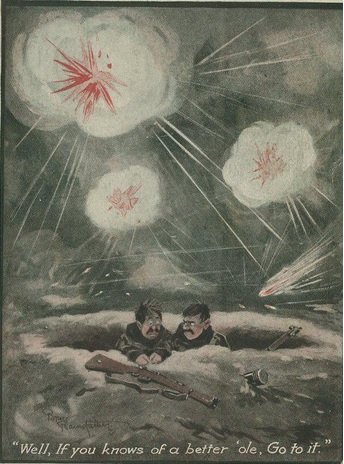
The Bystander’s sales rocketed and it was popular with front line troops. In 1916 more than half a million copies were sold of the first of his six cartoon collections Fragments from France. Some critics saw them as vulgar caricatures of our heroes and questions were asked in parliament, but the army saw his value. He joined the War Office Intelligence Department as an officer cartoonist. He drew similar cartoons for the French and Italian armies; and later the American Army.
In 1917 his musical The Better ‘Ole, written in collaboration with the theatrical impresario Charles Bruce Cochran, and starring Sybil Thorndike, was successful in the West End and in the provinces. It was made into a film in 1926.
Between the Wars On 15 January 1921 Charles Bruce Bairnsfather, thirty three, married Cecilia Agnes Scott née Bruton, thirty four at the City of London Registry Office. She was born in Sydney, Australia, in 1886 and had in 1907 married the Honourable Michael Scott who was the fifth son of the third Earl of Eldon. Michael Scott was a leading international golfer. He and Cecilia had divorced in 1919. As a divorcee Cecilia Agnes Scott could not marry in church hence the Registry Office marriage. Bairnsfather acquired a step daughter, Heather Alice Cecily Scott, who was born in 1908 and died in 1965. Ther Bairnsfathers had one daughter: Barbara Bruce Bairnsfather born on 26 December 1922, who married William Fowler Littlejohn in 1948.
There were tensions in the marriage and his wife sued Bairnsfather for divorce in 1930 in the USA. She accused him of adultery with the actress Laura Constance Boyle (née Hardie aged fifty two whose stage name was Constance Collier) but Bruce and Cecilia were reconciled and she dropped the divorce case.
Bairnsfather was a celebrity. He was the subject of one of the first talking movies in 1927; wrote, directed and produced Canada’s first major movie Carry on Sergeant in 1928; took part in the first experimental TV broadcast from Alexandra Palace in 1936; did lecture tours in Britain, the USA and Canada; music hall acts; and illustrated journalism.
Old Bill’s image was reproduced on pottery, playing cards, jigsaw puzzles, postcards and other items. Dolls of him were made; Madame Tussaud’s had a waxwork model of him; and the Imperial War Museum had a bus named after him in its collection complete with an Old Bill radiator mascot. There is still a market in Old Bill collectables but Bairnsfather was not a good businessman and other people made more money out of his work than he did. He was sued for bankruptcy in 1932. His autobiography Wide Canvas was published in 1939 when another World War was coming.
The Second World War. Bairnsfather’s cartoon books Old Bill Does it again, and Old Bill and Son were published in 1940 prompting Orwell’s jibes. Alexander Korda’s film Old Bill and Son starring John Mills appeared in 1941.
From 1942 to 1944 Bairnsfather was the American Army official cartoonist in Britain with the rank of Captain. His cartoon books Jeeps and Jests appeared in 1943, and No Kiddin’ in 1944. He drew cartoons for American air bases and aeroplane nosecones.
Final Years. After the Second World War Bairnsfather continued doing lecture tours, giving talks and other work, but never broke away from the Old Bill stereotype. He died on 29 September 1959, aged seventy two, of bladder cancer, a chronic urinary infection, and the after-effects of a cystectomy, at Worcester Royal Infirmary. His body was cremated at Cheltenham Crematorium. Despite his earlier money problems he left $3,164 8s 8d.
Cecilia died 10 February 1966 aged eighty of a fractured neck, a subdural haemorrhage, and old age, at Rookwood Nursing Home near Wychbold in Worcestershire. She left £960. Administration was granted to the solicitors/attorneys for her daughter and son-in-law Barbara Bruce Littlejohn and William Fowler Littlejohn. William died on 19 May 2000 aged seventy five. Barbara died on 5 October 2013 aged ninety in Tennessee in the USA.
Legacy. Some people still remember Bruce Bairnsfather. They are mainly military enthusiasts interested in the First World War such as myself.
There are plaques to Bairnsfather at places associated with him including his former home, Victoria Spa Lodge, Bishopton near Stratford upon Avon; 1 Sterling Street, Knightsbridge in London where he had a studio; Colwall Royal British Legion Club – he lived in Colwall from 1951 to 1954 near the Malvern Hills; and on the cottage at St Yvon in Belgium where he drew his first trench cartoon. If readers want to know more about Bairnsfather and Old Bill I recommend In Search of the Better ‘Ole: The Life and Works and the Collectables of Bruce Bairnsfather by Tonie & Valmai Holt (Milestone Publications, 1985).
Final Thoughts. The Old Bill cartoons displayed the stoical humour with which the British Tommy endured the hell of the trenches. In the Second World War didn’t the civilian populations need that humour too?
Leave a Reply