
Zamyatin’s Short Stories Reviewed
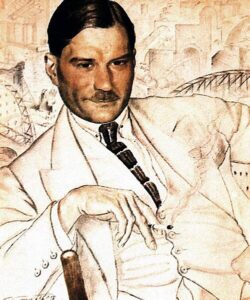
Yevgeny Zamyatin (1884 – 1937) is, of course, best known to Orwellians and lovers of Russian Literature for his anti-utopian novel of 1921 – We. Zamyatin was not a prolific writer, his first short story was published in 1908 but he continued to work as a naval engineer until 1917. He had spent two years in England supervising the construction of icebreakers and returned to Petrograd (St. Petersburg) just before the October revolution broke out whereupon he more or less abandoned his former career in order to throw himself into the maelstrom of literary life that accompanied the Bolshevik revolution. Given the bleak and repressive literary regime that came to typify the Soviet Union it is sometimes hard to recall that initially there was an explosion of cultural life with a myriad of literary groups contending for attention – and scarce paper. Zamyatin was at the forefront of this ferment and noted for his encouragement and sponsorship of new and emerging talents such as the group known as the Serapion Brothers – a non-party group of writers linked mainly by their belief in the autonomy of art and the freedom of the writer. Zamyatin was a heretic to the core, for him “real literature can exist only where it is produced by madmen, hermits, heretics, dreamers, rebels and sceptics…” Zamyatin had been arrested for political activity in 1905 and had had a number of brushes with the Tsarist authorities thereafter but typically, by the time of the 1917 revolution, his political allegiance had shifted away from the Social Democratic party to a much more liberal and democratic position. As Gleb Struve, who introduced Orwell to Zamyatin’s writing, wrote, it is very typical that he was a Bolshevik before the Russian Revolution and ceased to be one when Bolshevism became the official doctrine in power. Zamyatin’s antecedents in Russian Literature were writers like Leskov and Gogol the great proponents of skaz – the rendering of the idiosyncratic, peculiar and individual language of real people as opposed to the bookish language of intellectuals. It was, he thought, vital to use the language and usages of the milieu depicted in the story rather than correct or grammatical language So much so that fellow writer Boris Pilnyak asserted that Zamyatin wrote with a dictionary of slang and dialect ever at hand.
X and other stories contains six stories written between 1913 and 1929. The first story, Provincial Life was hailed as the emergence of a new and original talent by the likes of the critic and theorist Boris Eikhenbaum amongst others; The second story At the End of the Earth written in 1914 however attracted the attention of the Tsarist censors and the journal it was published in was “placed under arrest” for immorality and anti-militarism. The next two stories The Cave and Mamai transport us to the grim realities of War Communism in post revolutionary Petrograd and were guaranteed not to find favour with the Party or the orthodox literary establishment. X is a more light hearted and satirical story revealing Zamyatin’s talent for humour and the last story Flood – which was to be Zamyatin’s last work before he left the Soviet Union – marks a significant departure in style.
In 1929 an unauthorised and shortened version of We was published in Russian in Prague by an émigré magazine and Zamyatin, already under attack by the orthodox literary establishment was effectively as we say today cancelled. Unable to publish and publicly vilified he wrote to Stalin asking permission to leave Russia – for a short while on the understanding that he would be able to return as soon as it became possible in Russia to serve great ideas in literature without being subservient to little men. Quixotically Stalin probably encouraged by Gorky agreed and Zamyatin went into exile in Paris never to return.
*
X and other stories by Yevgeny Zamyatin
Translated by Galya and Hugh Aplin
Alma Classics 2024 256pp
978-1-84749-929-5
I have read and greatly enjoyed Zamyatin’s We, and its influence on Nineteen Eighty-Four is all too clear. I am curious whether Orwell would have read these short stories by Zamyatin, and whether there is any detectable influence of them on Orwell’s writings? Are any of these short stories in the collection also dystopian in their portrayals of the Soviet Union?