
Polperro, Autumn 2025
The Orwell Society’s Visit to Polperro
(October 3 – 6, 2025)
A Report by Oliver Buckton
*
George Orwell possibly came to Polperro in late 1904 and definitely visited before WWI, while he last visited the village in September 1927, shortly after his return from Burma.
Friday, October 3rd
Excited to be part of the inaugural Orwell Society Polperro trip, Laurice, my wife, and I travelled to Polperro from Plymouth where we had broken our journey from London (actually from Miami!). We’d stayed the night at Plymouth, recovering from jetlag and enjoying walks along the scenic Hoe. On Friday morning we took the charming branch line train from Liskeard to Looe, and then a taxi to the Claremont Hotel, Polperro, where we were soon admitted by the friendly and welcoming Becky. She said our room was available at around 12:30, some time before official check-in at the hotel. Delighted with our room, having unpacked we walked down to the harbor. It was a rainy and windy Friday, and it seemed the ideal opportunity to visit one of the local pubs. We chose the “Three Pilchards”—which we knew would be our dining location on Sunday evening—and enjoyed a delicious lunch with local beer and cider. Choosing a different route, we soaked up the atmosphere (literally, as it was still raining) walking back to the hotel. We got back to the hotel just as a large group of Orwell Society folks were arriving, welcomed by Quentin and Liz, the architects and supremos of the trip. Comforting to have confirmation we were in the right place!

Polperro Harbour with the 3 Pilchards on the right in the middle of the photo
We relaxed in our room until 6pm, then joined the group downstairs in the lounge. The first planned event was a visit to Polperro Primary Academy to view the artwork done by the pupils whose teachers had received an Orwell Society Award for 2024-25. We were kindly offered a lift by Bruce Dear and Katharine Farnham-Dear, as the school was too far to walk from the hotel. Bruce leads the Orwell Society’s work with schools and in education, and has worked closely with the Polperro Primary Academy as they received the Orwell Society Award. The children’s artwork was informed by Orwell’s love of nature, and featured beautiful designs of butterflies, leaves, and some brilliant collages of Orwell’s face. To me these suggested Orwell’s complex personality, not to say duality, with the striking contrasts of the sides of his visage. The children were on hand to show off their work—from years 4 to 6. We also met Sean Hewitt , the local artist who had worked with the children on their amazing artwork. One of the girls explained that Sean had taught them about “magic colors,” especially yellow, which could be used as a layer over other colors. The head of the school, Anthea Hillman also described the great impact of the Orwell Society award on inspiring the pupils to create memorable works of art. Orwell’s son Richard Blair presented Anthea with a plaque featuring a piece of slate from Barnhill, the home on Jura where Orwell lived for several years, raised young Richard, and wrote Nineteen Eighty-Four. Group photos of all the children and their teachers, with Quentin, Richard, Anthea, and Sean, wrapped up a memorable evening.
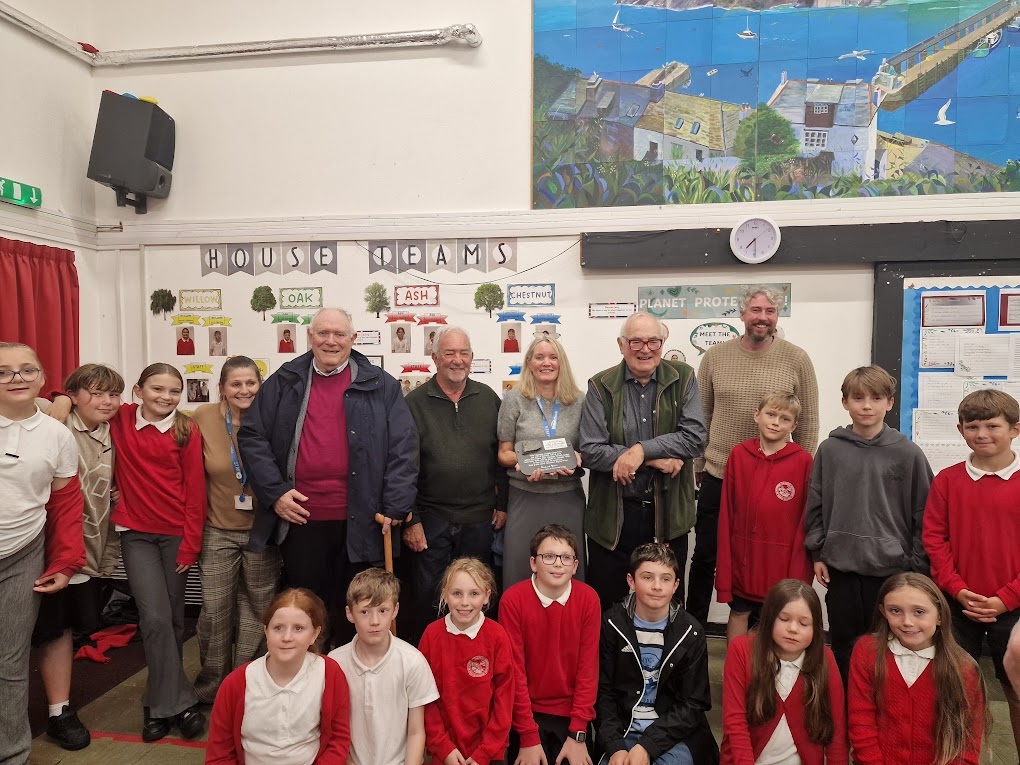
Sean Hewitt the Artist and Anthea Hillman are in the centre of the photo
An example of their wonderful work is below.
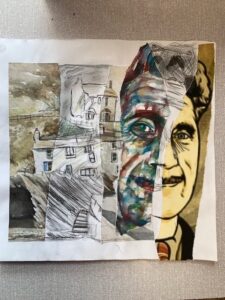
You can learn more about the project at https://orwellsociety.com/teacher-bursary/polperro-2024-2025/
+
We drove back into the village, the rain still coming down, for dinner at OXOX (Noughts and Crosses), a warm and inviting restaurant with exposed beams and spacious seating. Having pre-ordered our delicious meals, we only had to rack our brains to choose from the wine-list. After a fine dinner, we returned to the hotel, bracing against the wind, for conversation and night-caps.
Saturday, October 4th
We awoke to a rainy and windy morning, continuing the weather pattern from the day before. We’d been warned that Storm Amy would be leaving her mark on South Cornwall. Having booked breakfast at 8:30am, we joined Sherry and Joe from San Francisco and enjoyed talking about Orwell, literature and art. The Full English breakfast cooked by Stuart lived up to the rave reviews Liz had given us. As we had the morning free, we walked down to the harbor and on to the beach, where several locals were letting their dogs run around. A bit of browsing in local shops, was followed by a visit to the local heritage museum. This featured histories of fishing and smuggling in the region and was packed with interesting information about two important foundations of the Cornish economy! The museum also had a pleasant café, perfect for a coffee break.
On the way back to the hotel, the skies opened again. Forced therefore to take refuge in the pub closest to the hotel, The Ship Inn, we opted to stay for lunch.
We arrived back at the hotel in plenty of time to dry off and head up to the village hall for the afternoon’s main event– the talks on Orwell, Polperro, and his love of nature which had been advertised throughout the village and had an excellent turnout from locals as well as Orwell Society members.
The first speaker was Richard Blair who spoke about “Richard’s time with his Father and his interests in nature for practical and other reasons”
Richard told the audience that in 1945 his mother Eileen died, under anaesthetic, leaving Orwell in full charge of raising a young baby. Richard stated of Orwell, “he was an extraordinarily good father,” who knew how to change, bathe, feed him. He’d made up his mind to go to an island in the Hebrides, Jura. Orwell spent a couple of weeks there in 1946, and found a home to rent, Barnhill. Orwell left London in May 1946, for Jura. A few weeks later Richard followed to Jura with his nanny Susan Watson. Soon Orwell’s younger sister Avril arrived there to look after Richard. They were concerned about snakes! Richard said Jura was a “Very good place to be brought up.” Despite Orwell’s plan to focus on writing 1984, there was a succession of friends coming up to visit them on Jura. Orwell’s health collapsed in 1947 shortly before Christmas
Richard recalled that Orwell spent 7 months at Hairmyres hospital in East Kilbride, during which time Richard hardly saw him. Orwell took a course of the drug streptomycin, obtained through the agency of David Astor from the US, but had an allergic reaction to the drug. Orwell returned to Jura in 1948, planning to finish “the book” 1984. Richard offered anecdotes of his childhood, including how he learned to smoke when he was 4 (!) Richard also recounted how he and his father nearly drowned in Gulf of Corryvreckan, during an expedition in a dinghy with outboard motor, when they got caught in the currents. The next speaker was Darcy Moore, his talk titled “Orwell in Cornwall: Eric Blair in Polperro and Looe.” Moore noted that Orwell possibly came to Polperro in late 1904 and definitely visited before WWI. Moore wrote and published a piece on Orwell in Cornwall a couple of years ago and his talk drew on his research. Darcy began his talk with Orwell’s last visit to Polperro in September 1927 where he informed his family that he would be quitting the Indian Police Service (IPS) job in Burma and wanted to become a writer. Orwell felt he was “outraging his true nature” in the IPS. The first thing he did on returning to England was to go down to Cornwall; he wanted to go for a month. Avril noted his appearance had changed while in Burma, as he looked like his father, had moustache, and his hair was darker. Down and Out in Paris in London was published Jan 1933, under the identity of George Orwell. Concerning Orwell’s visits to Cornwall, Moore noted that hard evidence is lacking. Avril gives us an idea, however, recollecting she, Eric, and the Perrycoste children going down a lane in Polperro “where a headless ghost was said to lurk.” Darcy showed a photograph taken of the family at a studio in Looe, in late august 1918 while Orwell’s father was on leave from the Army. Other photos shown by Moore included Orwell in the Wall Game, at Eton. Another slide showed a picture of a letter from Orwell to his Eton friend Stephen Runciman—who became a famous historian– addressed from Grove Terrace Polperro Cornwall Aug 1920. This described his first adventure tramping. Orwell’s adventure began when he got left behind at Seaton Junction, then got the train to Plymouth, and went on an “amateur tramp”; Orwell slept in a field, under a large tree for shelter. He eventually got the train to Looe, walked to Polperro in the hot sun. The address of the house, Grove Terrace is now named Berea House between Cleta House and Coombes House. Moore mentioned that the census documents really assist with his research. Darcy’s fascinating talk also delved into the Orwell connection with Geoffrey Grigson, the poet and naturalist who was born at the vicarage in Pelynt (a few miles from Polperro). Grigson was a great source of information on the Perrycostes, as Grigson knew Honor and Bernard Perrycoste, Maud’s children.
The next speaker was David Tovey, an Independent art historian specializing in Cornish art, who spoke on “Maud Perrycoste and the attractions of Polperro as an art centre.” Tovey had planned a short work on the subject, but ended up writing 500 pages published in two volumes. Tovey had found out that, curiously, there’d been no art gallery in Polperro. And yet by 1930s half the artists in Britain had worked in Polperro. The first depictions of Polperro in early nineteenth century were by engravers, J.M.W. Turner and William Daniell. In the 19th Polperro was very difficult to get to—some things haven’t changed !—as the rail line from Looe did not open till 1901.Unsurprisingly, most artists who worked in Polperro in 1860s-70s were Plymouth-based, not needing to travel long distances; these included William Cook of Plymouth, and William Henry Pike.
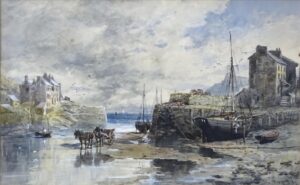
William Henry Pike 1887
Tovey referred to Louisa Parr’s novel called Adam and Eve (1880s) that highlighted the period when Polperro was a smuggling center. Other artists who painted Polperro included William Borrow (RA 1885), Herbert Butler (“Hauling in the Pilchard Nets” 1887) William Mouat Loudan (“Fish Sale, Polperro” (RA 1888)). Tovey pointed out that despite its popularity as a location, an art colony never developed in Polperro. One reason for this, surprisingly, was the lack of light: the village is lovely in summer but some properties in the village don’t see sunlight from October to March. We were evidently fortunate to enjoy such stunning light during our October visit!
Tovey informed the audience that Maud Perrycoste exhibited paintings in Falmouth in 1897. She was already known as an artist. Tovey described Maud as the first long-term Polperro artist.
The next speakers of the afternoon were Jay Gates and Peter White, talking about “Bodmin Airport and the special unspoiled field.” Peter White told the audience he’d taken his first solo flight over sixty years ago, on 19 July 1964. After many years spent flying, he wanted to give something back, and share his enthusiasm for flying. After Bodmin airfield opened, White launched the organization “Feet off the Ground” (FOG), which took children flying. FOGs particular purpose was to give disadvantaged and disabled children the opportunity to experience flying. FOG works with youth groups and schools and hosts Devon and Cornwall Scouts aero camps—they (the campers) have to plan a course of flying and then they fly that course. One recent project White described involved poetry combined with Remembrance for those lost in conflicts—poems written on biodegradable paper and three seeds: poppies, forget-me-not, cornflower (representing Britain, France and Germany) are dropped around the fields.
Jay Gates next presented on: “How Green is an Airfield?: Bodmin Airfield where aviation and ecology meet.” Bodmin Airfield Opened June 1 1975—it’s been there for 50 years. The key to the airfield’s natural environment, Gates explained, is that no pesticides, herbicides, or chemicals have ever been used. As Gates said, it “truly is organic.” The airfield is especially valuable because traditional hay meadows are increasingly rare in Britain. Airfields are important because not open to public: hence they have inbuilt protection from human intrusion. Rare species of orchids have been found on the Bodmin airfield. There are 35 bee species considered as being under threat of extinction. Gates cited the 97% loss of wildflower meadows since World War II, which have especially affected oil beetles and miner bees. One challenge faced is that ragwort, which grows abundantly on fields adjacent to Bodmin airfield, is banned by law. Gates cited the Ragwort act of 2003, noting its toxicity to cattle and sheep; hence Jay and his team have to relentlessly remove it from the airfield. In conclusion, Gates noted that Bodmin airfield was granted County Wildlife Site status by Natural England.
The final speaker of the afternoon, Les Hurst, spoke all too briefly (due to time constraints) on Orwell’s reviews in the Manchester Evening News (MEN) on farming and the incipient organic movement. Hurst had copies of some of the first editions of books that Orwell reviewed. Orwell’s reviews of important books on natural history including The Way of a Countryman by Sir William Beech-Thomas and The Natural Order by HJ Massingham: Orwell described this book as “a useful corrective to the optimism that still flourishes even amongst the bombs….such major disasters as deforestation are happening all the time.” Orwell blamed this sentimental view on nature writing: he stated Richard Jeffries’ “daydream was of an England from which human beings have vanished” referring to Jefferies’ dystopian novel After London. Hurst noted Orwell’s point that nature worship is inherently anti-social. Following the talks, Richard Blair presented Pat Hayday with a piece of the slate roof from Barnhill
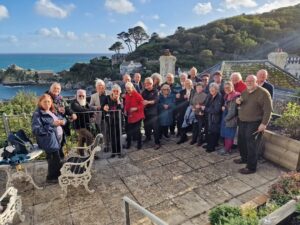
After the highly informative and entertaining talks, the group walked up to Higher Shute, the home of Nick Childs and Tessa Jackson, which had been the Polperro home of the Perrycostes, where the Blairs stayed on visits to Polperro. Nick and Tessa were welcoming and gracious hosts, opening their home to the curious and appreciative Orwell Society. In bright sunshine, we enjoyed prosecco and snacks on the beautiful terrace overlooking Polperro Harbor and the Blue Peter pub. A highlight of the visit were the tours, in small groups, of the home, led by Nick and Tessa. Nick explained that he and Tessa originally lived in the studio used by Maud for her painting, spending weekends there. Having fallen in love with the place, they then acquired the other flats as they became available and restored the home to its beautiful former glory. We got to see the bedroom in which Orwell probably stayed on his visits to Polperro, as well as Maud’s art studio. Dinner followed at Priscilla’s restaurant, where further lively conversation accompanied the delicious food and beverages. It was the capstone of a full and enjoyable day.
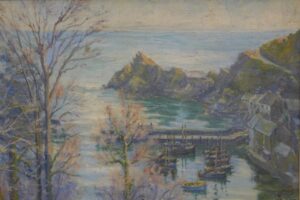
Maud Perry-Coste Polperro from Talland Hill & The Members and Guests at Higher Shute
Sunday October 5th
Sunday was a more relaxed day, breakfast followed by a free morning spent exploring the village. In the afternoon, a viewing had been scheduled of the entries for the Orwell- themed art competition at Ebeneezer Gallery. When I arrived around 3pm, the judges were in deep discussion about the merits of the various entries; at 4pm the artist Glenn Ibitson awarded second prize to Rachel Brown for a colorful fish picture made from a large number of carefully selected fabrics—perhaps of pike from Coming Up for Air?
Richard Blair then announced the competition winner was Tracy Watts for the beautifully-detailed painting of a toad, with a quotation from Coming Up for Air.
Unfortunately, neither of the winning artists were present to receive their prizes, so they were presented to others involved in the art community in Polperro on their behalf. Following the presentation, there was free time to enjoy the beauties of Polperro and, for those who felt energetic, to explore the Cornish coastal path and its spectacular views of the cliffs and ocean.
On Sunday night, dinner was at the Three Pilchards pub, on the Harbor—delicious food and drink, stimulating conversation in a relaxed atmosphere with friendly service. After dinner the group returned to the hotel and assembled in the sitting room of the Claremont Hotel to read passages from Orwell’s work and explain why they chose it. First Richard Blair thanked Quentin and Liz for all their outstanding work putting the Polperro weekend together and making sure everything ran smoothly. Thirteen members of the group chose to read a passage from Orwell. The readers, listed in order, follow:
- Quentin Kopp read from “Politics and the English Language” and highlighted its relevance to corrupt political language today
- Richard Blair read the conclusion from Homage to Catalonia (final passage) as Orwell meditated on the “deep, deep sleep of England,” offering it as a beautiful piece of prose.
- Jason Crimp read a piece from Orwell’s wartime essay The Lion and the Unicorn—in which Orwell prophesied the English socialist revolution but he got it wrong!
- Joe Luttrel read an extract from Orwell’s essay “Books vs Cigarettes,” in which Orwell admits he spends more on cigarettes than books.
- Sherry Goodman read from “Why I Write” about Orwell’s success in turning political writing into an art.
- Bruce Dear read from Lion and Unicorn, Orwell’s portrait of social injustice, asking England to be true to herself by treating refugees humanely, taxing the rich properly and promoting the interests of ordinary people.
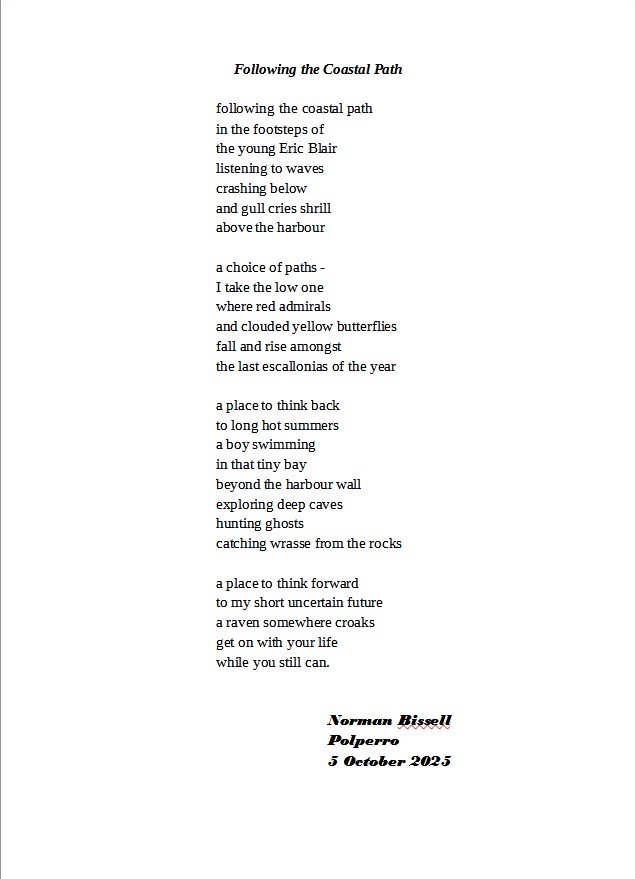
- Norman Bissell (Norrie) read from “Some Thoughts on the Common Toad,” about nature springing up irresistibly in urban settings. Bissell also read a lovely poem he’d written earlier that day while walking on the coastal path.
- Oliver Buckton read from “Some Thoughts on the Common Toad” in which Orwell turns his love of nature into a political statement defying the “important people” who would stop him enjoying it if they could.
- Glenn Ibbitson read an excerpt from Down and Out in Paris and London about the London street artist, named Bozo.
- Carol King read from The Road to Wigan Pier in which Orwell describes the squalid conditions of living in the lodging above the Brookers’ tripe shop.
- Patrick Fox read the memorable conclusion of Animal Farm, a book he’d first read in secondary school.
- Les Hurst read the first section of Orwell’s “As I Please” column from Tribune for 25 February 1944, which does not have a title as such. Les thinks of it though, as “I believe the trousers don’t fit”, which is a line in Orwell’s imaginary telephone call in the entertaining piece.
- Darcy Moore read from Coming Up for Air to illustrate Orwell’s penchant for prophesying doom.
Following the readings, one of the two new arrival guests who were going to be walking the coastal path kindly took a group photograph
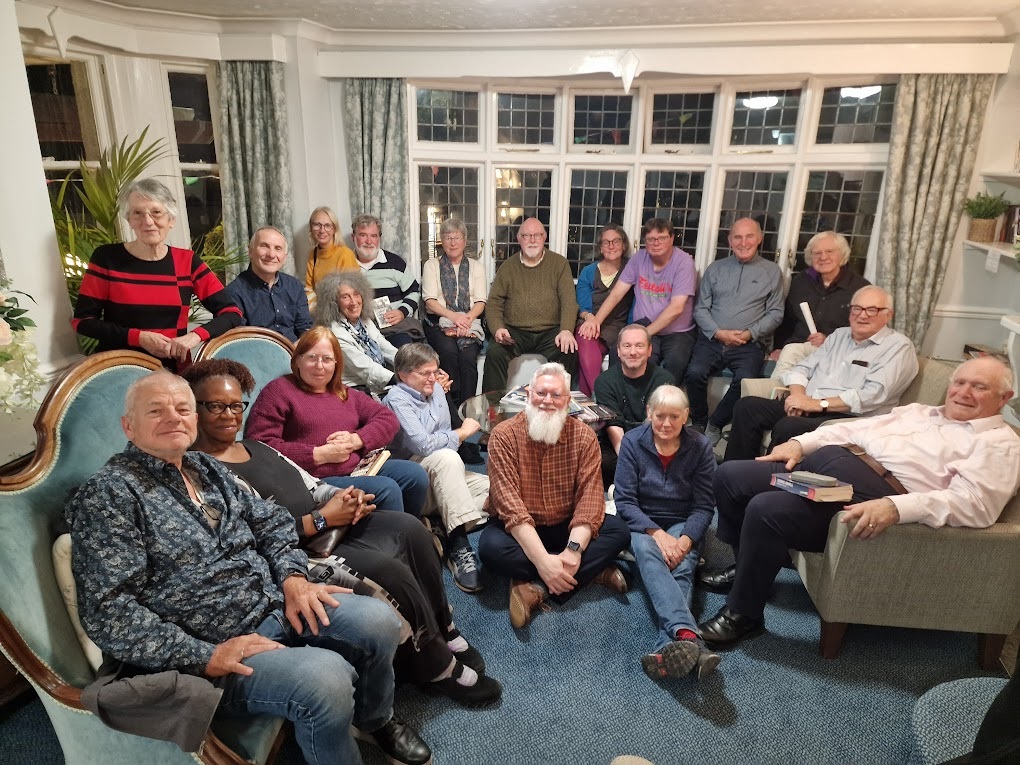
Oliver and Laurice Buckton are on the left front
Quentin offered thanks for a fantastic weekend that he looked forward to seeing everyone at a future event.
Farewells were exchanged with those who planned to leave early the next morning.
Monday, October 6th
Departure day, a final cooked breakfast, enjoying good conversation, finalizing travel arrangements, and sharing farewells with new and old friends. The Polperro motto that Quentin had shared with us in his itinerary–“Arrive as Strangers, leave as Friends”–certainly applied to this superb trip. We met many new people–both members of the Orwell Society group and hospitable locals–and left feeling we had found many new friends. We look forward to meeting everyone again at future Orwell Society Events. And hopefully Polperro will become a regular fixture on the Orwell Society Events calendar.
Additional Notes of outcomes from Quentin Kopp
- The Museum The Village Committee and the Trustees of the Harbour were very taken with the weekend and are planning to make the Barnhill Slate awarded after the talks the centre piece of a new section in the Museum dedicated to Orwell and Polperro. This will include audio-visual input from Darcy Moore.
- The School’s Award Polperro is part of the Bridge Schools Academy Trust which has 15 schools. Dani May, who is is the Head of English and Environment for the whole group of schools have been accepted as the Award Winners for 2025-6 on behalf of 3 more Primary Schools in the nearby Tamar Valley. A feature of their plan is for children who participated in this year’s project to teach their peers in the 3 schools.
- 2026 In view of the Schools Award I am planning to have another event combining the schools, events in Polperro and an Art Competition in 2026. Too early to give you dates yet.
A fabulous long weekend and great report from Oliver! The Orwell Society’s encouragement of young people by supporting local education in Cornwall is to be applauded!
Thanks Darcy! Absolutely agree about the amazing OS work with schools. It was great to meet you and learn more about your awesome research on Orwell.
Thanks to Oliver for such a comprehensive report and to Quentin and Liz for organising such a great weekend. We learnt so much about so many different things.
Thanks Katharine. It was great spending time with you and Bruce in Polperro!