
GOS Carries Exclusive Publication of Holbrook novel
*
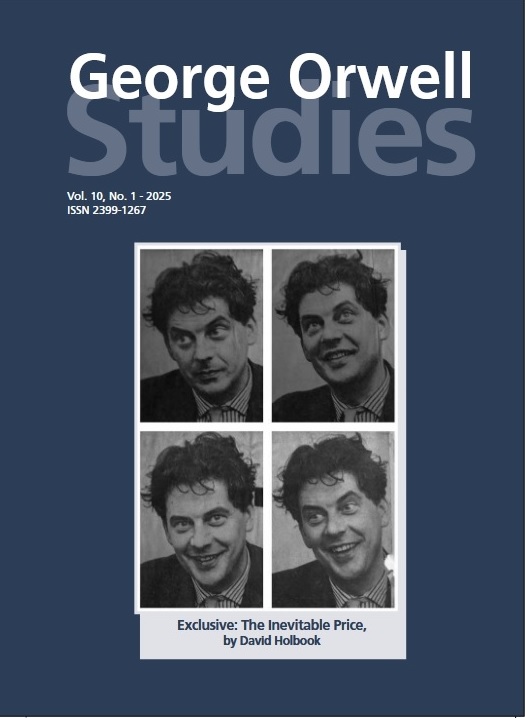
The latest edition of George Orwell Studies (Vol. 10, No. 1) opens with the exclusive publication of the first three chapters of David Holbrook’s novel, The Inevitable Price, written shortly after his stay on Jura in 1946. Holbrook, writer, poet and educationalist, had been invited to the remote Scottish island on the invitation of his then-girlfriend Susan Watson, who was looking after Orwell’s two-year-old son Richard. D.J. Taylor played a crucial role in securing the rights to publish from the Holbrook family. So many thanks to David. And as he points out, while introducing the novel, Holbrook ‘makes plain his disillusionment with a man whose work he very much liked’.
The Australian researcher, G. Alexander Denning continues his forensic and thought-provoking explorations of Nineteen Eighty-Four, this time casting his critical gaze at the Appendix. How come Winston Smith’s name appears there? That’s just one of the many intriguing questions Denning ponders.
In another seminal essay, Darcy Moore examines Orwell’s Anglo-Indian cultural identity focusing on both his social environment and his less-often-read novels, essays and reviews. Moore concludes:
Orwell was both a product of the imperial system and a dissenter from its ideology. His Anglo-Indian ancestry and family upbringing were formative influences on his writing, shaping his critiques of empire, class, and power. His essays, in particular, reveal the ways in which his personal experiences as an Anglo-Indian and a colonial officer informed his understanding of empire’s contradictions.
The journal next continues its series of interviews with distinguished Orwell scholars as Nathan Waddell meets Sandra Newman, author of Julia, the highly acclaimed reworking of Nineteen Eighty-Four from a feminist perspective. ‘Julia was fun to write,’ she says, ‘partly because I was devising her to be fun to write. But there are things I was conscious of the whole time, such as the fact that she’s not a very virtuous person. So she has to be likeable.’
Dean J. Hill, of the University of Brimingham, brings us totally up-to-date, examining the ways TikTok Live’s algorithmic surveillance and performative self-presentation create a corporate Big Brother. Building on his postgraduate research, Hill argues that the platform’s profit-driven attention economy recalls Orwell’s Nineteen Eighty-Four, from ubiquitous pocket telescreens to contemporary manifestations of algorithmic doublethink. TikTok users ‘may not know exactly when they are being watched by algorithms, but many suspect they always are – a perfect realisation of Orwell’s warning. For Winston, it was impossible to hide one’s thoughtcrime. For the TikTok user, it may be impossible to hide one’s data trails’.
Along with two essays by joint editor Tim Crook, L.J. Hurst examines in detail the letter Orwell sent from his remote farmhouse on Jura to Dwight Macdonald in America, dated 15 April 1947, dealing with nineteen or twenty books on the nature of the Bolshevist and Stalinist state that he could recommend. Hurst concludes:
If nothing else, the letter from 1947 helps put ‘Orwell’s List’ he handed over to Celia Kirwan, of the recently formed secret government propaganda unit, the Information Research Department, in 1949 into a wider context. It clarifies that for years he had been studying the threat from Stalinism from first-hand sources. … And so he could describe the threat of concentration camps and exile posed by those he saw as Stalin’s propagandists on the list given to Kirwan.
Next, John Rodden highlights the links between Orwell and Kafka. As he writes, coming a close second to Orwell ‘in the eponym sweepstakes and perhaps even in literary influence among twentieth-century writers our candidate in the continental European category may well be “Kafkaesque”’.
Two further extracts follow from Ann Kronberg’s highly original and moving collection of short stories, Holding Up His Sky: Stories of Women in the Life of George Orwell. ‘Poissons d’Avril’ features Nellie Limouzin, Orwell’s favourite aunt, whom he always addressed as ‘Ellen’, while, in ‘The Unfinished Letter’, we follow Eileen O’Shaugnessy as she composes her final (and hence so tragic) message to husband Orwell (away on a reporting assignment for David Astor’s Observer) from her hospital bed in Newcastle upon Tyne.
Not forgetting New Pitcher’s always intriguing diary column, the issue ends with a substantial books reviews section where Nathan Waddell features prominently. First his 806-page edited collection of essays, The Oxford Handbook of George Orwell, is hailed as ‘a treasure trove of Orwellian scholarship to delight’. Next, because the journal rates Waddell’s A Bright Cold Day: The Wonder of George Orwell a particularly original and entertaining addition to the Orwellian canon, it does something special – adding short and incisive reviews by Marsha Karp, John Rodden Jean Seaton and Richard Young to accompany the longer essay and to extend the conversation.
So lots to ponder and enjoy!
George Orwell Studies, which is completely independent of the Orwell Society, is edited by Richard Lance Keeble and Tim Crook and published by Abramis, of Bury St Edmunds. For purchase and subscription details see https://www.abramis.co.uk/george-orwell-studies/subs.htm.
Look forward to this issue very much. Regarding visitors to Jura, I believe Inez Holden did visit. It is hard for me to believe she did not write about her stay there and I wondered if the Society could commission any research into this.