
Orwell and A. S. M. Hutchinson: I
Introduction. George Orwell mentioned A. S. M., (Arthur Stuart Menteth) Hutchinson, several times. Here I look at these references; and at the life of A. S. M. Hutchinson, one of the many once well-known people Orwell mentioned who are now remembered only by specialist literary historians.
Orwell and A. S. M. Hutchinson. George Orwell first mentioned Hutchinson in his 12-19 November 1936 New English Weekly article In Defence of the Novel, writing that: Similarly “If Winter Comes”, and “The Well Beloved”, and “An Unsocial Socialist” and “Sir Lancelot Greaves” are all bad books but at different levels of badness.
*
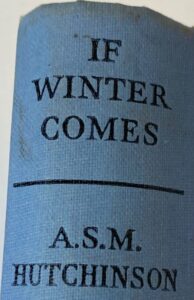
If Winter Comes, A. S. M. Hutchinson’s fourth novel, was published serially in Everybody’s Magazine, an American journal, between December 1920 and July 1921; as a book in 1921 by Hodder and & Stoughton in the UK, and Little, Brown and Co. in the USA; and serially in August 1922-March 1923 in Reynold’s Weekly News in the UK.
This novel’s central character Mark Sabre, a middle aged man, serves in the British Army in the trenches in the First World War; returns home to his loveless marriage to the harridan Mabel; tries to help an unmarried mother Effie who is therefore assumed to be his mistress; is divorced; is cheated by his business partners; and loses his job. There is a scandal when Effie kills herself.
This book was a best seller in Britain and the USA. Hutchinson adapted it into a play which opened at the Margate Hippodrome in August 1922; and at the St James’s Theatre in the London West End in January 1923, where it had fifty three performances. In 1923 it was staged on Broadway in New York; and at the Theatre Royal in Sydney, Australia. Hollywood film versions were made in 1923 and 1947.
*
On 16 November 1940 as the bombs fell on London Orwell reviewed Hutchinson’s fourteenth novel He Looked for a City writing that:
Mr Hutchinson is also a byword and with better reason. There is no question about the vitality of those early novels, which though people now do not care to remember it, were taken with the greatest seriousness at the time. “If Winter Comes” was the subject of long letters to the newspapers from, for instance Lady Asquith and G. K. Chesterton. People liked it – in the immediate post war years its popularity was only out done by “Tarzan of the Apes” – because it was about a man who was Good.
Mark Sabre the hero suffered one undeserved misfortune after another and goes on being Good. In this the reader could easily see a portrait of himself. Since then Mr Hutchinson has written novels of several other kinds, but “He Looked for a City” is a return to the vein of “If Winter Comes”, though in this case there is no happy ending. The hero, a clergyman, simply spends his life in picking himself up – always with a gallant smile of course – from a series of blows below the belt, struck by a malignant Providence. Back in 1920 this kind of thing written with the horrible quivering “tenderness” that Mr Hutchinson has made so peculiarly his own, seemed deeply moving. I do not prophesy the same success for this novel, as for the earlier one, if only because individual perfection now seems less important and the struggles of vicars with stipends of only £700 a year less impressive. But Mr Hutchinson’s powers have not deserted him. Anyone wanting a good cry might do worse than “He Looked for a City”.
Orwell next mentioned Hutchinson in his 2 November 1945 Tribune article Good Bad Books, writing that:
There is another kind of good bad book, which is more seriously intended, and which tells us I think something about the nature of the novel and the reasons for its present decadence. During the last fifty years there has been a whole series of writers – some of them are still writing – whom it is quite impossible to call good by any strictly literary standard, but who are natural novelists and who seem to attain sincerity partly because they are not inhibited by good taste. In this category I put Leonard Merrick himself, W. L. George, J. D. Beresford, Ernest Raymond, May Sinclair, and – at a lower level than the others but still essentially similar – A. S. M. Hutchinson.
Later in this article Orwell writes that in some supposed serious books: Some indefinable quality, a sort of literary vitamin, which exists even in a book like “If Winter Comes” is absent from them. In other words, as most readers agree good bad books are more readable than many supposedly serious novels.
Orwell last mentioned Hutchinson in a 4 February 1949 letter to Sir Richard Rees, during his last illness, writing that: Among other things I read a Deeping for the first time – actually not so bad as I expected, a sort of natural novelist like A. S. M. Hutchinson. Deeping referred to Warwick Deeping, a prolific novelist. George Orwell had earlier written scornfully of Deeping perhaps out of malignant envy (see my earlier article about Deeping on this website).
Family Background. Arthur Stuart Menteth Hutchinson was born on 2 June 1879 in India and baptised on 26 June 1879 at Gorakhpore in Bengal. His father, Henry Doveton Hutchinson, was born on 13 September 1847 at Dinapore in Bengal, while his grandfather, Dr Theodosius Cayley Hutchinson, rose to be Deputy Inspector of Indian Army Hospitals and died in 1903 aged eighty seven.
Henry Doveton Hutchinson became an Indian Army officer; fought in many campaigns; and rose to be a Lieutenant General. On 6 October 1874 he married Annie Alice Campbell the sister of Lieutenant Colonel James Stuart-Menteth, a fourth baronet, at Simla in India. They were to have three sons and two daughters.
Henry Doveton Hutchinson was a military writer whose books included Military Sketching Made Easy and Military Maps explained; Tactics made easy for Non-Coms and Men; Field Fortification; The Story of Waterloo ; The Campaign in Tirah 1897-1898; The Operations in the Peninsula (Spain) 1808-1809 ; and A short history of the 3rd (Queen’s Own) Gurkha Rifles. He translated Sergeant Major William Gordon’s Physical Training without Arms, and Physical Drill with Arms, into Asian languages such as Urdu.
Arthur Stuart Menteth Hutchinson’s younger sister, Vere Stuart Monteith Hutchinson, was born in Paignton in Devon in 1891. Her first novel Sea Wrack was published in 1922. It told the story of a boy rescued from the sea and then adopted. She had several other novels published, some of which were translated into languages including French, German and Norwegian; and had short stories and articles published in various journals. She had long standing health problems and in later years was paralysed. For her last nineteen years she lived with her friend and carer Dorothy Mary Burroughes, a painter, book illustrator, poster designer and linocut artist; finally dying in 1932 aged forty one.
Early Life. A. S. M. Hutchinson had been expected to join the British Army, as his two brothers did, but his eyesight was poor. He became a medical student studying at St Thomas’s Hospital in London but eventually abandoned medicine and became a writer and journalist. His first novel Once aboard the Lugger: the history of George and his Mary was published by Alston Rivers of London in 1908. Despite its title it is not a nautical novel. It ran through several editions. To quote an anonymous reviewer in the Thursday 15 July 1915 Crystal Lake, Illinois, Herald;
A vein of wit combined with a certain cleverness and eccentricity of style makes the simple, almost ludicrous plot of “Once Aboard the Lugger” by A. S. M. Hutchinson, worth reading.
George, “his Mary”, miserly old Mr Marrapit George’s uncle, and masterly Mrs Major are the chief characters. Besides them there are Mrs Chater, Mary’s unprincipled employer; her vicious son Bob; George’s cousin Margaret; Bill her lover and Fletcher, the gardener, whose dry remarks cause half the laughs in the book.
The story follows George’s career through medical school, involving many encounters with his uncle, who holds back much of the money left by George’s mother for her son’s education, and refuses unconditionally to help him start the practise of his profession. The clever and ultimately successful scheme of Mrs Major to capture the heart of old Mr Marrapit forms a subordinate plot of almost equal interest. She is the woman engaged by Mr Marrapit to care for his large and magnificent collection of cats, choicest of which is the Rose of Sharon. Her chief aim in life is not alone care for the cats, as Mr Marrapit believes, but (as we learn from her diary) to “get on” with the gentleman himself. Her designs however are rudely shaken, when one night “Old Tom” (brandy) gets the better of her, with the result that she is driven out by Mr Marrapit early next morning.
Meanwhile George has romantically met his Mary and fallen desperately in love. An emergency follows and with his graduation from medical school he finds that he has a real desire to succeed for the first time in his life. The most desirable chance to start in life requires £500 and George does not have the money. He decides to beard the lion, but neither entreaty nor threats bring forth the promise of the needed amount, and George is discouraged.
But out of despair comes a plan to obtain the money which is rightfully his own, from his uncle in spite of himself. In accordance with his plan he steals the beautiful Rose of Sharon intending to force his uncle to offer a large reward for her return and thus secure for himself the much needed money. The execution of this plan is however more difficult than he had expected, and moreover his uncle refuses to offer more than £150 reward.
Mrs Major still hoping to regain favour with Mr Marrapit, perfects a plan more clever than George’s. She steals a cat very similar to the Rose of Sharon. In the act of concealing it in a cabin nearby she hears George telling Mary of his plot and conclusion to abandon it. She promises to care for the cat till George can with safety return it to his uncle. When they have gone Mrs Major takes the real Rose, leaving the stolen substitute in her place, goes straight to Mr Marrapit in all humility, begs his forgiveness, gives him the dear Rose, and tells what she has overheard. When George enters with what he believes to be the Rose of Sharon, he soon discovers the trap into which he has fallen and realises the uselessness of explanation.
Driven from his uncle’s home in disgrace, he is again in deep despair until Bill, his newspaper friend, discovers that he has in possession in all probability the cat stolen from a certain author who at the time of his loss was engaged in writing a story for Bill’s particular newspaper. The theft of his cat has occasioned him such distress that he cannot continue the story until the cat is recovered. Accordingly the newspaper offers £500 for its return.
With this development, of course George’s troubles are over. The money is his and arrangements are at once made for the purchase of the longed for practice. This happy circumstance lands him safe aboard the lugger and there the story ends…
By 1911 Hutchinson was night editor of the Daily Graphic, an illustrated London newspaper founded in 1890 (which ceased publication in 1926 when it was taken over by Allied Newspapers and merged with the Daily Sketch). From 1912 to 1916 Hutchinson edited the newspaper.
Alston Rivers published A. S. M. Hutchinson’s next novel The Happy Warrior 1912. Hodder and Stoughton published his third The Clean Heart in 1915. In 1916 he joined the British Army serving with the Royal Engineers in the First World War despite his bad eyesight.
Hodder and Stoughton published A. S. M. Hutchinson’s fourth novel If Winter Comes (see above) in 1921. This brings us to the end of part one of this article. Part two will look at his later career and at his marriage and family.
*
Leave a Reply