
Down the Mine – First Shift?
*
A literary precursor to George Orwell
*
We should never forget that mining in the British Isles has involved many minerals: coal was the most significant by weight and number of mines, but tin mining goes back to prehistoric times as does flint knapping, while lead was mined in Derbyshire by the Romans and not so differently under the Tudors, and gold was extracted from the mountains of Wales and Ulster. George Orwell in his investigations for The Road to Wigan Pier descended coal mines in both Lancashire and Yorkshire.
Eighty years before Orwell’s descent another writer – again like Orwell still not especially well-known when venturing – and again like Orwell, principally on foot – made his own journey to an unexplored part of Britain. This was Wilkie Collins, later to be known for The Woman In White and The Moonstone. In 1851 he found himself on the outskirts of Looe, with no account of how he reached the port (Orwell began his ‘road’ by train to Coventry) with a companion, Henry Brandling, to begin an exploration lasting nearly a month, spending no more than one night in any one place. Collins came from a family of artists with wider artistic connections; he may have had thoughts of a career writing tour guides, with illustrations by skilled nature artists. If so, it did not take off – Brandling’s name is almost forgotten, and Collins turned to writing sensation novels.
We now know that Orwell’s family had connections with artists living in and around Polperro on the Cornish coast, but he makes almost no mention of Wilkie Collins and no mentions of his book. Collins visited Looe near Polperro, but avoided the village by then travelling inland. If Orwell read Rambles Beyond Railways (perhaps when he worked in a bookshop) he would have recognised not just the artistic treatments of the rocky peninsula landscape but the living that was scooped painfully from the sea by the pilchard fishermen: Polperro still has its fish market for the landed catches; Collins dedicates a chapter to the life and work of the fishermen.
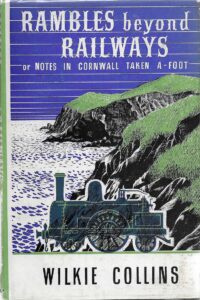
Rambles Beyond Railways, 1948 re-issue
Collins makes his readers wait for his most extraordinary chapter: his party’s descent into the Botallack Mine near Land’s End. Even the access must have been heart-stopping:
The black bole, when we entered it, proved to be not quite so dark as it had appeared from above. Rays of light occasionally penetrated it through chinks in the outer rock. But by the time we had got some little way further down, these rays began to fade. Then, just as we seemed to be lowering ourselves into total darkness, we were desired to stand on a narrow landing-place opposite the ladder, and wait there while the miner went below for a light. He soon reascended to us, bringing, not only the light he had promised, but a large lump of damp clay with it. Having lighted our candles he stuck them against the front of our hats with the clay – in order, as he said, to leave both our hands free to us to use as we liked. Thus strangely accoutred, like Solomon Eagles in the Great Plague, with flame on our heads, we resumed the descent of the shaft; and now at last began to penetrate beneath the surface of the earth in good earnest.
The process of getting down the ladders was not very pleasant. They were all quite perpendicular, the rounds were placed at irregular distances, were many of them much worn away, and were slippery with water and copper-ooze. Add to this, the narrowness of the shaft, the dripping wet rock shutting you in, as it were, all round your back and sides against the ladder – the fathomless-looking darkness beneath – the light flaring immediately above you, as if your head was on fire – the voice of the miner below, rumbling away in dull echoes lower and lower into the bowels of the earth – the consciousness that if the rounds of the ladder broke, you might fall down a thousand feet or so of narrow tunnel in a moment – imagine all this, and you may easily realize what are the first impressions produced by a descent into a Cornish mine.
By the time we had got down seventy fathoms, or four hundred and twenty feet of ladders, we stopped at another landing-place, just broad enough to afford standing room for us three. Here, the miner, pointing to an opening yawning horizontally in the rock at one side of us, said that this was the first gallery from the surface; that we had done with the ladders for the present; and that a little climbing and crawling were now to begin.
There were no electric or battery lights, and no cage down, as Orwell experienced. Collins clarifies the purpose of the mine and the minerals extracted:
Botallack mine is a copper mine; but tin, and occasionally iron, are found in it as well. It is situated at the western extremity of the great strata of copper, tin, and lead, running eastward through Cornwall, as far as the Dartmoor hills. According to the statement of my informant in the counting-house, it has been worked for more than a century. In former times, it produced enormous profits to the speculators; but now the case is altered. The price of copper has fallen of late years; the lodes have proved neither so rich nor so extensive, as at past periods, and the consequence is, that the mine does not at present pay the expenses of working it.
Collins details how the miners are paid, and calculates their average take-home pay, as Orwell would do. He goes on specify how the ore is treated once it is brought to the surface:
Although the occupation of smelting the copper above-ground is, as may well be imagined, unhealthy enough, the labour of getting it from the mine (by blasting the subterranean rock in the first place, and then hewing and breaking the ore out of the fragments), seems to be attended with no bad effect on the constitution. The miners are a fine-looking race of men – strong and well-proportioned. The fact appears to be, that they gain more, physically, by the pure air of the cliffs and moors on which their cottages are built, and the temperance of their lives (many of them are” tee-totallers”), than they lose by their hardest exertions in the under-ground atmosphere in which they work.
Serious accidents are rare in the mines of Cornwall. From the horrors of such explosions as take place in coal mines, they are by their nature entirely free. The casualties that oftenest occur are serious falls, generally produced by the carelessness of inexperienced, or foolhardy people…
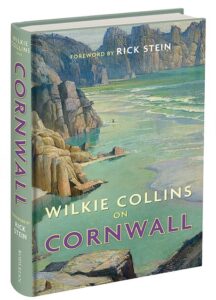
Rambles Beyond Railways appeared in 1851 and was re-printed in the 1860s but then disappeared from bookseller’s new stock until it was re-issued in a series of West Country books in 1948 without the illustrations, which the Introduction to the re-issue tried to hide by making no mention of Brandling apart from one reference to Collins’ ‘artist companion’. A table must have appeared in one edition or more, listing each of Collins and Brandling’s stopping places and the inn in which they resided, which makes it clear that the couple began and ended their journey shipboard at Plymouth: I have found this online. The 1948 edition, however, did have the benefit of Collins’ account of his cruise to the Scilly Isles as an Appendix which seems to be missing from the Bodleain’s 2026 re-issue published as Wilkie Collins on Cornwall.
Collins and Brandling’s exploration is a fascinating document: as a historic record of a part of England still unaffected by mass industrialisation; as a record of the livings made on the peninsula; and as an example of exploratory literature. The chapter on Botallack Mine can be compared with the second chapter of The Road to Wigan Pier, Orwell’s ‘Down the Mine’. Things were known, things were reported. Perhaps too little was done in consequence.
*
Rambles Beyond Railways or Notes in Cornwall Taken A-Foot is now re-issued as Wilkie Collins on Cornwall with Henry Brandling’s illustrations and a Foreword by Rick Stein (Bodleian editions, ISBN-13: 9781851246564).
Fascinating Les, and as a fan of Wiklie Collins, a great and welcome surprise.