
Orwell’s Place in the Global Classroom
by
OS Membership Secretary, Chris Harrison
*
Why track Orwell’s impact?
It is always worth asking how we can understand the reach and relevance of a writer’s ideas across generations. One way to approach this is to examine indicators such as public engagement, readership patterns, media coverage, and more. Among these, an area that particularly interested me was the place Orwell’s works occupy in school curricula around the world.
Exploring how often his writing appears in national and international education systems can offer useful insights into when and where young people encounter his ideas. There is, of course, a much wider conversation to be had about the many other ways a writer’s influence can be traced, but that is a topic for another time.
Reviewing the evidence
Curiosity prompted me to conduct a brief desktop review of readily accessible online sources. I wanted to get a clearer picture of where and how Orwell’s writing is taught in schools around the world. I spent some time digging through online published curriculum frameworks, exam board specifications, and teaching resources from a wide range of countries and international systems. For each jurisdiction, I checked whether Orwell’s works are required, optional, commonly taught, or rarely included, and which texts students are most likely to encounter. and at what stage in their education.
What I found
Despite the many obvious limitations and biases inherent in this type of review (a longer paper detailing the methods, materials, and findings is available), the results were interesting but unsurprising. They confirmed what most of us already think. In a nutshell:
- United Kingdom: Orwell’s works are widely taught. Animal Farm is a major set text at GCSE, and Nineteen Eighty-Four is widely used at A-level. Extracts from his essays and other works are also commonly used.
- Other English-speaking countries (USA, Canada, Australia, New Zealand): Both Animal Farm and Nineteen Eighty-Four are widely taught, and Orwell’s essays often feature in language and composition courses.
- Ireland and Western Europe: Orwell is often included as an option, though not always required.
- Eastern Europe: Political sensitivities clearly limit the teaching of Nineteen Eighty-Four.
- India: Orwell’s essays are common in English-medium schools, but the novels are less frequently set.
- Singapore: Nineteen Eighty-Four is taught at the upper secondary level, with Animal Farm as an option.
- China, Japan, the Middle East, Africa, and Latin America: Orwell’s works are rarely included in national curricula, though they’re more common in international schools following Cambridge or International Baccalaureate syllabuses.
Beyond the curriculum
Of course, inclusion in a curriculum is no guarantee of the quality of learning or of the interpretation of the text. It was clear, though, that even where Orwell is frequently taught, most students encounter only Animal Farm and Nineteen Eighty-Four. There’s a whole world of Orwell’s essays and journalism that rarely makes it into the classroom.
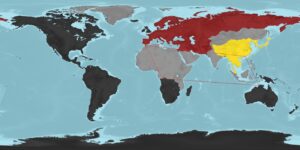
Map of the World according to Nineteen Eighty-Four (Wikipedia)
What next?
So, what do these findings suggest? On the one hand, the presence of Orwell’s work in many parts of the world is reassuring. On the other hand, it highlights clear gaps and inconsistencies. Mapping where his writing is firmly embedded in curricula and where it is largely absent offers a useful starting point for anyone interested in supporting the study of Orwell or strengthening literary education more broadly.
The brief review also highlights that most students encounter only Animal Farm and Nineteen Eighty-Four, while Orwell’s wider essays and journalism remain comparatively overlooked. This raises broader questions about how schools balance canonical texts, political sensitivity, and the practical constraints of teaching time.
More generally, understanding the global distribution of an author’s presence in education can help educators, researchers, and cultural organisations consider how best to promote critical engagement with literature. It highlights opportunities to celebrate areas where a writer’s work is thriving, address regions with limited exposure, and encourage initiatives that help new generations encounter a diverse range of texts.
Above all, the findings emphasise the ongoing importance of engaging younger readers. Ensuring influential works remain part of the conversation in classrooms, cultural programmes, or public discourse helps keep their ideas alive, relevant, and open to debate.
Leave a Reply