
The Road to Southwold Pier
*
Orwell Society trip to Southwold, Suffolk – 27th-29th March 2026
Described by one of our number
*
One of the regular Orwell Society trips is to Barnhill on Jura, where Orwell completed Nineteen Eighty-Four. Barnhill was described by Orwell as an ‘extremely un-get-atable place’. It still is.
Well, as it turns out, Southwold presents some challenges of its own to reach. Perhaps that is why this was the first Society visit to this charming seaside retreat.
My own journey to join the event was smooth until I got off the train at Darsham station – the nearest the railway goes to Southwold, and still 10 miles short of the town. Darsham station, I found, was totally devoid of any means of further progress to Southwold (and don’t even bother trying to use ‘Uber’ around there!).
Happily, and luckily, soon after I arrived the minibus from the St Felix school in Southwold turned up to drop off pupils heading home for Easter on the hourly train south, and I was very kindly offered a lift. A lifesaver. The moral being if you want to go to Southwold either drive, or work out well in advance how you are going to complete the last leg of the journey.
So why had the Orwell Society arranged to go to Southwold? Well if you are interested in the life of Eric Arthur Blair aka George Orwell, then this really is a must see location.
It turns out there is a lot of Orwell in Southwold.
His connections with the town cover a period from late 1921, until at least 1939. The reason for this connection being that Orwell’s parents, Richard and Ida Blair, chose to retire here, arriving at the end of 1921. At various stages over the next 17 years Orwell resided with his parents at the four different addresses they occupied in Southwold during this time.
The Orwell Society Southwold visit (17 of us) began on Friday afternoon at the Southwold Theatre, with a screening of the new Orwell documentary by Raoul Peck Orwell: 2+2=5. The film very effectively shows the relevance of Orwell’s writings to the modern world.
The Society had booked the comfortable family-run Randolph Hotel, which is situated in Reydon – a mile north of Southwold itself. So following the screening we headed there to check in and prepare for dinner.
*
On Saturday morning we headed back into Southwold, fortified by a Randolph Hotel breakfast, for a walking tour of the main sites associated with Orwell and his family. We were lucky to have Ronald Binns to guide us around, which he did at a brisk pace. Ronald has written Orwell in Southwold (Zoilus Press), an indispensable guide to Orwell’s life there. Meeting outside Southwold lighthouse on Stradbroke Road, we learned that when the Blair family moved to their first home in the town, on this street, it had a very different social and business make-up.
During the tour we saw all four of the houses in which the Blair family lived during their time in Southwold, as well as the building where in 1922 Eric studied (‘crammed’ was the word at the time) for the exams which would gain him entry to the India Police force, and take him to Burma for five years. We also saw the building that housed the tea shop (now an RNLI shop) that was run by Orwell’s younger sister Avril in the 1930s.
A visit was made to Denny’s outfitters, where Orwell used to get his clothes, and which is still happily an independent family run business. Explaining why so many were gathered on the pavement, we were welcomed inside and told more about the shop and its history. Indeed one of the joys of Southwold is the preponderance of independent shops in the high street, such a contrast with much of the UK these days.
The first three houses in which the Blair family resided in Southwold were rented, but in 1932 they were able to purchase Montague House at 36 High Street. It was in this house that Orwell worked on his first novel, Burmese Days, and largely wrote his second, A Clergyman’s Daughter. The current owner of the property, Cathy Schling, very kindly welcomed the Society in with tea, coffee and cakes, and we were able to see the room in which Orwell worked on A Clergyman’s Daughter. Of all Orwell’s works this book is the one most closely associated with Southwold, as the fictional town of ‘Knype Hill’ in the novel is a thinly veiled portrait of Southwold – and not a very flattering one!
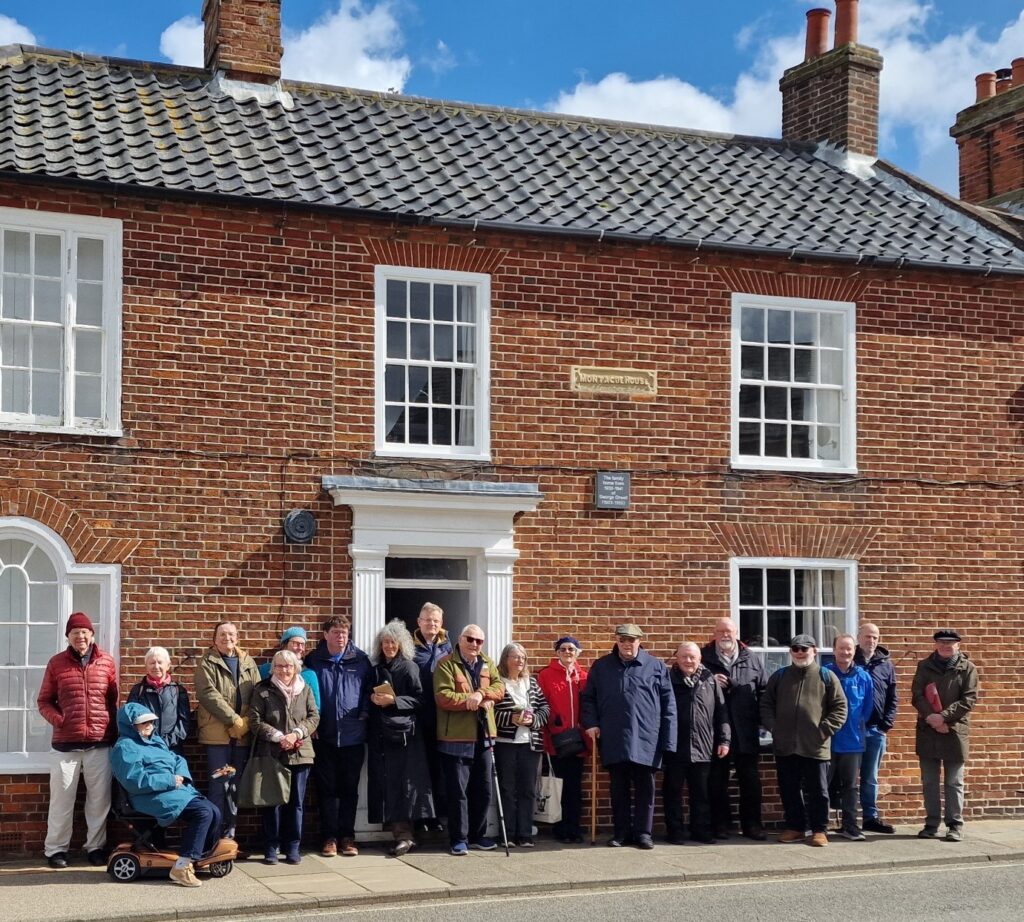
The Orwell Society at Montague House
(Richard Blair, Centre, with Cathy Schling to his left; Ronald Binns, Right)
(Eric’s room was above Richard’s head)
Some years ago the Society was able to help with renewing the plaque on Montague House, the only one which commemorates Orwell’s association with the town.
Whilst at the house we were shown an inscribed early edition of Burmese Days, which now resides at the Southwold museum.
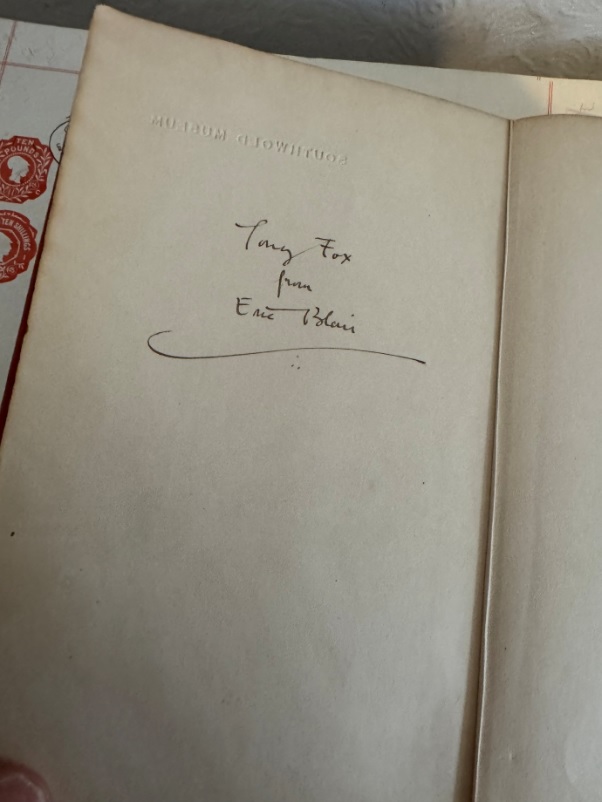
Burmese Days (Harpers US second edition 1934) inscribed by Eric Blair (George Orwell) to local Southwold resident Tony Fox.
In the afternoon it was back to the Southwold Theatre, for a series of talks on Orwell, including by his most recent biographer – D J Taylor. This event, along with the previous day’s film screening, was open to Southwold residents, and there was a good turnout of locals to listen to our speakers. In addition to D J Taylor there were talks by two speakers from the Society, Les Hurst on Orwell’s realisation of ‘the meme’ in the town, and Ann Kronbergs on Orwell’s to-and-fro on his return from Burma; and by Ronald Binns – providing further insight into Orwell’s time in Southwold. Speaker succeeded speaker faultlessly thanks to the work of the backstage staff of the theatre.
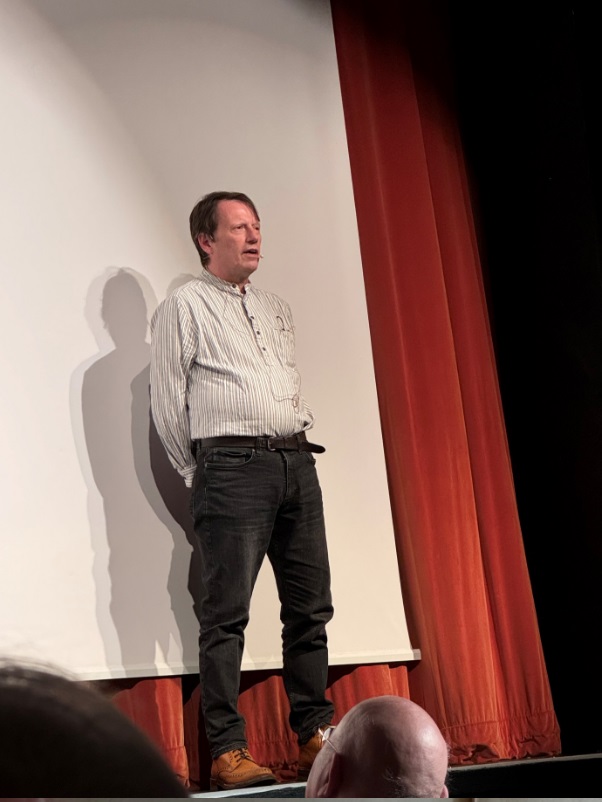
D J Taylor on stage at the Southwold Theatre
As any readers of Binns’ excellent Orwell in Southwold will know, two of Orwell’s early girlfriends – Brenda Salkeld and Eleanor Jaques lived in the town. His relationships with both of these ladies has been the subject of much biographers’ ink. The relationship with Jaques being particularly complex, given that she married Orwell’s main male friend in Southwold – Dennis Collings. Orwell’s frustrations with these relationships, coupled with long periods residing with his parents as he waited for his writing career to take off, no doubt contributed to his somewhat negative view of his time in the town. My guess is he largely associated Southwold with failure.
*
On the Sunday morning we travelled to the very attractive village of Walberswick, which lies a mile or so south of Southwold on the other side of the Blyth river (which means it is actually a seven mile drive to get there by car from Southwold; the ferry shown on maps is a rowing boat still today).
Orwell often walked to Walberswick, did some teaching there (we peered through the gates of the property), and famously saw a ghost there. That latter incident occurred in 1931. Indeed, we know exactly when it occurred, as Orwell wrote a letter to his Southwold friend Dennis Collings all about it. Orwell was sitting alone in the Walberswick churchyard by his own account ‘at about 5.20 pm on 27.7.31’ when he ‘saw a man’s figure, small & stooping and dressed in lightish brown’. This figure made no noise and mysteriously disappeared into thin air. The letter to Collings contains a diagram of exactly where Orwell was sitting when this strange encounter occurred. This allowed the Orwell Society patron and Orwell’s son, Richard Blair, to sit in the exact same spot at 10.27 am on 29.3.26 and read from Orwell’s letter.
A lovely connection over time.
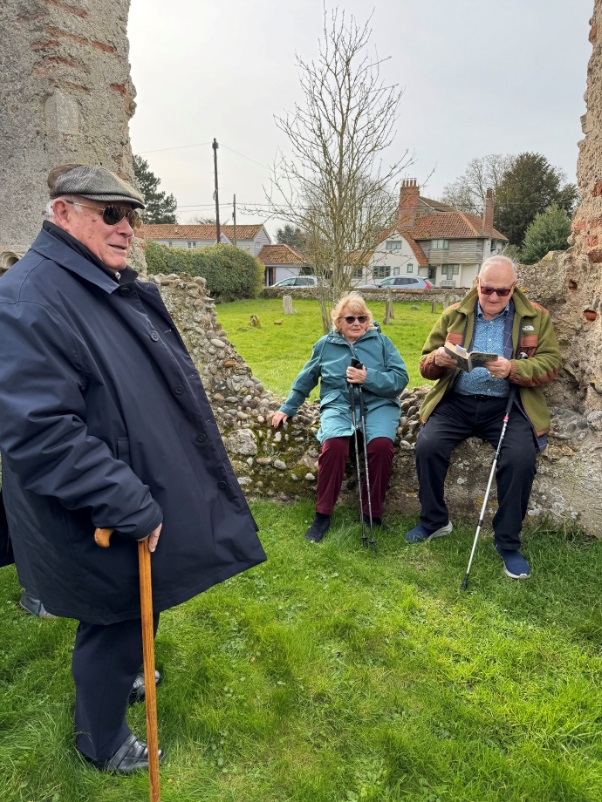
Richard Blair reads an Orwell letter in Walberswick Churchyard
The church and churchyard at Walberswick are certainly worth seeing, the church itself sitting within the ruined walls of a much larger church that once stood there.
After exploring the village and the river frontage, where the chain ferry once ran, we repaired to The Anchor pub for a farewell lunch, before going our separate ways. Our meal which was already enjoyable ended with the delightful surprise of saffron buns, one of the delights of English cooking featured in George Orwell’s essay on the subject, made for our party.
I do hope that Southwold becomes a permanent fixture on the Society visit list. It is actually one of the most important places associated with Orwell in the UK, the scene of his early love affairs, as well as of key moments during his development as a writer. Thanks to our guide Ronald Binns, our speakers, and to Quentin and Liz Kopp for all the organisation!
*
PS – although there is a pier at Southwold, which contains an twenty-first century Orwell mural, it is not the original from Orwell’s time – but I could not resist the title.
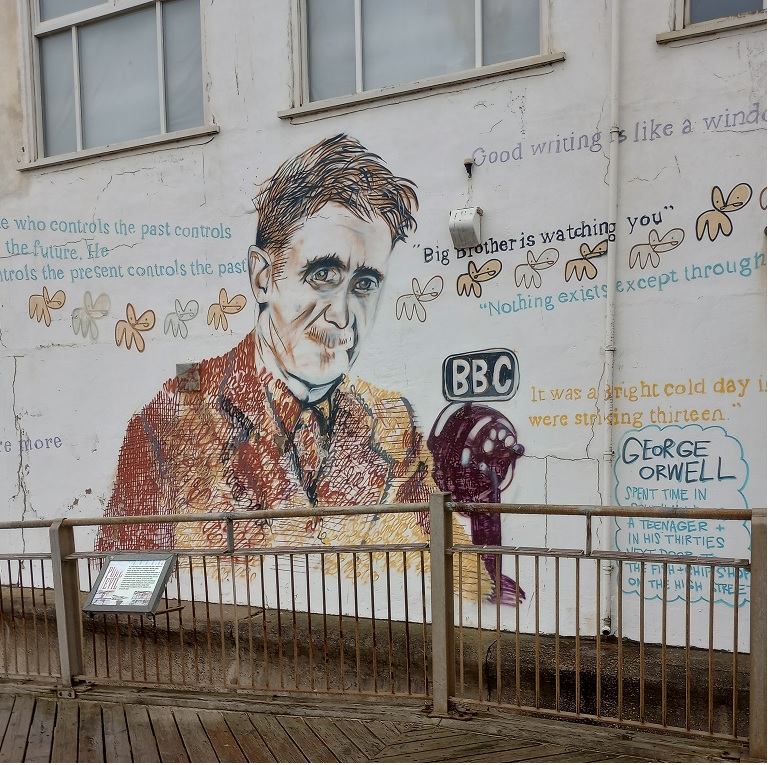
George Orwell Mural on Southwold Pier, by the public artist ‘Pure Evil’.
Leave a Reply