
Orwell and the Arts: II
*
Part Two
*
Horror Comics
In late 1946 Orwell made the first mention of what would come to be known as ‘horror comics’ after his death. Discussing a popular children’s book set in New England Orwell went on:
English children are still Americanised by way of the films, but it would no longer be generally claimed that American books are the best ones for children. Who, without misgivings, would bring up a child on the coloured ‘comics’ in which sinister professors manufacture atomic bombs in underground laboratories while Superman whizzes through the clouds…
In his final column of the year Orwell ended with an update on the comics:
A correspondent has sent me a copy of one of the disgusting American ‘comics’ which I referred to a few weeks ago. [And goes on…] My correspondent asks me whether I think this is the kind of thing that should be put into the hands of children, and also whether we could not find something better on which to spend our dwindling dollars.
Certainly I would keep these things out of children’s hands if possible. But I would not be in favour of actually prohibiting their sale. The precedent is too dangerous. But meanwhile, are we actually using dollars to pay for his pernicious rubbish? The point is not completely unimportant, and I should like to see it cleared up.
One can’t help feeling that one of Orwell’s previous remarks is appropriate here: reviewing Oliver Goldsmith’s The Vicar of Wakefield he wrote of ‘the confusion in Goldsmith’s mind between simple goodness and financial prudence’ (and restates it a couple of times before the review ends), and both Orwell and his correspondent seem to confuse the objectionable material and its purchase cost in a similar way.
What Orwell was ruing would return, sometimes with references to his work, in different forms in the mid-1950s and then again in the 1980s. The 1950s saw the ‘horror comics’ campaign which lead to the Harmful Publications Act of 1955, and in the 1980s came the ‘video nasties’ campaign which lead to the Video Recordings Act of 1984. The best account of the ‘horror comics’ campaign is Martin Barker’s A Haunt of Fears (1984). This is regrettably brief in its index, omitting Orwell’s name even though it appears early on in the book (Page 5, for example). David Holbrook was one of the movers of the ‘video nasties’ campaign and according to Martin Barker he referred to George Orwell’s work of 1939 in his early publicity i.e. linking Orwell to both comics and videos. Holbrook – who thirty years earlier had visited Orwell on Jura while Nineteen Eighty-Four was being written – confused ‘Boys’ Weeklies’ of 1940 with Orwell’s briefer comments on horror comics in 1946. Holbrook’s remarks on the manuscript of Nineteen Eighty-Four at which he stole a glance showed no better understanding. Holbrook also managed to forget that Orwell had written ‘I would keep these things out of children’s hands if possible. But I would not be in favour of actually prohibiting their sale. The precedent is too dangerous.’
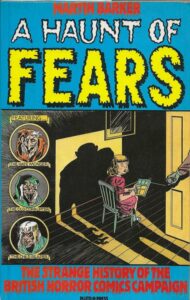
Remembering that both the acts of 1955 and 1984 were passed by Conservative governments, the most extraordinary thing one learns from Martin Barker about the ‘horror comics’ campaign is that it was organised by the Communist Party of Great Britain and that the Party’s objection was not to the horror in the comics but that they were American. In essence this was another manifestation of artistic oppositions such as ‘socialist realism’ versus ‘abstract expressionism’, which was played out in galleries throughout the world, political struggles reduced to walls and picture frames. All ultimately ideological but with physical consequences in Eastern Europe, Vietnam and wherever the superpowers could fight by proxy, destroying lives on the way. And in Britain in the petty prosecution of newsagents and corner shops.
In his 1941 article about Donald McGill Orwell said that newsagents were sometimes prosecuted for obscenity for selling his postcards, but he mentions no attack on McGill himself. That was to come in 1954 when, at the age of 80, McGill was prosecuted, convicted, and sentenced to pay a heavy fine, with many of his postcards consequently being immolated either by the authorities or by terrorised wholesalers themselves. About this time Nineteen Eighty-Four was being denounced as ‘Orwell’s horror comic’: one wonders what threats he would have faced in the same period had he lived.
Photo-story Captionist
In March 1941 Picture Post magazine published a four-page account, ‘A Roadman’s Day’. Like most articles in the magazine it consisted of photographs – ten of them – over four pages, along with an introductory article, which included a short autobiography by one of the road-menders featured, and captions under each photograph. George Orwell was credited as the journalist, with the implication that he had met Ernest Short, the road-man in question.
Road-menders were not new in literature: John Buchan’s The Thirty-Nine Steps (1915) gives a chapter to one. Buchan, though, did not discuss the benefits of trade union membership or the inequalities of the rationing system for someone doing work both so physical and essential.
Film
Yet to be discovered is the work that Orwell did in 1937 and 1938 with Len Lye, the film-maker who worked mainly in animation by printing colour on film. Just a short letter exists in which Lye thanks Orwell for the work he has done, without specifying what it was (some of Lye’s work was for the GPO Film Unit which became the wartime Crown Film Unit), but talking of a potential contract with the Shell Oil Company (Shell became known for their cartoon-like advertisements with captions such as ‘That’s Shell, that was’). It seems that Orwell was not a film-virgin at the outbreak of the Second World War.
In the early years of the War Orwell worked as a theatre and film reviewer. Either he was unlucky or he was regarded as the second-shot by his editor as the films he was sent to review were second-rate and struggling. He paid particular attention to contemporary documentaries, which he found to be mostly poor attempts at propaganda.
Then Orwell saw one film in December 1940 that stunned him, so much that he mentioned it briefly in one review, and then returned the next week dedicating his whole review to the film: Charlie Chaplin’s The Great Dictator. Yet Orwell’s was always an analytic eye. Consider some of his review in which he looks at the construction of the film:
Chaplin never seems to have profited by certain modern advances of technique, so that all his films have a kind of jerkiness, an impression of being tied together with bits of string. Yet this film gets away with it. The hard-boiled audience of the press show to which I went laughed almost continuously and were visibly moved by the great speech at the end. What is Chaplin’s peculiar gift? It is his power to stand for a sort of concentrated essence of the common man, for the ineradicable belief in decency that exists in the hearts of ordinary people, at any rate in the West.
Orwell is sometimes thought to be conservative as a writer, yet here the opposite is implied: that Orwell knew how film techniques had changed and movie narrative had developed. Of course, at this time everyone went to the cinema frequently and Orwell must have gone whether alone or with friends and workmates. It has been suggested that his father went to the town cinema in Southwold to see every film, and that Orwell when he was there (on and off over a ten year period) went with him. Orwell was taking note of how films changed in everything from dialogue to camera-angles.
Orwell’s appreciation of film technique emerges in his comments on a dramatic poem that he felt would work as a film script. The poem was Thomas Hardy’s The Dynasts, written about, but a century after, the Napoleonic Wars. In September 1942 Orwell wrote:
Hardy set free his genius by writing a drama which was definitely not meant to be acted, and quite unknowingly—for The Dynasts was written round about 1900—produced something that would do as it stands for the script of a talkie. Though it is mostly in blank-verse dialogue, it contains a great deal of visual description, and its effect is really got by the constant switching of perspective from one end of Europe to the other, and from the earth to the middle air in a way that could only be reproduced on the screen.
Reading the account it is clear that Orwell is not considering it as just a film script, but as a shooting script, as he mentions the changing camera angles (‘constant switching of perspective’), with story-boards. Putting him closer to the world of film-making.
Orwell was to use these experiences when he wrote the opening diary scene at the beginning of Nineteen Eighty-Four. Winston Smith, supposedly about to rebel, starts writing about the ‘war films’ he saw at the cinema the previous evening, and he praises the camerawork, the construction of the shots, the grotesquerie. Yet all of it is no more than a record of an atrocity as refugees are slaughtered while trying to escape. This is how technocrats try to separate themselves from the violence being performed in their name, talking about the technique. Even in Orwell’s lifetime (though Orwell was not to know but we do from posthumously discovered diaries) this is how the Nazis’ Josef Goebbels was writing about the weekly newsreels he was distributing showing ships being bombed and cities devastated.
Images take multiple forms in Nineteen Eighty-Four: there are cinemas (‘flicks’) catering for large audiences; there are telescreens small enough to hang on a wall, and there are ‘big telescreen[s]’ which can be viewed collectively during the office Two Minutes Hate. And then there are photographs. In Orwell’s Oceania people are edited out and files updated, very much as with modern word-processors.
Broadcasting
During the early years of the BBC Orwell was out of the country. He went to Burma as a police officer in 1922, the year that the commercial British Broadcasting Company was founded. He returned in 1927, the year that the BBC became a public corporation, but was frequently abroad, in Paris, for the next two years. He thus had little experience of wireless in its early days, and later (from 1936 when he married and settled in Wallington, a village in Hertfordshire) he did not have a receiver at home. As he spent considerable times in lodgings, or staying with his parents in Southwold in Suffolk, or with his in-laws in the London suburb of Greenwich, however, he was likely exposed to radio elsewhere.
In August 1941 Orwell joined the BBC as a producer on the BBC Eastern Service, a relatively new feature of distance broadcasting. Orwell’s responsibilities were wide: he wrote news reports, he gave talks, he introduced magazine programmes (‘Voice’ was the world’s first literary magazine on air). He became a skilled dramatist, and adaptor of literary works for broadcast (so much so that he continued to received requests to work even after he left the Corporation). In his last year at the BBC he began to organise lectures to India by British academics at university level based on the curriculum of the University of Calcutta. Orwell and his fellow broadcasters having shown that distance learning was possible his one-time colleague Jennie Lee would introduce this in Britain as the Open University when she was a Minister in the Wilson government in the 1960’s.
In turn, Orwell was analysing how radio worked and how it was used and abused. He knew that the audience to which he was broadcasting was also being targetted by broadcasters from the enemy Axis states – Germany, Italy and Japan. Orwell wanted to share this with the home audience in Britain, and he published a volume, Talking to India, containing the broadcasts that had gone out on the Eastern Service, but he also included the text of one enemy broadcast, so that readers could see a fuller picture. In addition, other workers in the field were publishing their own analyses of how Nazi propaganda worked: Orwell reviewed such books in print.
Not trusting solely to the spoken word and knowing that a large part of the Eastern Service’s output was news reports and analysis of moving front lines Orwell and his colleagues arranged for newspapers in India to print world maps so that listeners could follow military progress and regress and identify exactly where was being talked about. That is, the work was audio-visual.
Orwell was to summarise his thoughts about work in the medium. ‘Propaganda and Demotic Speech’ and ‘Poetry and the Microphone’ describe his experience, suggesting how arts broadcasting could develop post-war.
The Implications of Control
Significantly, Orwell recognised and wrote about trends in communication and projection and their consequences in his non-fiction and in his fiction before they came into public gaze elsewhere or began to be called ‘cybernetics’. A precursor to the ‘telescreen’ of Nineteen Eighty-Four is a real-world example in his 1941 book The Lion and the Unicorn, in which he explained the reasons for the collapse in ability in civil servants throughout the empire: it was due, he wrote, to the electric telegraph being extended world-wide. According to Orwell:
The middle-class families celebrated by Kipling, the prolific lowbrow families whose sons officered the army and navy and swarmed over all the waste places of the earth from the Yukon to the Irrawaddy, were dwindling before 1914. The thing that had killed them was the telegraph. In a narrowing world, more and more governed from Whitehall, there was every year less room for individual initiative.
He went on to explain that this was not just a failing in government service:
From that time onwards it has been next door to impossible to induce young men of spirit to take any part in imperial administration. And what was true of the official world was true also of the commercial. The great monopoly companies swallowed up hosts of petty traders. Instead of going out to trade adventurously in the Indies one went to an office stool in Bombay or Singapore.
A few years later, in 1944, he saw this happening even closer to home as civil servants began to manipulate individual choices through popular journalism; in the case noted by Orwell, in ordering stories to be published in weekly magazines (Orwell had read an issue of Home Companion and Family Journal) when it became necessary to prompt applications for jobs that were not being filled. The examples Orwell had were telephone exchange operators and bus conductresses. Imagining the conversation between the men from the ministries (sexual discrimination can be taken as certain: men would make plans for the recruitment of women) he then concluded about this plan in Britain:
Something resembling this already happens with radio features and documentary films, but hitherto there has not been any very direct connection between fiction and propaganda. That half-inch ad. in the Home Companion seems to mark another small stage in the process of ‘coordination’ that is gradually happening to all the arts.
Orwell puts ‘coordination’ in quotation marks because it is the translation of the Nazi euphemism ‘Gleichschaltung’ – the practice of making everything within the totalitarian state line-up and fit-in. Orwell had other examples – if not of ‘coordination’ then of agreement – and from very different countries—such as this from the previous year, 1943: ‘right up to Pearl Harbour the American movie industry had an agreement with the Japanese Government never to present a Japanese character in an unfavourable light!’ A line that extends ‘radio features and documentary films’ considerably but can also be understood as revealing the true line in which contemporary ‘nudge theory’ sits.
All of these examples were a considerable change to the power that Orwell (in the third chapter of The Road to Wigan Pier) had noted being exerted over working-class men whose employers could force them to wait in the cold and rain for their pensions and sick-pay – an enforced immiseration. Consider the torturer’s catechism in Nineteen Eight-Four:
‘How does one man assert his power over another, Winston?’
Winston thought. ‘By making him suffer,’ he said.
Orwell had reported that power in a colliery yard years before.
How Did Orwell Do It?
No medium of his day seems alien to Orwell. His vision was wide enough that he could see precursors in one field returning in another. He could apply the lessons he learned from one author or book and apply them to another work in a different medium. In some cases he would take one basic idea and express it in a number of outlets, each relevant to its intended audience.
Orwell read widely, and was prepared to identify both sweeping comparisons and widely-differing contrasts. Take children’s books as a signifier. He was prepared to use a neologism such as ‘Wendily’ when describing the illustrations in children’s literature, putting the nameless books in question in a tradition that was wearing thin. Gordon Comstock in Keep The Aspidistra Flying could see the ‘how’ but he could not explain it, he could only experience it. Orwell himself was the fuller character.
Orwell did not engage in ‘world building’ but in ‘world suggestion’. This emerges, for example, in the absence of detail about personal life in Eurasia and Eastasia, in Nineteen Eighty-Four, where Winston Smith reads accounts about those places but only in a tendentious work which might bear no relation to reality. Orwell did this even more successfully in the surveillance behind the telescreens – he never mentions how they work, and does not say that there are humans at the remote end. Winston’s interactions with the screen – during morning exercise or in the holding cell in the Ministry Love – today are possible via facial recognition and AI. A date such as 1984 might seem early for such advances but the pressures of war speed development. In the novel we read that scientists are constantly at work on tools of war and oppression; consequently what was once human-operated could become inhuman as technology advanced but Orwell elides over all such points. We readers fill them in.
Orwell engaged in implicit parallelism. Winston Smith is entrapped over a number of years – a photograph from the past dropped onto his desk, as if it had been misdirected, showing the enemies of the state (Jones, Aaronson and Rutherford) in one place when they were alleged to have been plotting with enemies in another. It is the memory of this photograph that drives Winston to rebel. Compare this with Winston’s presence at the public meeting when it is discovered that Oceania is no longer at war with Eurasia but is at war with Eastasia. Everyone works themselves into exhaustion to change every reference and reshape the past. The one thing that Winston misses is that the leaders, the Inner Party members even higher than O’Brien must have done what Jones, Aaronson and Rutherford had been accused of doing, having ‘intelligence with the enemy’ in order to change alliance. In Goldstein’s book Winston reads ‘it is only by reconciling contradictions that power can be retained indefinitely’ but Winston never seems to notice the contradictions of the two collusions – Orwell leaves it to the reader. For a novel about hypocrisy writ large, the word ‘hypocrisy’ makes almost no appearance in Nineteen Eighty-Four.
If anything, Orwell’s gift was his apperception. His was a mind that could take multiple ideas and find in them connections; equally from his experiences he could find ways to examine new areas using what he had learned from the past. Returning to a point in ‘The Rediscovery of Europe’, Orwell says:
Every now and again something happens—no doubt it’s ultimately traceable to changes in industrial technique, though the connection isn’t always obvious—and the whole spirit and tempo of life changes, and people acquire a new outlook which reflects itself in their political behaviour, their manners, their architecture, their literature and everything else.
He does not say, though, that the people acquiring a new outlook would be aware that that is what has happened. In fact, Orwell thought that this gift was rare. He was able to identify one nineteenth-century figure who personified this ability as he denied that Dickens had it:
There are people (Tennyson is an example) who lack the mechanical faculty but can see the social possibilities of machinery.
Some of ‘the social possibilities of machinery’ in Orwell’s day lay in photography, broadcasting studios, printing, record pressing, film distribution corporations, advertising agencies, and publishing companies, and in all of them art was being reproduced. The implication of all of Orwell’s studies of the output in all its forms was a question: how can we find a meaning to any of it? For Orwell wrote about so much.
Splendid follow up