
Orwell and the Arts: I
*
Commentator, Critic, Writer
*
Has there been one person who made it possible to study popular entertainment in all its varying forms with the same intensity that the classical field is studied? Has there been one person who made media studies credible? Let’s see how George Orwell fits: he showed that one could apply the same critical eye to ‘pop’ art such as movies, sea-side postcards and comic best-sellers that is also applied to King Lear and Jonathan Swift. He could see a performance of Shakespeare’s King John and relate its thirteenth century events to the politics and wars of the times contemporary to him.
Of the many developments in visual arts in his lifetime (1903 – 1950) George Orwell found himself involved in some, he commented on others, and he wrote about even more. He worked with the technologies such as photo-journalism, film, and broadcasting in which the arts found new expression. Orwell’s particular skill was recognising trends in media and then to find sub-trends within media trends. He never mentions having seen a television set yet in his final novel Nineteen Eighty-Four he made the ‘telescreen’ the basis of everyday life. He knew that cartoon films such as Walt Disney’s Snow White emerged from an artistic production line, not much different from one of Henry Ford’s factories, which metamorphosed into the ‘novel-writing machines’ of Nineteen Eighty-Four. And he was aware that photography, which was already one hundred years old, did not fix reality but could be edited, montaged and re-touched.
Orwell was able to take images that exemplified ideas to him and share them with his readership. Take the opening of his broadcast talk ‘The Rediscovery of Europe’ (1943):
When I was a small boy and was taught history—very badly, of course, as nearly everyone in England is—I used to think of history as a sort of long scroll with thick black lines ruled across it at intervals. Each of these lines marked the end of what was called a “period,” and you were given to understand that what came afterwards was completely different from what had gone before.
Many of us reading that first sentence will remember the scrolls that went along the top of the walls in our school classrooms illustrating changes in castle-building, ship-building, ordinary homes, and so on. It is a very clear image, yet in his next paragraph he retracts his opening statement:
Now in fact these abrupt transitions don’t happen, either in politics, manners or literature. Each age lives on into the next—it must do so, because there are innumerable human lives spanning every gap. And yet there are such things as periods.
And he does so by substituting for the image of a scroll human experience in its place. And then Orwell challenges us – to think of the humans, think of our relatives: what changes have they seen in their lifetimes? Orwell could have mentioned that he was six months old when the Wright Brothers first flew. He was one of the humans who spanned one of the gaps he mentioned, crossing from the pre-flight period to the age of powered-flight.
How did Orwell illustrate the age in which he lived? There was to be no escape in his more traditional novels. In Keep The Aspidistra Flying (1937) his character is at work:
Gordon averted his eyes from a beastly Rackhamesque dust-jacket; elvish children tripping Wendily through a bluebell glade.
And, instead, his averted eyes look out at an advertising hoarding opposite the bookshop in which Gordon Comstock is working where he sees ‘A gallery of monstrous doll-faces – pink vacuous faces, full of goofy optimism.’ Someone chose the illustration. Someone chose the caption. Was it Gordon who used to work in an advertising agency?
And in Orwell’s next novel, Coming Up For Air (1939), George Bowling who narrates his own story says:
I suppose by this time you’ve got a kind of picture of me in your mind – a fat middle-aged bloke with false teeth and a red face – and subconsciously you’ve been imagining that I was just the same even when I was in my cradle.
For a man who thought a lot, Orwell was a very visual writer. So were many of his favourite authors.
From Page To Stage
The works of Charles Dickens are thick pages of text, but Dickens supplied his readers with detailed descriptions of his characters. That is, in addition to the one or two full page illustrations by ‘Phiz’ which accompanied each monthly issue in part-work before the novels were published in full. The consequence of the illustration and the pen-portrait Orwell wrote (in 1940) were:
A music-hall comedian can (or at any rate could quite recently) go on the stage and impersonate Micawber or Mrs Gamp with a fair certainty of being understood,
Still in his essay on Charles Dickens, though, we find interesting examples of Orwell using art and the physical world as manifestations of ideology. How many critics would be able to explain Thomas Babington Macaulay’s objection with the following explanation?
It is said that Macaulay refused to review Hard Times because he disapproved of its ‘sullen Socialism’. Obviously Macaulay is here using the word ‘Socialism’ in the same sense in which, twenty years ago, a vegetarian meal or a Cubist picture used to be referred to as ‘Bolshevism’.
The two phrases are worth repeating: ‘a vegetarian meal or a Cubist picture’ as they exemplify Orwell’s ability to capture an idea in a physical representation that is comparable to Dickens’ ability to complete a portrait of a character in words.
Orwell’s longest work on art is his essay ‘Benefit of Clergy’, actually a review of an autobiography, about Salvador Dali. While a large part of it is a restatement of Dali’s life – or at least Dali’s account of his life – Orwell turns after a brief discussion of Dali’s subject matter to something deeper: a philosophical question:
Since ‘Mannequin rotting in a taxicab’ is a good composition (as it undoubtedly is), it cannot be a disgusting, degrading picture: whereas Noyes, Elton, etc., would tell you that because it is disgusting it cannot be a good composition. And between these two fallacies there is no middle position: or rather, there is a middle position, but we seldom hear much about it. On the one side, Kulturbolschevismus: on the other (though the phrase itself is out of fashion) ‘Art for Art’s sake.’
That is, Orwell restates the problem as one of Aristotelian reasoning: a thing is either A or not-A, but then denies such a binary division, suggesting there is ‘a middle position’. Depending on how one goes on to read the rest of the paragraph beyond those sentences quoted, this middle position might be ‘obscenity’ but Orwell does not explicitly say so.
Orwell goes on to give one of his most concrete examples of what must be done to be morally worthwhile. It develops the consideration of the binary division and gives a real-world case:
The one does not invalidate or, in a sense, affect the other. The first thing that we demand of a wall is that it shall stand up. If it stands up it is a good wall, and the question of what purpose it serves is separable from that. And yet even the best wall in the world deserves to be pulled down if it surrounds a concentration camp.
At The Newsagent’s
When we read Orwell’s seminal ‘Boys’ Weeklies’, a long essay from 1940 which created media studies from almost nothing, we have to remember that he was not dealing with comic strips. Within the colour covers of The Gem, The Magnet, The Hotspur and so on there were pages of stories in text, with occasional illustrations, not in the comic strip form they were to take as late as the 1960s. Similarly, when Orwell talks about ‘Yank Mags’ (he said he had a ‘Yank Mag’ with him when he had himself arrested to research being in Clink in the early 1930s) this was again text-based magazines with illustrations. Orwell mentions Action Stories, but the magazine that would be best recognised today as a ‘Yank Mag’ would be Black Mask, one of ‘the pulps’ in which the crime stories of writers such as Dashiell Hammett and Raymond Chandler appeared.
Very late in his life Orwell went to the effort to review The English Comic Album, compiled by Leonard Russell and Nicolas Bentley, in which he gives his opinion on developments in comic art and what made it work in his time. Orwell wrote:
… since the nineteen-thirties the ‘American joke’ has naturalised itself. It is no longer assumed that every magazine-reader is a member of the upper-middle classes, whose one great terror in life is of being made to think, and, above all, it has come to be accepted that a comic drawing ought to be funny in itself and ought to convey a meaning without further explanation.
By ‘American joke’ Orwell is presumably thinking of the work of artists such as James Thurber in the New Yorker. Orwell had his reservations and he ended with a final one:
And since both advertisements and comic strips are included, might there not have been at any rate one seaside post-card?

Orwell, of course, was a self-educated expert on said seaside post-cards. He had published his long examination of ‘The Art of Donald McGill’ in September 1941, which has been reprinted many times and read closely all over the world. The odd thing about Orwell and seaside postcards is that he had one such artist if not on his doorstep then just down the road (literally the same road) in Southwold – Reg Carter. Carter (1886-1949) was a successful postcard artist who drew fewer fat ladies than McGill but just as many comic situations. Moreover, in 1938 he had become the cover artist for one of Britain’s first comic-strip papers, The Beano, for which he drew ‘Big Eggo’ on the front page. Carter’s studio, where he worked and gave lessons, was on the same street in Southwold as the home of Orwell’s parents, where Orwell had spent weeks and months but Carter’s name makes no appearance, not even in his letters or diaries.
Orwell’s only contribution to a children’s or Young Adult publication was a political analysis of the world at the end of the Second World War in a small book-like magazine, Junior. It was not a comic strip.
Poster Art
Gordon Comstock could not escape the enormous advertising hoardings about the square outside the shop in which he worked.
A gallery of monstrous doll-faces – pink vacuous faces, full of goofy optimism. Q. T. Sauce, Tru-weet Breakfast Crisps (‘Kiddies clamour for their Breakfast Crisps’), Kangaroo Burgundy, Vitamalt Chocolate, Bovex. Of them all, the Bovex one oppressed Gordon the most. A spectacled rat-faced clerk, with patent-leather hair, sitting at a café table grinning over a white mug of Bovex. ‘Roland Butta enjoys his meal with Bovex’, the legend ran.
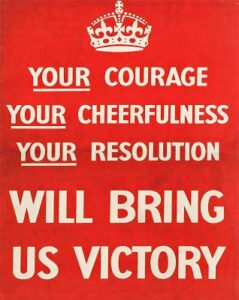
By the time that war broke out Orwell was critical of an even wider range of developments. In at least three places he drew attention to the inadequacy of the Chamberlain government’s ‘red poster’ propaganda, and explained why it contained its own destruction:
Everywhere privilege is squandering good will. In such circumstances even propaganda becomes almost impossible. As attempts to stir up patriotic feeling, the red posters issued by the Chamberlain government at the beginning of the war broke all depth-records. Yet they could not have been much other than they were, for how could Chamberlain and his followers take the risk of rousing strong popular feeling against Fascism? Anyone who was genuinely hostile to Fascism must also be opposed to Chamberlain himself, and to all the others who had helped Hitler into power. So also with external propaganda.
By the time that Orwell wrote this he had Mass Observation’s account of the reception and report on the campaign. He knew that it had to have been rubbish. Orwell did not even have to quote the texts on the posters, they were so well known and so despised. ‘YOUR COURAGE YOUR CHEERFULNESS YOUR RESOLUTION WILL BRING US VICTORY’ (they were printed in capitals) led the men and women in the street to ask if it should not have been ‘our courage will bring us victory’ (emphasis added)? Why was it someone else’s victory?
But what of posters in Orwell’s own life? As he reflected on the loss of his pacifist beliefs as the Second World War began he looked at how attitudes changed in his lifetime:
I have often laughed to think of that recruiting poster, ‘What did you do in the Great War, daddy?’ (a child is asking this question of its shame-stricken father), and of all the men who must have been lured into the army by just that poster and afterwards despised by their children for not being Conscientious Objectors.
Which, of course, ignores all the children whose fathers did not survive the war to be despised after it. This article, ‘My Country Right or Left’, is explicitly tendentious.
Who was to look over everyone? If the government could not be trusted to look after the people who was there? The masters of propaganda knew who, as in the vestibule of Victory Mansions, an apartment block in the capital of Airstrip One:
… a coloured poster, too large for indoor display, had been tacked to the wall. It depicted simply an enormous face, more than a metre wide: the face of a man of about forty-five, with a heavy black moustache and ruggedly handsome features.
As we climb the stairs we learn:
On each landing, opposite the lift-shaft, the poster with the enormous face gazed from the wall. It was one of those pictures which are so contrived that the eyes follow you about when you move. BIG BROTHER IS WATCHING YOU, the caption beneath it ran.
And here is one example of Orwell’s wish to include technical information without being able to phrase it comfortably: he has to use the clumsy ‘one of those pictures which are so contrived that the eyes follow you about when you move’, a technique which must have a name among portrait artists but of which Orwell was ignorant. Yet he wanted to draw attention to the consequence of its use as a few moments later Winston gazes out of the window to see another poster opposite where ‘the dark eyes looked deep into Winston’s own’.
Cartoons
Orwell often used the cartoons in Punch magazine to illustrate his example of how a popular medium – weekly journalism- was used as an ideological weapon. In The Road to Wigan Pier (1937) he remembered this:
In a number of Punch soon after the war, when coal was still fetching high prices, there is a picture of four or five miners with grim, sinister faces riding in a cheap motor-car. A friend they are passing calls out and asks the where they have borrowed it. They answer, ‘We’ve bought the thing!’ This, you see, is ‘good enough for Punch‘; for miners to buy a motor-car even one car between four or five of them, is a monstrosity, a sort of crime against nature. That was the attitude of a dozen years ago, and I see no evidence of any fundamental change.
And then in his essay ‘Inside The Whale’ (1940) he recorded:
About 1928, in one of the three genuinely funny jokes that Punch has produced since the Great War, an intolerable youth is pictured informing his aunt that he intends to ‘write’. ‘And what are you going to write about, dear?’ asks the aunt. ‘My dear aunt,’ says the youth crushingly, ‘one doesn’t write about anything, one just writes.’
The attitude of the intolerable youth could be explained in a phrase Orwell used elsewhere,‘Art for Art’s sake’. Contrary-wise, in 1946 Orwell said of his own work:
Every line of serious work that I have written since 1936 has been written, directly or indirectly, against totalitarianism and for democratic Socialism, as I understand it.
Significantly, though, Orwell in describing the Punch cartoons with their captions has to describe the image and recount the text. That is, as comic works they do not match his ideal of a comic picture, which should work without an explanation. On the other hand, Orwell’s work in which he does both is his success as a media analyst.
Orwell mentioned some of the anti-Semitic cartoons that degraded the French press in the 1930s in his war-time journalism, and then in Nineteen Eighty-Four made one of the three thought-criminals, Rutherford, a cartoonist, said to have been very active before the Revolution and still producing occasional works in Winston’s day. David Low, who drew the cartoons of Colonel Blimp may have been his massively inverted inspiration – references to Colonel Blimp-like characters occur repeatedly in Orwell’s journalism.
An excellent article Les, I am going to read on.