
Eugene Brieux
Orwell and Brieux. In a 1947 column George Orwell drew attention to ‘one of the few sensible things in the army system, i.e., its straightforward attitude towards venereal disease‘. The condition had appeared in Orwell’s earlier writings, though it was as a repeated mention of the French playwright Eugene Brieux.
A Kind of Compulsion. George Orwell first mentioned Brieux in a 6 October 1928 article ‘Censorship in England‘ in the French Journal Monde, writing that British censors have
either forbidden or held up the production of half the significant modern plays which have been produced in England in the last fifty years. Ibsen’s “Ghosts”, Brieux’s “Damaged Goods”, George Bernard Shaw’s “Mrs Warren’s Profession” – all strictly even painfully moral plays – were kept off the English stage for many years.
In the December 1933 Adelphi in a review of G. K. Chesterton’s book Criticisms and Opinions of the Works of Charles Dickens, Orwell writes that:
Most modern literary criticism is literary and nothing else – that is it concentrates on an author’s style and thinks it rather vulgar to notice his subject matter. Undoubtedly the influence of this type of criticism has been healthy (it has saved us from Shakespeare the Great Moral Teacher and all that, and from the windy platitudes of the Bernard Shaw era, when duds like Brieux were foisted upon us for the sake of their sermons) but it misses the point with such a writer as Dickens. Dickens was essentially a moralist and he cannot be treated as though he were say [his contemporary] Flaubert.
Facing Unpleasant Facts. In a review of Professor Frederick Charles Green’s book Stendhal (Stendhal was the French novelist Marie Henry Boyle’s penname) in the 27 July 1939 New English Review, Orwell wrote that Stendhal:
also caught syphilis, a thing which must have affected his outlook to some extent, though as Professor Green* points out, before Ibsen and Brieux had done their worst syphilis was merely a disease like any other.
All Propaganda is Lies. On 10 March 1942 the BBC Eastern Service broadcast Orwell’s talk The Re-discovery of Europe. It looked at the effects of the First World War on English literature. On 19 March 1942 The Listener published a shorter printed version. On 26 March 1942 The Listener published a letter from Robert Malise Bowyer Nichols a First World War British officer, war poet and playwright. He criticised Orwell for claiming that pre First World War English writers were little influenced by continental European ones. George Orwell’s reply was published in the same issue. He wrote that:
As Mr Nichols points out, Shaw also championed Brieux, a lifeless tract writer, whose Les Avaries (Damaged Goods) was staged in 1917 or thereabouts in hopes of frightening young soldiers about the dangers of venereal disease. Should we say that a French critic who suddenly “discovered” Upton Sinclair, while ignoring Lawrence and Eliot, showed great awareness of English literature?
Keeping Our Little Corner Clean. On 22 January 1943 the BBC broadcast Orwell’s radio talk Calling All Students; George Bernard Shaw, Arms and the Man. Oxford University Press published it as a BBC pamphlet in Bombay in 1946. In it Orwell said:
I don’t want to give the impression though that Shaw is one of those writers, like the French dramatist Brieux or the English novelist Charles Reade, who squander their talents on “showing up” some local and temporary abuse which will probably have disappeared of its own accord within a few years.
Early Life. Eugene Brieux was born on 19 January 1858. His father was a carpenter in the Temple District of Paris (the 3rd Arrondissement); and his mother was a housewife.
Eugene Brieux read widely reading works such as Goethe’s Faust and Henri Murger’s Boheme; but left school at thirteen and became a bank clerk. He wrote plays in his spare time. His one act play Bernard Palissy written in collaboration with Gaston Salandri was performed once on 21 December 1879 in Paris at the Theatre de Cluny (which opened in 1864, became a cinema in 1933 and closed in 1989). The subject, Bernard Palissy, a French Protestant potter and engineer died in the Bastille in 1589 aged seventy nine. He was imprisoned for his faith and refused to become a Catholic. France is a Catholic country and because of persecution Protestantism by the nineteenth century was very weak except in Languedoc.
Eugene Brieux became a journalist in Dieppe and then editor of Le Nouvelliste in Rouen where some of his plays were locally performed. His play Menage des Artistes satirising the art world was produced by Andre Antoine’s Theatre Libre in Paris in 1890.**
In 1892 Andre Antoine produced Brieux’s play Blanchette at the Theatre Libre. It ran for a hundred performances and toured the French provinces. Its title character Blanchette Rousset a small farmer and publican’s daughter has qualified as a teacher but cannot find work. On the basis of this success Brieux returned to Paris; wrote articles for Patrie, Gaulois, and Le Figaro; and was a theatre and music critic for La Vie Contemporaire.
Brieux’s play Monsieur de Reboval (1892) criticised hypocrisy. L’engrenage (1894) attacked political corruption. Les Bienfaiteurs exposed the frivolity of fashionable charity. L’Evasion satirised over reliance on the hereditary principle.
Bitterness. Eugene Brieux’s early plays used comedy as a satirical tool but he became bitterer. The 1897 four act Les Trois Filles de M.Dupont (The Three Daughters of Monsieur Dupont) exposed the misery inflicted by the French dowry system on poor middle class families. Of the three daughters one is seduced early in life, thrown out of her family home and becomes a prostitute. The second dutiful daughter ends up an old maid. The third marries a man she does not love, poses as a respectable housewife and enjoys herself as much as she can on the side. Their father Monsieur Dupont thinks he is clever but is stupid and wrong.
This play was banned in Britain by the Lord Chamberlain until 1917. A translation starring Ethel Irving (Frances Emily Irving’s stage name) and Oliver Burchett Clarence was performed in that year in the West End of London at the Ambassadors Theatre. The writer Arnold Bennett saw this play. He found it much worse than he expected, extremely crude throughout, but “a great tract for those who need such things”.
Le Berceau (The Cradle) was released in 1898, as was Le Resultat des courses which showed the evils of gambling amongst the Paris working class. La Robe Rouge (1900) attacked the French legal system. A version of it was staged in London by Arthur Bourchier as The Arm of the Law. Les Remplacantes (1901) exposed the problems caused by wealthy women using wet nurses for their babies rather than suckling them themselves.
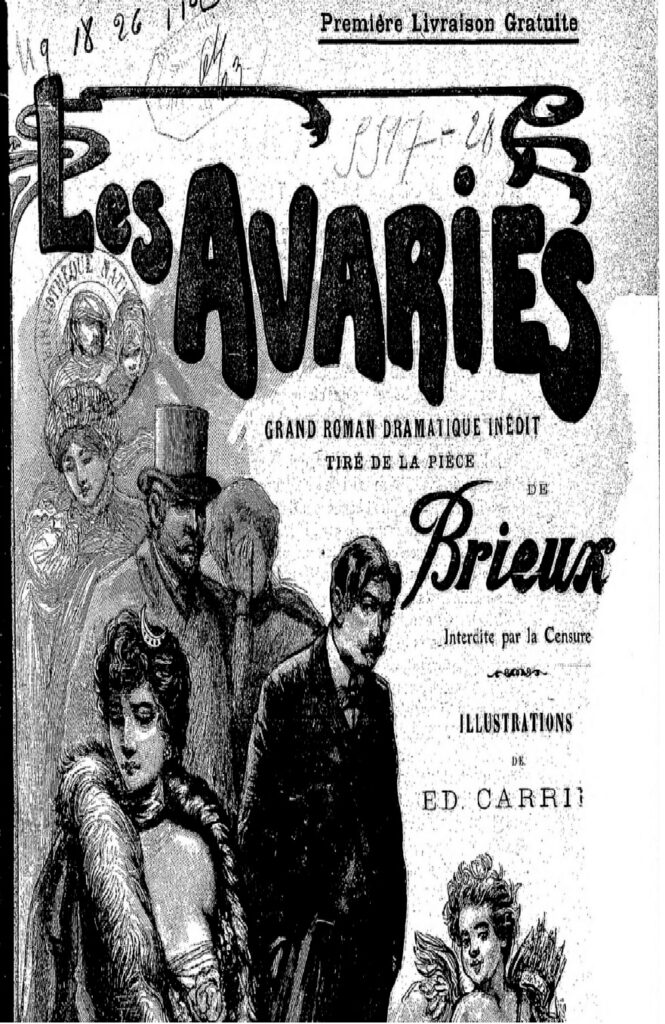
Damaged Goods. Les Avaries (1901) a three act play looked at a then taboo topic the impact of syphilis on marriage. Brieux dedicated it to a French doctor Jean Alfred Fournier Europe’s leading VD expert (‘VD’ is now usually replaced by ‘STD’, ‘sexually transmitted disease’). It was banned in France and Britain. In 1902 a private reading of it was permitted in Paris at the Theatre Antoine***.
Frederick John Pollock**** in 1905 translated Les Avaries into English in 1905 as Damaged Goods.
Act One. George Dupont, twenty six, a lawyer, is engaged to Henriette Loche. A doctor warns him that he is syphilitic, recommends him to postpone marriage and take three to four years treatment with mercuric chloride. A quack deceives Dupont that he has cured him. Quacks flourished in this period.
Act Two. George and Henriette have married and she has had her first child. The doctor explains it is ill because it has congenital i.e. hereditary syphilis; and warns the wet nurse to stop suckling. In return for a large bribe she agrees to continue to do so but retracts this agreement. Henriette learns the truth and falls screaming to the floor.
Act Three. Henriette’s father Monsieur Loche, a politician, confronts the doctor at the hospital. The doctor refuses to sign a divorce agreement on the grounds of patient confidentiality. Monsieur Loche says that the law should require medical tests before marriages. The doctor says there are too many laws already and what is needed is more education and open discussion of VD.
This play criticised the double standard which expected women to be virgins before marriage and faithful when they married; but let men have sex with prostitutes before and during marriage. It was published in print in Britain in 1911 alongside two other Brieux plays as Three Plays by Brieux and sold well.
At the urging of Dr Thomas Norval Hepburn an American expert on VD, George Bernard Shaw, who thought Brieux was France’s greatest playwright since Moliere, wrote a preface for Damaged Goods. He wrote that:
No play ever written was more needed than Les Avaries. Sex is a necessary and healthy instinct; and its nurture and education is one of the most important uses of all art; and for the present at all events, the chief use of the theatre.
Damaged Goods was performed privately, thus evading censorship, at London’s Little Theatre on 16 February 1914. It was sponsored by the Society for Race Betterment, a eugenic group. The Lord Chamberlain***** lifted his ban in 1916, and in 1917 James Bernard Fagan, an actor, theatre manager and playwright, produced Damaged Goods at the St Martin’s Theatre in London. VD was a massive threat in the First World War especially for the armed forces. The play ran for nine months.
Lady Cynthia Mary Evelyn Asquith née Charteris, a writer, was the daughter in law of the recently deposed Liberal Prime Minister Herbert Henry Asquith. She saw Damaged Goods with some friends two of who walked out after Act One. She commented that it was unavoidably unpleasant; but not gratuitously so,
The reviews were mixed. To quote the Monday 19 March 1917 Times:
Yet in spite of all its faults as a play, “Damaged Goods” is a powerful sermon. It touches with urgency and good sense on all the points which have come under discussion of late before the Royal Commission and in the various debates on its report.
This play had been performed to an all-male audience in Montreal in Canada in 1905. The American socialist novelist Upton Sinclair published it as a novel in the USA in 1913 with Brieux’s approval. Damaged Goods premiered at the Fulton Theatre in New York on 14 March 1913 for an audience of Sociological Fund members. On April 6 1913 it was performed at the National Theatre in Washington. The audience included President Woodrow Wilson, cabinet ministers and congressmen. It then toured the USA.
Damaged Goods was staged at the Theatre Royal in Melbourne in Australia in December 1916. The first performance there reportedly ended with a stunned silence from the audience. The German Society for Combating Venereal Diseases propagated Les Avaries in Germany. Between 1910 and 1920 millions of Germans saw it.
Between 1914 and 1937 six film versions of Les Avaries were produced. Thomas Ricketts, a British born American actor and director directed Damaged Goods (1914); Luise Kolm and Jacob Fleck Die Geibel der Menschheit (1918); the Hungarian Mihaly Fekete A Metely (1918); Alexander Butler Damaged Goods (1918); Edgar Georg Ulmer Damaged Goods (1933); and the Polish American director Phil Goldstone Damaged Goods (1937).
Later Plays. Eugene Brieux continued playwriting. Petite amie (1902) was about a Paris shop-girl. There followed La Couvee (1903); Maternite (1904) about an unmarried mother; and La Deserteuse (1904), written in collaboration with a novelist Jean Sigaux about a stage struck beautiful provincial French woman who deserts her homely but kind and faithful husband and becomes a mediocre actress.
Les Hannetons (1906) was a three act comedy about a man and woman who live together without being married but bicker as much as any married couple. Simone (1908) was a melodrama about a love triangle.
La Fai (1909), with incidental music by Camille Saint Saens, a satirical study of dogmatic religion was staged in England by Beerbohm Tree as False Goods. La Femme Seule (1913) was about the problems single French women faced in making their own living. There followed Le Bourgeois aux champs (1914).
Eugene Brieux was made a Chevalier de la Légion d’honneur (Knight of the Legion of Honour) and in 1909 was elected to the Acadamie Francais against strong competition. He wrote travelogues – Voyages aux Indes et a Indochina (1910); Algerie (1912); Tunisie (1912); and Au Japan par Java, la Chine, la Corre (1914). During the First World War he wrote patriotic pamphlets and was especially interested in providing good care for blinded French servicemen.
After the First World War Brieux wrote Les Americains chez nous (1920); L’Avocat (1922) about a lawyer who successfully defends a woman he adores who has murdered her coarse and brutal husband; L’Enfant (1923); and La Familie Layoletter (1926). His plays declined in popularity as issue plays became unfashionable.
Apart from six films based on Les Avaries five other Brieux plays inspired films between 1918 and 1937. Blanchette, Simone and L’Avocat inspired two each. Le Berceau (the Cradle) and Le Robe Rouge inspired one each. Personally he was modest, gentle and gently humorous.
British critics and the theatre going public had mixed feelings about Brieus. They used him as a stick to beat the stupidity of censorship and found his plays a relief from conventional comedy; but accused him of preaching and caring little for dramatic art. He was warmly welcomed when he came to Britain in 1921 to lecture on The Frenchwoman in My Plays.
Last Years. Eugene Brieux mellowed and retreated into the countryside. His villa near Cannes became a tourist attraction so he withdrew to a more remote location where he fished and farmed. He died on 6 December 1932 aged seventy four. He was interred in the Cimetiere Jas in Cannes on the French Riviera.
Conclusion. Venereal Diseases are still threats despite medical advances. Without sex the human race would not exist but promiscuous societies self-destruct. Even venereal diseases such as gonorrhoea which do not normally kill can cause sterility i.e. genetic death. Humanity must walk a path between two extremes.
George Orwell savaged Brieux for writing glorified sermons. The same criticism was made of his own Animal Farm and Nineteen Eighty-Four. In fact all societies must enforce a moral code to survive however they are governed. Have events disproved his allegation that the subject was ‘a local and temporary abuse which will probably have disappeared of its own accord within a few years‘?
* Professor Frederick Charles Green, a First World War British officer and Military Cross winner, was the Drapers’ Professor of French at Cambridge University.
** Andre Antoine was born in 1858; was a French actor, theatre manager, film director, author and critic; and died in 1943 aged eighty five. This Theatre Libre a theatre company operated from 1887 to 1896.
*** Andre Antoine was born in 1858; was a French actor, theatre manager, film director, author and critic; and died in 1943 aged eighty five. This Theatre Libre a theatre company operated from 1887 to 1896.
**** He was born in 1878; studied at Eton and Trinity College Cambridge; got a First in History; was called to the bar in 1904; was to be an Olympic Games official, International Red Cross official, journalist, historian and translator; married twice and had one child; inherited his father’s baronetcy in 1937; and died in 1963 aged eighty four.
***** The Lord Chamberlain is in charge of the Royal Household. The office has existed since medieval times. In 1737 Robert Walpole, a Whig, authorised the Lord Chamberlain to censor plays when Jacobite threat was then real. In 1968 Harold Wilson’s Labour government took this power off the Lord Chamberlain. The office still exists and is reserved for aristocrats but its duties are running the royal household.
The Lord Chamberlains, when Les Trois Filles de Monsieur Dupont and Les Avaries were banned, were the 5th Earl of Clarendon a Conservative who held the post 1900-1905; the 1st Viscount Sandhurst a Liberal who held it 1905-1912; and the 6th Earl Spencer a Liberal who held it 1912-1920, and lifted the ban on plays which offended the squeamish but exposed brutal realities.
Leave a Reply